

Such slower development of sago palm leaves may be attributed to the low and
stable nitrogen concentration in leaves with less N remobilization as suggested by
Matsumoto et al. (1998). Miyazaki (2015b) supposes that sago palm leaf’s long
lifespan allows its growth in infertile soils.
17.3.3 Root
Root classification of sago palm was carried out by Yamamoto (1997, 1998), Nitta
et al. (2002), and Nitta and Matsuda (2005). Yamamoto (1997) grouped the roots of
sago palm into two types, namely thick roots (7–11 mm in diameter) and fine roots
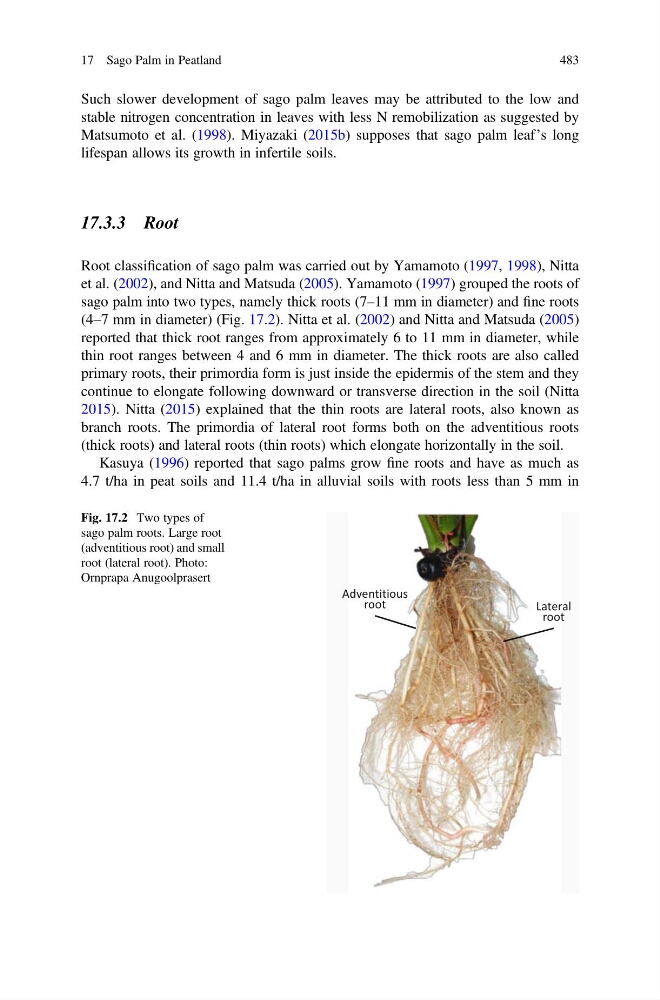
(4–7 mm in diameter) (Fig. 17.2). Nitta et al. (2002) and Nitta and Matsuda (2005)
reported that thick root ranges from approximately 6 to 11 mm in diameter, while
thin root ranges between 4 and 6 mm in diameter. The thick roots are also called
primary roots, their primordia form is just inside the epidermis of the stem and they
continue to elongate following downward or transverse direction in the soil (Nitta
2015). Nitta (2015) explained that the thin roots are lateral roots, also known as
branch roots. The primordia of lateral root forms both on the adventitious roots
(thick roots) and lateral roots (thin roots) which elongate horizontally in the soil.
Kasuya (1996) reported that sago palms grow fine roots and have as much as
4.7 t/ha in peat soils and 11.4 t/ha in alluvial soils with roots less than 5 mm in
Adventitious
root
Lateral
root
Fig. 17.2 Two types of
sago palm roots. Large root
(adventitious root) and small
root (lateral root). Photo:
Ornprapa Anugoolprasert
17 Sago Palm in Peatland
483
stable nitrogen concentration in leaves with less N remobilization as suggested by
Matsumoto et al. (1998). Miyazaki (2015b) supposes that sago palm leaf’s long
lifespan allows its growth in infertile soils.
17.3.3 Root
Root classification of sago palm was carried out by Yamamoto (1997, 1998), Nitta
et al. (2002), and Nitta and Matsuda (2005). Yamamoto (1997) grouped the roots of
sago palm into two types, namely thick roots (7–11 mm in diameter) and fine roots
(4–7 mm in diameter) (Fig. 17.2). Nitta et al. (2002) and Nitta and Matsuda (2005)
reported that thick root ranges from approximately 6 to 11 mm in diameter, while
thin root ranges between 4 and 6 mm in diameter. The thick roots are also called
primary roots, their primordia form is just inside the epidermis of the stem and they
continue to elongate following downward or transverse direction in the soil (Nitta
2015). Nitta (2015) explained that the thin roots are lateral roots, also known as
branch roots. The primordia of lateral root forms both on the adventitious roots
(thick roots) and lateral roots (thin roots) which elongate horizontally in the soil.
Kasuya (1996) reported that sago palms grow fine roots and have as much as
4.7 t/ha in peat soils and 11.4 t/ha in alluvial soils with roots less than 5 mm in
Adventitious
root
Lateral
root
Fig. 17.2 Two types of
sago palm roots. Large root
(adventitious root) and small
root (lateral root). Photo:
Ornprapa Anugoolprasert
17 Sago Palm in Peatland
483