

the efficient use of carbohydrates from the sago palm and related species as well as
predicted increase in the sustainable development and utilization of land in swampy
areas are currently anticipated. This chapter provides a brief review on future
prospects of sago palm growth and production in different soil conditions mostly
in accordance with the publications from the Society of Sago Palm Studies.
Keywords Metroxylon sagu · Morphogenesis · Peat soil · Photosynthesis ·
Waterlogging
17.1 Introduction
Metroxylon sagu Rottb., also known as sago palm (true sago palm), is the main
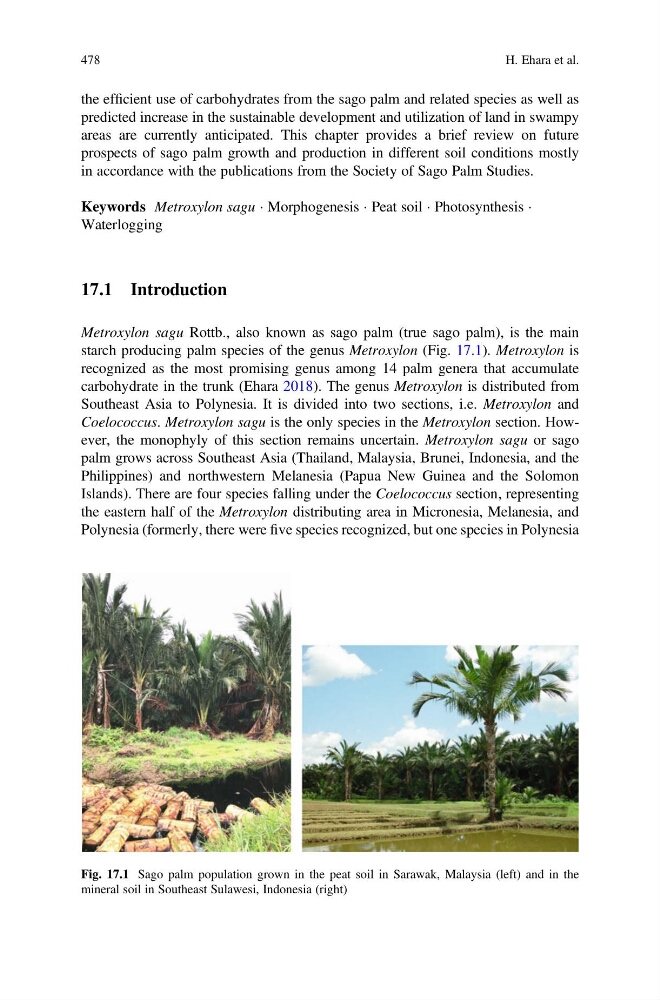
starch producing palm species of the genus Metroxylon (Fig. 17.1). Metroxylon is
recognized as the most promising genus among 14 palm genera that accumulate
carbohydrate in the trunk (Ehara 2018). The genus Metroxylon is distributed from
Southeast Asia to Polynesia. It is divided into two sections, i.e. Metroxylon and
Coelococcus. Metroxylon sagu is the only species in the Metroxylon section. However, the monophyly of this section remains uncertain. Metroxylon sagu or sago
palm grows across Southeast Asia (Thailand, Malaysia, Brunei, Indonesia, and the
Philippines) and northwestern Melanesia (Papua New Guinea and the Solomon
Islands). There are four species falling under the Coelococcus section, representing
the eastern half of the Metroxylon distributing area in Micronesia, Melanesia, and
Polynesia (formerly, there were five species recognized, but one species in Polynesia
Fig. 17.1 Sago palm population grown in the peat soil in Sarawak, Malaysia (left) and in the
mineral soil in Southeast Sulawesi, Indonesia (right)
478
H. Ehara et al.
predicted increase in the sustainable development and utilization of land in swampy
areas are currently anticipated. This chapter provides a brief review on future
prospects of sago palm growth and production in different soil conditions mostly
in accordance with the publications from the Society of Sago Palm Studies.
Keywords Metroxylon sagu · Morphogenesis · Peat soil · Photosynthesis ·
Waterlogging
17.1 Introduction
Metroxylon sagu Rottb., also known as sago palm (true sago palm), is the main
starch producing palm species of the genus Metroxylon (Fig. 17.1). Metroxylon is
recognized as the most promising genus among 14 palm genera that accumulate
carbohydrate in the trunk (Ehara 2018). The genus Metroxylon is distributed from
Southeast Asia to Polynesia. It is divided into two sections, i.e. Metroxylon and
Coelococcus. Metroxylon sagu is the only species in the Metroxylon section. However, the monophyly of this section remains uncertain. Metroxylon sagu or sago
palm grows across Southeast Asia (Thailand, Malaysia, Brunei, Indonesia, and the
Philippines) and northwestern Melanesia (Papua New Guinea and the Solomon
Islands). There are four species falling under the Coelococcus section, representing
the eastern half of the Metroxylon distributing area in Micronesia, Melanesia, and
Polynesia (formerly, there were five species recognized, but one species in Polynesia
Fig. 17.1 Sago palm population grown in the peat soil in Sarawak, Malaysia (left) and in the
mineral soil in Southeast Sulawesi, Indonesia (right)
478
H. Ehara et al.