

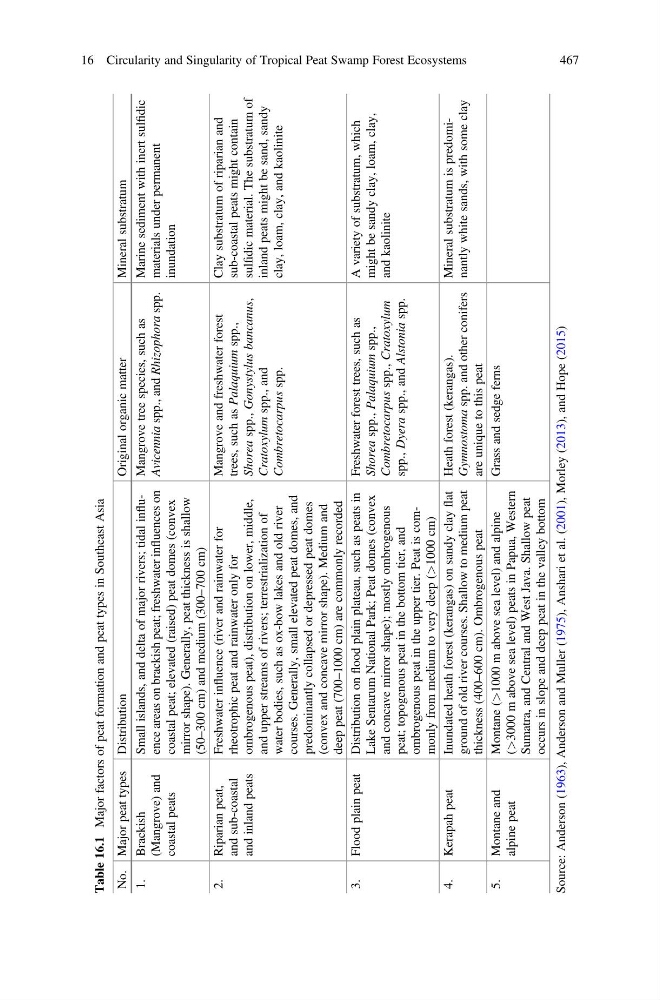
Table 16.1
Major factors of peat formation and peat types in Southeast Asia
No. Major peat types Distribution
Original organic matter
Mineral substratum
1.
Brackish
(Mangrove) and
coastal peats
Small islands, and delta of major rivers; tidal influence areas on brackish peat; freshwater influences on
coastal peat; elevated (raised) peat domes (convex
mirror shape). Generally, peat thickness is shallow
(50–300 cm) and medium (300–700 cm)
Mangrove tree species, such as
Avicennia
spp., and Rhizophora
spp.
Marine sediment with inert sulfidic
materials under permanent
inundation
2.
Riparian peat,
and sub-coastal
and inland peats
Freshwater influence (river and rainwater for
rheotrophic peat and rainwater only for
ombrogenous peat), distribution on lower, middle,
and upper streams of rivers; terrestrialization of
water bodies, such as ox-bow lakes and old river
courses. Generally, small elevated peat domes, and
predominantly collapsed or depressed peat domes
(convex and concave mirror shape). Medium and
deep peat (700–1000 cm) are commonly recorded
Mangrove and freshwater forest
trees, such as Palaquium
spp.,
Shorea
spp., Gonystylus bancanus,
Cratoxylum
spp., and
Combretocarpus
spp.
Clay substratum of riparian and
sub-coastal peats might contain
sulfidic material. The substratum of
inland peats might be sand, sandy
clay, loam, clay, and kaolinite
3.
Flood plain peat
Distribution on
flood plain plateau, such as peats in
Lake Sentarum National Park; Peat domes (convex
and concave mirror shape); mostly ombrogenous
peat; topogenous peat in the bottom tier, and
ombrogenous peat in the upper tier. Peat is commonly from medium to very deep (>1000 cm)
Freshwater forest trees, such as
Shorea
spp., Palaquium
spp.,
Combretocarpus
spp., Cratoxylum
spp., Dyera
spp., and Alstonia
spp.
A variety of substratum, which
might be sandy clay, loam, clay,
and kaolinite
4.
Kerapah peat
Inundated heath forest (kerangas) on sandy clay
flat
ground of old river courses. Shallow to medium peat
thickness (400–600 cm). Ombrogenous peat
Heath forest (kerangas).
Gymnostoma
spp. and other conifers
are unique to this peat
Mineral substratum is predominantly white sands, with some clay
5.
Montane and
alpine peat
Montane (>1000 m above sea level) and alpine
(>3000 m above sea level) peats in Papua, Western
Sumatra, and Central and West Java. Shallow peat
occurs in slope and deep peat in the valley bottom
Grass and sedge ferns
Source: Anderson (1963), Anderson and Muller (1975), Anshari et al. (2001), Morley (2013), and Hope (2015)
16 Circularity and Singularity of Tropical Peat Swamp Forest Ecosystems
467
Major factors of peat formation and peat types in Southeast Asia
No. Major peat types Distribution
Original organic matter
Mineral substratum
1.
Brackish
(Mangrove) and
coastal peats
Small islands, and delta of major rivers; tidal influence areas on brackish peat; freshwater influences on
coastal peat; elevated (raised) peat domes (convex
mirror shape). Generally, peat thickness is shallow
(50–300 cm) and medium (300–700 cm)
Mangrove tree species, such as
Avicennia
spp., and Rhizophora
spp.
Marine sediment with inert sulfidic
materials under permanent
inundation
2.
Riparian peat,
and sub-coastal
and inland peats
Freshwater influence (river and rainwater for
rheotrophic peat and rainwater only for
ombrogenous peat), distribution on lower, middle,
and upper streams of rivers; terrestrialization of
water bodies, such as ox-bow lakes and old river
courses. Generally, small elevated peat domes, and
predominantly collapsed or depressed peat domes
(convex and concave mirror shape). Medium and
deep peat (700–1000 cm) are commonly recorded
Mangrove and freshwater forest
trees, such as Palaquium
spp.,
Shorea
spp., Gonystylus bancanus,
Cratoxylum
spp., and
Combretocarpus
spp.
Clay substratum of riparian and
sub-coastal peats might contain
sulfidic material. The substratum of
inland peats might be sand, sandy
clay, loam, clay, and kaolinite
3.
Flood plain peat
Distribution on
flood plain plateau, such as peats in
Lake Sentarum National Park; Peat domes (convex
and concave mirror shape); mostly ombrogenous
peat; topogenous peat in the bottom tier, and
ombrogenous peat in the upper tier. Peat is commonly from medium to very deep (>1000 cm)
Freshwater forest trees, such as
Shorea
spp., Palaquium
spp.,
Combretocarpus
spp., Cratoxylum
spp., Dyera
spp., and Alstonia
spp.
A variety of substratum, which
might be sandy clay, loam, clay,
and kaolinite
4.
Kerapah peat
Inundated heath forest (kerangas) on sandy clay
flat
ground of old river courses. Shallow to medium peat
thickness (400–600 cm). Ombrogenous peat
Heath forest (kerangas).
Gymnostoma
spp. and other conifers
are unique to this peat
Mineral substratum is predominantly white sands, with some clay
5.
Montane and
alpine peat
Montane (>1000 m above sea level) and alpine
(>3000 m above sea level) peats in Papua, Western
Sumatra, and Central and West Java. Shallow peat
occurs in slope and deep peat in the valley bottom
Grass and sedge ferns
Source: Anderson (1963), Anderson and Muller (1975), Anshari et al. (2001), Morley (2013), and Hope (2015)
16 Circularity and Singularity of Tropical Peat Swamp Forest Ecosystems
467