

level was high and stable (Yulianto et al. 2005; Dommain et al. 2011). Some tropical
peats in the upper river basins, e.g., the peat in the upper Kapuas River in West
Kalimantan Province, were initiated in Late Pleistocene (over 15,000 YBP), during
the last ice age (Anshari et al. 2001, 2004). Late Pleistocene peats were found in
Central Kalimantan (Page et al. 2004). However, anthropogenic disturbances, e.g.,
logging and fires, accelerate the peat decomposition rates more than the
accumulation.
16.3 Basic of Peatland Classification
As an organic soil, peat classification is generally based on a decayed organic matter
content. According to Soil Survey Staff (2014), an order of peat soil is called
Histosol, with organic matter thickness of 40 cm for hemic and sapric peats. The
thickness of organic matter in fibric peat is 60 cm, and there is no sulfuric layer
within 50 cm profile, and no sulfidic substances until 100 cm depth. Folists have a
short term of water saturation in undrained peat. On the other hand, Wassists have
water saturation almost all times. The organic soil is water-saturated for at least
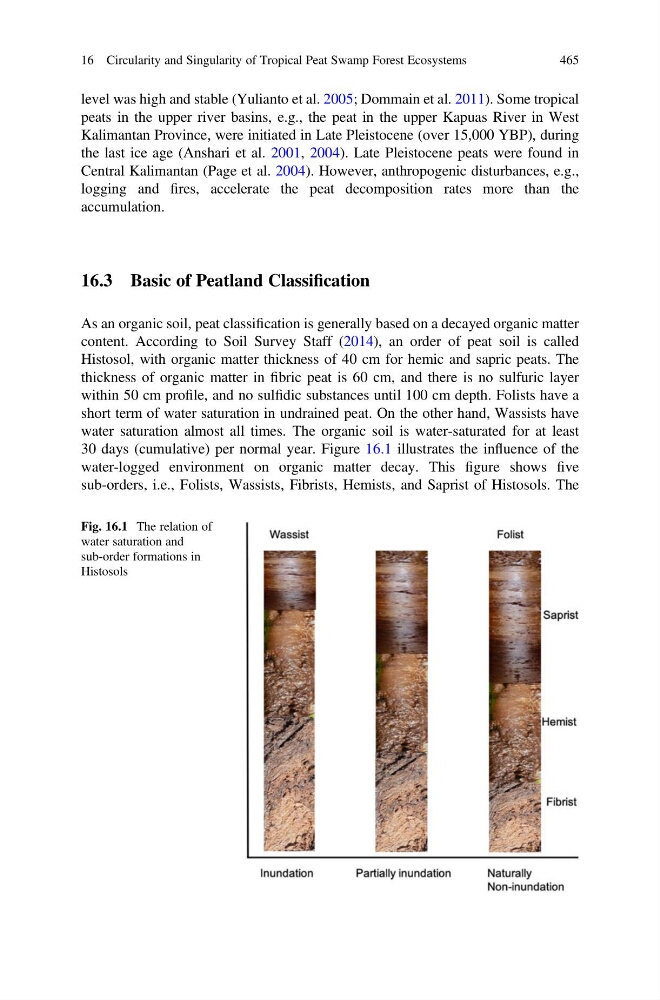
30 days (cumulative) per normal year. Figure 16.1 illustrates the influence of the
water-logged environment on organic matter decay. This figure shows five
sub-orders, i.e., Folists, Wassists, Fibrists, Hemists, and Saprist of Histosols. The
Fig. 16.1 The relation of
water saturation and
sub-order formations in
Histosols
16 Circularity and Singularity of Tropical Peat Swamp Forest Ecosystems
465
peats in the upper river basins, e.g., the peat in the upper Kapuas River in West
Kalimantan Province, were initiated in Late Pleistocene (over 15,000 YBP), during
the last ice age (Anshari et al. 2001, 2004). Late Pleistocene peats were found in
Central Kalimantan (Page et al. 2004). However, anthropogenic disturbances, e.g.,
logging and fires, accelerate the peat decomposition rates more than the
accumulation.
16.3 Basic of Peatland Classification
As an organic soil, peat classification is generally based on a decayed organic matter
content. According to Soil Survey Staff (2014), an order of peat soil is called
Histosol, with organic matter thickness of 40 cm for hemic and sapric peats. The
thickness of organic matter in fibric peat is 60 cm, and there is no sulfuric layer
within 50 cm profile, and no sulfidic substances until 100 cm depth. Folists have a
short term of water saturation in undrained peat. On the other hand, Wassists have
water saturation almost all times. The organic soil is water-saturated for at least
30 days (cumulative) per normal year. Figure 16.1 illustrates the influence of the
water-logged environment on organic matter decay. This figure shows five
sub-orders, i.e., Folists, Wassists, Fibrists, Hemists, and Saprist of Histosols. The
Fig. 16.1 The relation of
water saturation and
sub-order formations in
Histosols
16 Circularity and Singularity of Tropical Peat Swamp Forest Ecosystems
465