

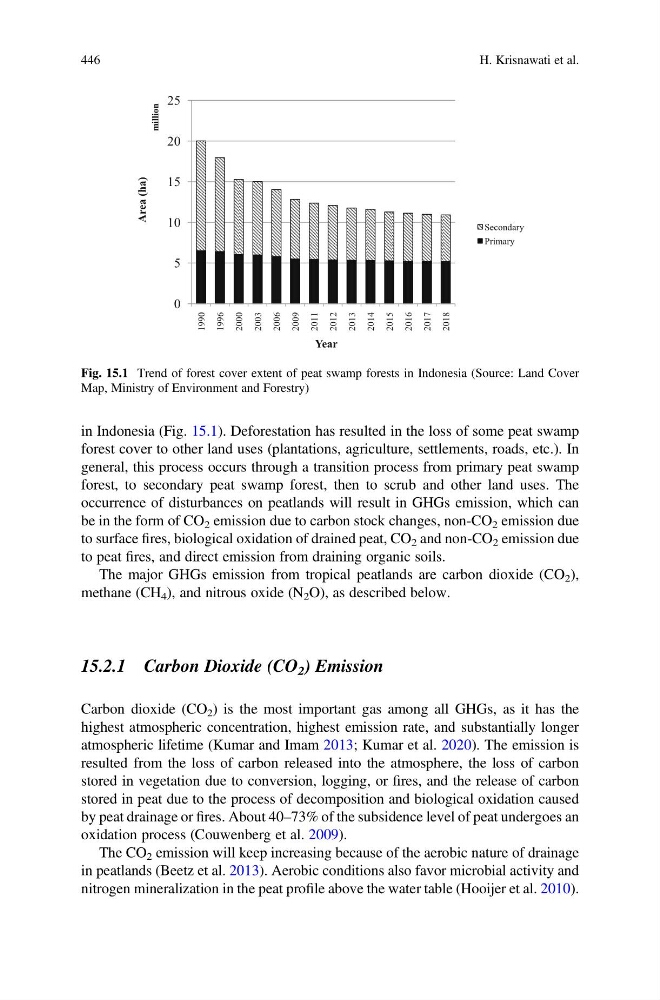
in Indonesia (Fig. 15.1). Deforestation has resulted in the loss of some peat swamp
forest cover to other land uses (plantations, agriculture, settlements, roads, etc.). In
general, this process occurs through a transition process from primary peat swamp
forest, to secondary peat swamp forest, then to scrub and other land uses. The
occurrence of disturbances on peatlands will result in GHGs emission, which can
be in the form of CO 2 emission due to carbon stock changes, non-CO 2 emission due
to surface fires, biological oxidation of drained peat, CO 2 and non-CO 2 emission due
to peat fires, and direct emission from draining organic soils.
The major GHGs emission from tropical peatlands are carbon dioxide (CO 2 ),
methane (CH 4 ), and nitrous oxide (N 2 O), as described below.
15.2.1 Carbon Dioxide (CO 2 ) Emission
Carbon dioxide (CO 2 ) is the most important gas among all GHGs, as it has the
highest atmospheric concentration, highest emission rate, and substantially longer
atmospheric lifetime (Kumar and Imam 2013; Kumar et al. 2020). The emission is
resulted from the loss of carbon released into the atmosphere, the loss of carbon
stored in vegetation due to conversion, logging, or fires, and the release of carbon
stored in peat due to the process of decomposition and biological oxidation caused
by peat drainage or fires. About 40–73% of the subsidence level of peat undergoes an
oxidation process (Couwenberg et al. 2009).
The CO 2 emission will keep increasing because of the aerobic nature of drainage
in peatlands (Beetz et al. 2013). Aerobic conditions also favor microbial activity and
nitrogen mineralization in the peat profile above the water table (Hooijer et al. 2010).
0
5
10
15
20
25
1990
1996
2000
2003
2006
2009
2011
2012
2013
2014
2015
2016
2017
2018
Area (ha)
million
Year
Secondary
Primary
Fig. 15.1 Trend of forest cover extent of peat swamp forests in Indonesia (Source: Land Cover
Map, Ministry of Environment and Forestry)
446
H. Krisnawati et al.
forest cover to other land uses (plantations, agriculture, settlements, roads, etc.). In
general, this process occurs through a transition process from primary peat swamp
forest, to secondary peat swamp forest, then to scrub and other land uses. The
occurrence of disturbances on peatlands will result in GHGs emission, which can
be in the form of CO 2 emission due to carbon stock changes, non-CO 2 emission due
to surface fires, biological oxidation of drained peat, CO 2 and non-CO 2 emission due
to peat fires, and direct emission from draining organic soils.
The major GHGs emission from tropical peatlands are carbon dioxide (CO 2 ),
methane (CH 4 ), and nitrous oxide (N 2 O), as described below.
15.2.1 Carbon Dioxide (CO 2 ) Emission
Carbon dioxide (CO 2 ) is the most important gas among all GHGs, as it has the
highest atmospheric concentration, highest emission rate, and substantially longer
atmospheric lifetime (Kumar and Imam 2013; Kumar et al. 2020). The emission is
resulted from the loss of carbon released into the atmosphere, the loss of carbon
stored in vegetation due to conversion, logging, or fires, and the release of carbon
stored in peat due to the process of decomposition and biological oxidation caused
by peat drainage or fires. About 40–73% of the subsidence level of peat undergoes an
oxidation process (Couwenberg et al. 2009).
The CO 2 emission will keep increasing because of the aerobic nature of drainage
in peatlands (Beetz et al. 2013). Aerobic conditions also favor microbial activity and
nitrogen mineralization in the peat profile above the water table (Hooijer et al. 2010).
0
5
10
15
20
25
1990
1996
2000
2003
2006
2009
2011
2012
2013
2014
2015
2016
2017
2018
Area (ha)
million
Year
Secondary
Primary
Fig. 15.1 Trend of forest cover extent of peat swamp forests in Indonesia (Source: Land Cover
Map, Ministry of Environment and Forestry)
446
H. Krisnawati et al.