

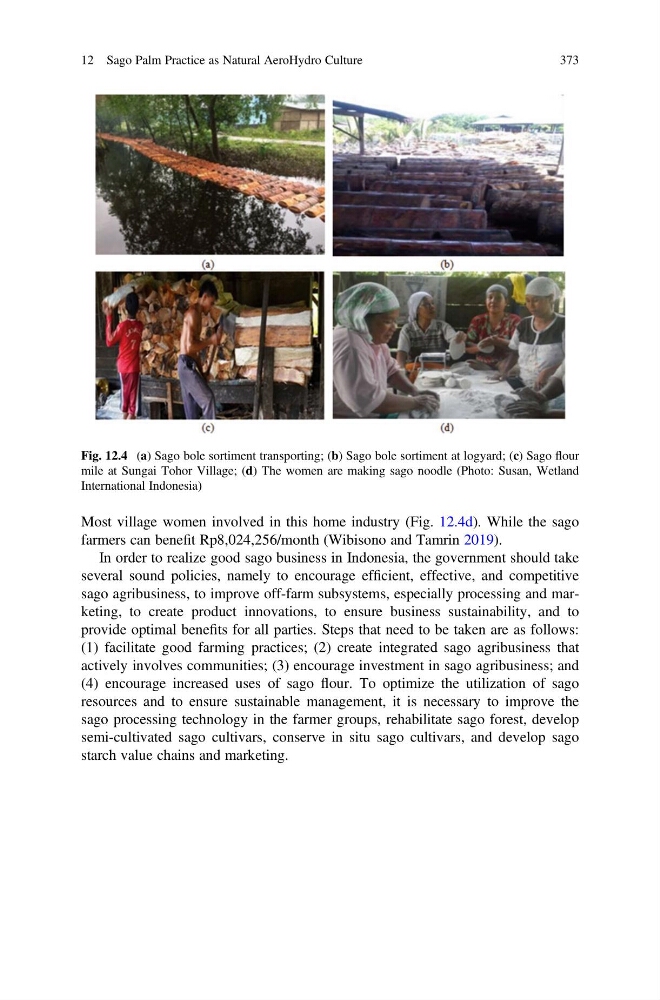
Most village women involved in this home industry (Fig. 12.4d). While the sago
farmers can benefit Rp8,024,256/month (Wibisono and Tamrin 2019).
In order to realize good sago business in Indonesia, the government should take
several sound policies, namely to encourage efficient, effective, and competitive
sago agribusiness, to improve off-farm subsystems, especially processing and marketing, to create product innovations, to ensure business sustainability, and to
provide optimal benefits for all parties. Steps that need to be taken are as follows:
(1) facilitate good farming practices; (2) create integrated sago agribusiness that
actively involves communities; (3) encourage investment in sago agribusiness; and
(4) encourage increased uses of sago flour. To optimize the utilization of sago
resources and to ensure sustainable management, it is necessary to improve the
sago processing technology in the farmer groups, rehabilitate sago forest, develop
semi-cultivated sago cultivars, conserve in situ sago cultivars, and develop sago
starch value chains and marketing.
Fig. 12.4 (a) Sago bole sortiment transporting; (b) Sago bole sortiment at logyard; (c) Sago flour
mile at Sungai Tohor Village; (d) The women are making sago noodle (Photo: Susan, Wetland
International Indonesia)
12 Sago Palm Practice as Natural AeroHydro Culture
373
farmers can benefit Rp8,024,256/month (Wibisono and Tamrin 2019).
In order to realize good sago business in Indonesia, the government should take
several sound policies, namely to encourage efficient, effective, and competitive
sago agribusiness, to improve off-farm subsystems, especially processing and marketing, to create product innovations, to ensure business sustainability, and to
provide optimal benefits for all parties. Steps that need to be taken are as follows:
(1) facilitate good farming practices; (2) create integrated sago agribusiness that
actively involves communities; (3) encourage investment in sago agribusiness; and
(4) encourage increased uses of sago flour. To optimize the utilization of sago
resources and to ensure sustainable management, it is necessary to improve the
sago processing technology in the farmer groups, rehabilitate sago forest, develop
semi-cultivated sago cultivars, conserve in situ sago cultivars, and develop sago
starch value chains and marketing.
Fig. 12.4 (a) Sago bole sortiment transporting; (b) Sago bole sortiment at logyard; (c) Sago flour
mile at Sungai Tohor Village; (d) The women are making sago noodle (Photo: Susan, Wetland
International Indonesia)
12 Sago Palm Practice as Natural AeroHydro Culture
373