

quantity of biochar added, depending on biochar materials, pyrolysis processes
affecting the residual compounds (Ogawa 1994; Steiner et al. 2007). Microorganisms that live on the surface of biochar are able to decompose organic matters
surrounding the biochar.
Biochar can serve as a source of C and energy for soil microbes. Laborda et al.
(1999) shows that fungi (Trichoderma and Penicillium spp.) can contribute to coal
depolymerization (hard coal, sub-bituminous coal, and lignite) through the production of phenoloxidase enzyme. Ogawa and Yamabe (1986) suggested that biochar
can be a habitat that is not suitable for saprophytic fungi, but ideal for mycorrhizal
fungi.
11.5 Biochar Roles in Improving Suboptimal Land
Productivity
Aside from improving the physical, chemical, and biological properties of the soil,
biochar application also improves suboptimal land productivity. However, biochar
application effects on crop productivity fluctuate greatly according to soil type,
biochar type, and biochar application rate. In some suboptimal land, i.e. acid upland,
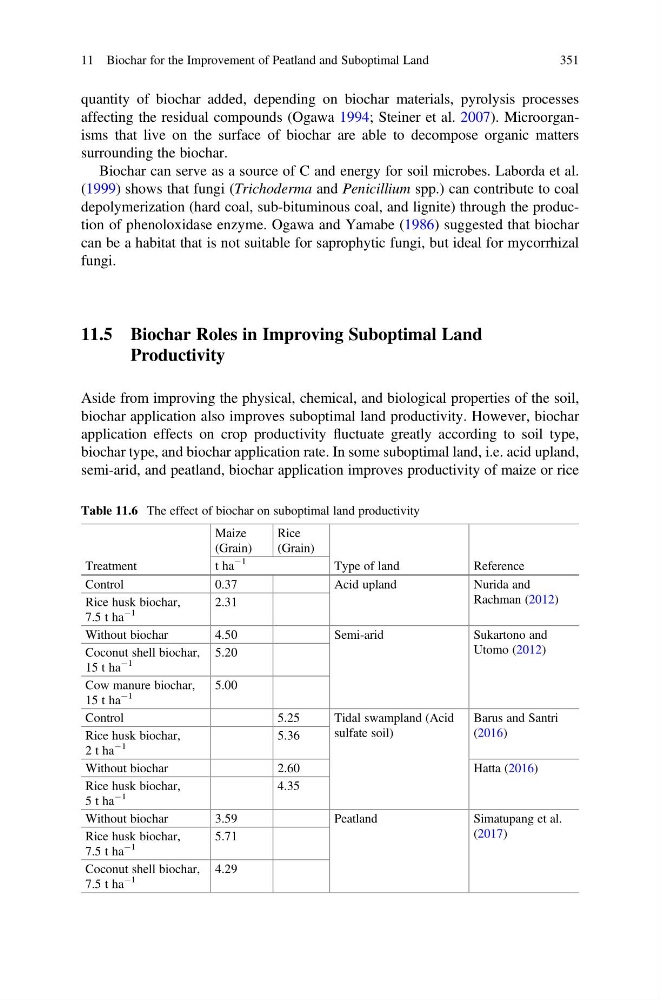
semi-arid, and peatland, biochar application improves productivity of maize or rice
Table 11.6 The effect of biochar on suboptimal land productivity
Treatment
Maize
(Grain)
Rice
(Grain)
Type of land
Reference
t ha
À1
Control
0.37
Acid upland
Nurida and
Rachman (2012)
Rice husk biochar,
7.5 t ha
À1
2.31
Without biochar
4.50
Semi-arid
Sukartono and
Utomo (2012)
Coconut shell biochar,
15 t ha
À1
5.20
Cow manure biochar,
15 t ha
À1
5.00
Control
5.25
Tidal swampland (Acid
sulfate soil)
Barus and Santri
(2016)
Rice husk biochar,
2 t ha
À1
5.36
Without biochar
2.60
Hatta (2016)
Rice husk biochar,
5 t ha
À1
4.35
Without biochar
3.59
Peatland
Simatupang et al.
(2017)
Rice husk biochar,
7.5 t ha
À1
5.71
Coconut shell biochar,
7.5 t ha
À1
4.29
11 Biochar for the Improvement of Peatland and Suboptimal Land
351
affecting the residual compounds (Ogawa 1994; Steiner et al. 2007). Microorganisms that live on the surface of biochar are able to decompose organic matters
surrounding the biochar.
Biochar can serve as a source of C and energy for soil microbes. Laborda et al.
(1999) shows that fungi (Trichoderma and Penicillium spp.) can contribute to coal
depolymerization (hard coal, sub-bituminous coal, and lignite) through the production of phenoloxidase enzyme. Ogawa and Yamabe (1986) suggested that biochar
can be a habitat that is not suitable for saprophytic fungi, but ideal for mycorrhizal
fungi.
11.5 Biochar Roles in Improving Suboptimal Land
Productivity
Aside from improving the physical, chemical, and biological properties of the soil,
biochar application also improves suboptimal land productivity. However, biochar
application effects on crop productivity fluctuate greatly according to soil type,
biochar type, and biochar application rate. In some suboptimal land, i.e. acid upland,
semi-arid, and peatland, biochar application improves productivity of maize or rice
Table 11.6 The effect of biochar on suboptimal land productivity
Treatment
Maize
(Grain)
Rice
(Grain)
Type of land
Reference
t ha
À1
Control
0.37
Acid upland
Nurida and
Rachman (2012)
Rice husk biochar,
7.5 t ha
À1
2.31
Without biochar
4.50
Semi-arid
Sukartono and
Utomo (2012)
Coconut shell biochar,
15 t ha
À1
5.20
Cow manure biochar,
15 t ha
À1
5.00
Control
5.25
Tidal swampland (Acid
sulfate soil)
Barus and Santri
(2016)
Rice husk biochar,
2 t ha
À1
5.36
Without biochar
2.60
Hatta (2016)
Rice husk biochar,
5 t ha
À1
4.35
Without biochar
3.59
Peatland
Simatupang et al.
(2017)
Rice husk biochar,
7.5 t ha
À1
5.71
Coconut shell biochar,
7.5 t ha
À1
4.29
11 Biochar for the Improvement of Peatland and Suboptimal Land
351