

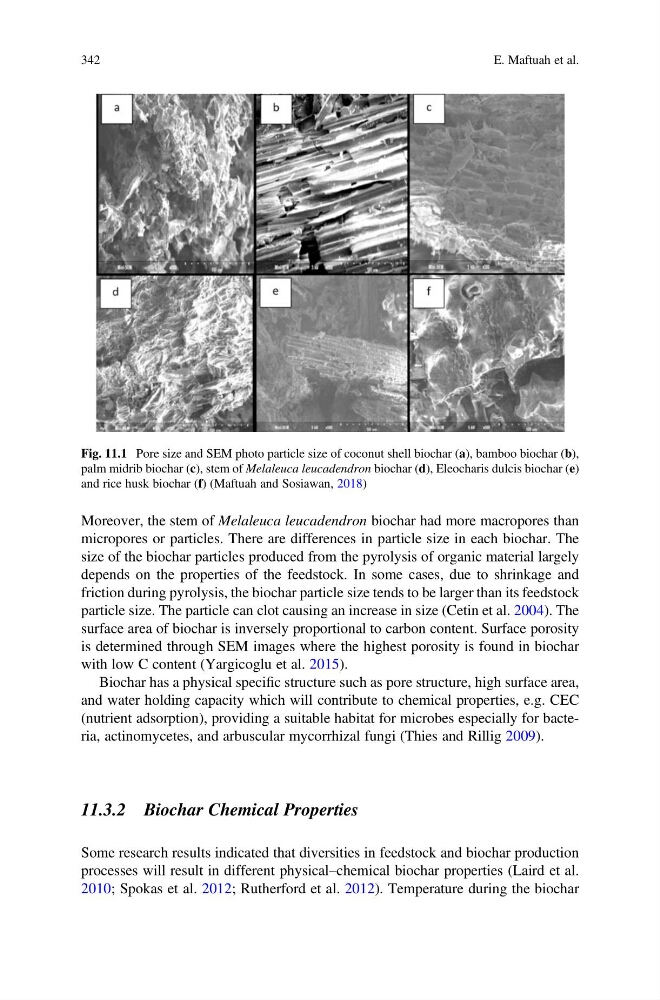
Moreover, the stem of Melaleuca leucadendron biochar had more macropores than
micropores or particles. There are differences in particle size in each biochar. The
size of the biochar particles produced from the pyrolysis of organic material largely
depends on the properties of the feedstock. In some cases, due to shrinkage and
friction during pyrolysis, the biochar particle size tends to be larger than its feedstock
particle size. The particle can clot causing an increase in size (Cetin et al. 2004). The
surface area of biochar is inversely proportional to carbon content. Surface porosity
is determined through SEM images where the highest porosity is found in biochar
with low C content (Yargicoglu et al. 2015).
Biochar has a physical specific structure such as pore structure, high surface area,
and water holding capacity which will contribute to chemical properties, e.g. CEC
(nutrient adsorption), providing a suitable habitat for microbes especially for bacteria, actinomycetes, and arbuscular mycorrhizal fungi (Thies and Rillig 2009).
11.3.2 Biochar Chemical Properties
Some research results indicated that diversities in feedstock and biochar production
processes will result in different physical–chemical biochar properties (Laird et al.
2010; Spokas et al. 2012; Rutherford et al. 2012). Temperature during the biochar
Fig. 11.1 Pore size and SEM photo particle size of coconut shell biochar (a), bamboo biochar (b),
palm midrib biochar (c), stem of Melaleuca leucadendron biochar (d), Eleocharis dulcis biochar (e)
and rice husk biochar (f) (Maftuah and Sosiawan, 2018)
342
E. Maftuah et al.
micropores or particles. There are differences in particle size in each biochar. The
size of the biochar particles produced from the pyrolysis of organic material largely
depends on the properties of the feedstock. In some cases, due to shrinkage and
friction during pyrolysis, the biochar particle size tends to be larger than its feedstock
particle size. The particle can clot causing an increase in size (Cetin et al. 2004). The
surface area of biochar is inversely proportional to carbon content. Surface porosity
is determined through SEM images where the highest porosity is found in biochar
with low C content (Yargicoglu et al. 2015).
Biochar has a physical specific structure such as pore structure, high surface area,
and water holding capacity which will contribute to chemical properties, e.g. CEC
(nutrient adsorption), providing a suitable habitat for microbes especially for bacteria, actinomycetes, and arbuscular mycorrhizal fungi (Thies and Rillig 2009).
11.3.2 Biochar Chemical Properties
Some research results indicated that diversities in feedstock and biochar production
processes will result in different physical–chemical biochar properties (Laird et al.
2010; Spokas et al. 2012; Rutherford et al. 2012). Temperature during the biochar
Fig. 11.1 Pore size and SEM photo particle size of coconut shell biochar (a), bamboo biochar (b),
palm midrib biochar (c), stem of Melaleuca leucadendron biochar (d), Eleocharis dulcis biochar (e)
and rice husk biochar (f) (Maftuah and Sosiawan, 2018)
342
E. Maftuah et al.