

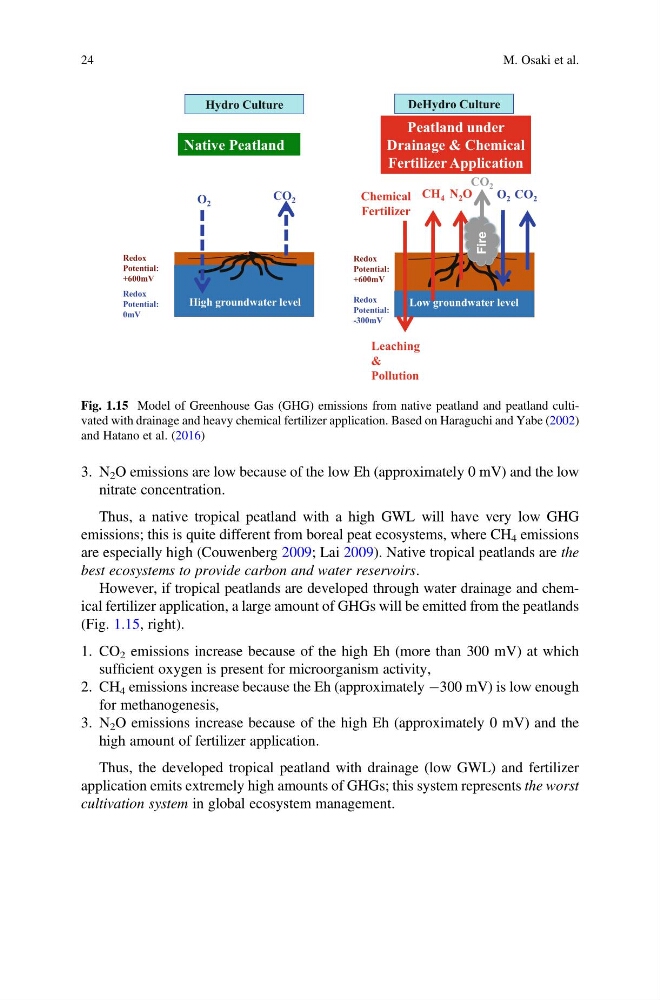
3. N 2 O emissions are low because of the low Eh (approximately 0 mV) and the low
nitrate concentration.
Thus, a native tropical peatland with a high GWL will have very low GHG
emissions; this is quite different from boreal peat ecosystems, where CH 4 emissions
are especially high (Couwenberg 2009; Lai 2009). Native tropical peatlands are the
best ecosystems to provide carbon and water reservoirs.
However, if tropical peatlands are developed through water drainage and chemical fertilizer application, a large amount of GHGs will be emitted from the peatlands
(Fig. 1.15, right).
1. CO 2 emissions increase because of the high Eh (more than 300 mV) at which
sufficient oxygen is present for microorganism activity,
2. CH 4 emissions increase because the Eh (approximately À300 mV) is low enough
for methanogenesis,
3. N 2 O emissions increase because of the high Eh (approximately 0 mV) and the
high amount of fertilizer application.
Thus, the developed tropical peatland with drainage (low GWL) and fertilizer
application emits extremely high amounts of GHGs; this system represents the worst
cultivation system in global ecosystem management.
Chemical
Fertilizer
High groundwater level
CO 2
O 2
Redox
Potential:
+600mV
Redox
Potential:
0mV
O 2 CO 2
Redox
Potential:
-300mV
Redox
Potential:
+600mV
Low groundwater level
CH 4 N 2 O
Peatland under
Drainage & Chemical
Fertilizer Application
Native Peatland
Leaching
&
Pollution
Fire
CO 2
DeHydro Culture
Hydro Culture
Fig. 1.15 Model of Greenhouse Gas (GHG) emissions from native peatland and peatland cultivated with drainage and heavy chemical fertilizer application. Based on Haraguchi and Yabe (2002)
and Hatano et al. (2016)
24
M. Osaki et al.
nitrate concentration.
Thus, a native tropical peatland with a high GWL will have very low GHG
emissions; this is quite different from boreal peat ecosystems, where CH 4 emissions
are especially high (Couwenberg 2009; Lai 2009). Native tropical peatlands are the
best ecosystems to provide carbon and water reservoirs.
However, if tropical peatlands are developed through water drainage and chemical fertilizer application, a large amount of GHGs will be emitted from the peatlands
(Fig. 1.15, right).
1. CO 2 emissions increase because of the high Eh (more than 300 mV) at which
sufficient oxygen is present for microorganism activity,
2. CH 4 emissions increase because the Eh (approximately À300 mV) is low enough
for methanogenesis,
3. N 2 O emissions increase because of the high Eh (approximately 0 mV) and the
high amount of fertilizer application.
Thus, the developed tropical peatland with drainage (low GWL) and fertilizer
application emits extremely high amounts of GHGs; this system represents the worst
cultivation system in global ecosystem management.
Chemical
Fertilizer
High groundwater level
CO 2
O 2
Redox
Potential:
+600mV
Redox
Potential:
0mV
O 2 CO 2
Redox
Potential:
-300mV
Redox
Potential:
+600mV
Low groundwater level
CH 4 N 2 O
Peatland under
Drainage & Chemical
Fertilizer Application
Native Peatland
Leaching
&
Pollution
Fire
CO 2
DeHydro Culture
Hydro Culture
Fig. 1.15 Model of Greenhouse Gas (GHG) emissions from native peatland and peatland cultivated with drainage and heavy chemical fertilizer application. Based on Haraguchi and Yabe (2002)
and Hatano et al. (2016)
24
M. Osaki et al.