

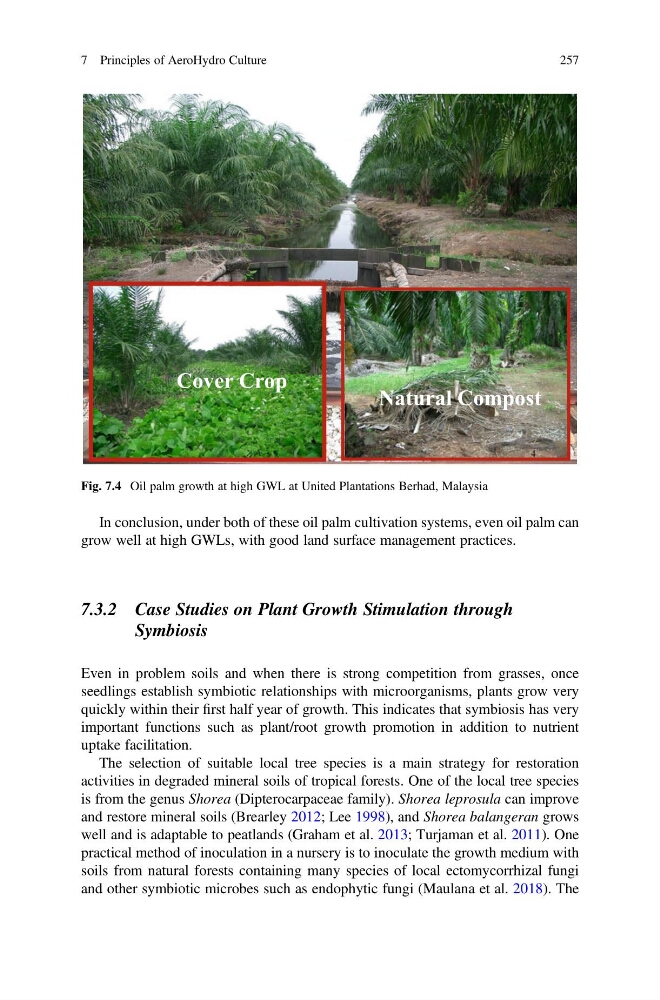
In conclusion, under both of these oil palm cultivation systems, even oil palm can
grow well at high GWLs, with good land surface management practices.
7.3.2 Case Studies on Plant Growth Stimulation through
Symbiosis
Even in problem soils and when there is strong competition from grasses, once
seedlings establish symbiotic relationships with microorganisms, plants grow very
quickly within their first half year of growth. This indicates that symbiosis has very
important functions such as plant/root growth promotion in addition to nutrient
uptake facilitation.
The selection of suitable local tree species is a main strategy for restoration
activities in degraded mineral soils of tropical forests. One of the local tree species
is from the genus Shorea (Dipterocarpaceae family). Shorea leprosula can improve
and restore mineral soils (Brearley 2012; Lee 1998), and Shorea balangeran grows
well and is adaptable to peatlands (Graham et al. 2013; Turjaman et al. 2011). One
practical method of inoculation in a nursery is to inoculate the growth medium with
soils from natural forests containing many species of local ectomycorrhizal fungi
and other symbiotic microbes such as endophytic fungi (Maulana et al. 2018). The
Natural Compost
Cover Crop
Fig. 7.4 Oil palm growth at high GWL at United Plantations Berhad, Malaysia
7 Principles of AeroHydro Culture
257
grow well at high GWLs, with good land surface management practices.
7.3.2 Case Studies on Plant Growth Stimulation through
Symbiosis
Even in problem soils and when there is strong competition from grasses, once
seedlings establish symbiotic relationships with microorganisms, plants grow very
quickly within their first half year of growth. This indicates that symbiosis has very
important functions such as plant/root growth promotion in addition to nutrient
uptake facilitation.
The selection of suitable local tree species is a main strategy for restoration
activities in degraded mineral soils of tropical forests. One of the local tree species
is from the genus Shorea (Dipterocarpaceae family). Shorea leprosula can improve
and restore mineral soils (Brearley 2012; Lee 1998), and Shorea balangeran grows
well and is adaptable to peatlands (Graham et al. 2013; Turjaman et al. 2011). One
practical method of inoculation in a nursery is to inoculate the growth medium with
soils from natural forests containing many species of local ectomycorrhizal fungi
and other symbiotic microbes such as endophytic fungi (Maulana et al. 2018). The
Natural Compost
Cover Crop
Fig. 7.4 Oil palm growth at high GWL at United Plantations Berhad, Malaysia
7 Principles of AeroHydro Culture
257