

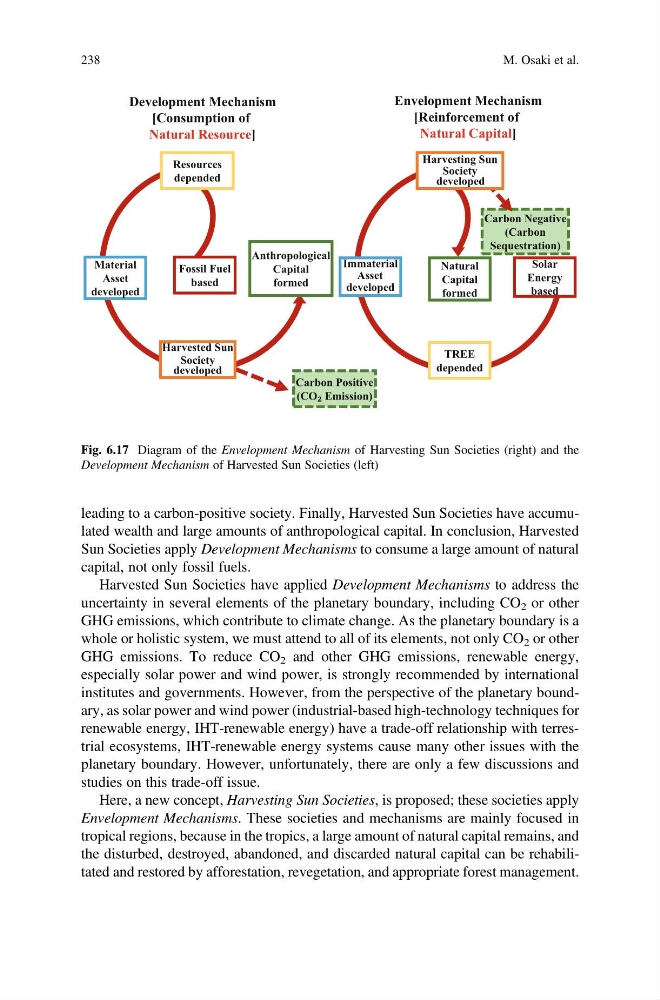
leading to a carbon-positive society. Finally, Harvested Sun Societies have accumulated wealth and large amounts of anthropological capital. In conclusion, Harvested
Sun Societies apply Development Mechanisms to consume a large amount of natural
capital, not only fossil fuels.
Harvested Sun Societies have applied Development Mechanisms to address the
uncertainty in several elements of the planetary boundary, including CO 2 or other
GHG emissions, which contribute to climate change. As the planetary boundary is a
whole or holistic system, we must attend to all of its elements, not only CO 2 or other
GHG emissions. To reduce CO 2 and other GHG emissions, renewable energy,
especially solar power and wind power, is strongly recommended by international
institutes and governments. However, from the perspective of the planetary boundary, as solar power and wind power (industrial-based high-technology techniques for
renewable energy, IHT-renewable energy) have a trade-off relationship with terrestrial ecosystems, IHT-renewable energy systems cause many other issues with the
planetary boundary. However, unfortunately, there are only a few discussions and
studies on this trade-off issue.
Here, a new concept, Harvesting Sun Societies, is proposed; these societies apply
Envelopment Mechanisms. These societies and mechanisms are mainly focused in
tropical regions, because in the tropics, a large amount of natural capital remains, and
the disturbed, destroyed, abandoned, and discarded natural capital can be rehabilitated and restored by afforestation, revegetation, and appropriate forest management.
Immaterial
Asset
developed
TREE
depended
Solar
Energy
based
Natural
Capital
formed
Carbon Positive
(CO₂ ₂ Emission)
Carbon Negative
(Carbon
Sequestration)
Material
Asset
developed
Resources
depended
Fossil Fuel
based
Anthropological
Capital
formed
Harvested Sun
Society
developed
Harvesting Sun
Society
developed
Development Mechanism
[Consumption of
Natural Resource]
Envelopment Mechanism
[Reinforcement of
Natural Capital]
Fig. 6.17 Diagram of the Envelopment Mechanism of Harvesting Sun Societies (right) and the
Development Mechanism of Harvested Sun Societies (left)
238
M. Osaki et al.
Sun Societies apply Development Mechanisms to consume a large amount of natural
capital, not only fossil fuels.
Harvested Sun Societies have applied Development Mechanisms to address the
uncertainty in several elements of the planetary boundary, including CO 2 or other
GHG emissions, which contribute to climate change. As the planetary boundary is a
whole or holistic system, we must attend to all of its elements, not only CO 2 or other
GHG emissions. To reduce CO 2 and other GHG emissions, renewable energy,
especially solar power and wind power, is strongly recommended by international
institutes and governments. However, from the perspective of the planetary boundary, as solar power and wind power (industrial-based high-technology techniques for
renewable energy, IHT-renewable energy) have a trade-off relationship with terrestrial ecosystems, IHT-renewable energy systems cause many other issues with the
planetary boundary. However, unfortunately, there are only a few discussions and
studies on this trade-off issue.
Here, a new concept, Harvesting Sun Societies, is proposed; these societies apply
Envelopment Mechanisms. These societies and mechanisms are mainly focused in
tropical regions, because in the tropics, a large amount of natural capital remains, and
the disturbed, destroyed, abandoned, and discarded natural capital can be rehabilitated and restored by afforestation, revegetation, and appropriate forest management.
Immaterial
Asset
developed
TREE
depended
Solar
Energy
based
Natural
Capital
formed
Carbon Positive
(CO₂ ₂ Emission)
Carbon Negative
(Carbon
Sequestration)
Material
Asset
developed
Resources
depended
Fossil Fuel
based
Anthropological
Capital
formed
Harvested Sun
Society
developed
Harvesting Sun
Society
developed
Development Mechanism
[Consumption of
Natural Resource]
Envelopment Mechanism
[Reinforcement of
Natural Capital]
Fig. 6.17 Diagram of the Envelopment Mechanism of Harvesting Sun Societies (right) and the
Development Mechanism of Harvested Sun Societies (left)
238
M. Osaki et al.