

energy across a diverse suite of recipient environments, including those characterized by land, crops, water, and built-up systems. They provide a conceptual model
and framework to describe 16 TESs of solar energy and characterize 20 potential
techno-ecological synergistic outcomes of their use.
As techno-ecological synergy (TES) is quite a new field of study, however
uncertainty remains, especially in the tropics. Because solar radiation is high in the
tropics, it is hypothesized that excess energy is regulated by the water–TREE–
carbon linkage system, thereby avoiding damage to tropical ecosystems (see sect.
6.1.1: Water Systems in the Tropics, 6.1.2: Carbon Systems in the Tropics, and sect.
6.2.1: TREE Model in the Tropics).
Solar panels have the ability to capture solar energy only; however, trees (TREE)
have several functions other than energy capture by photosynthetic cells; these
functions are extremely important for the protection, conservation, and restoration
of tropical ecosystems.
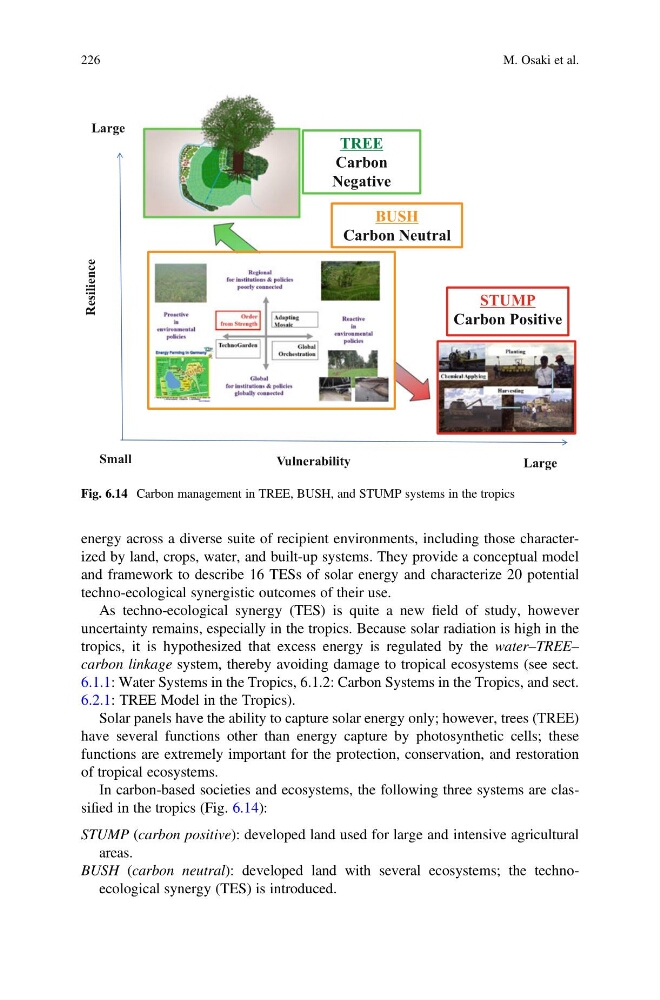
In carbon-based societies and ecosystems, the following three systems are classified in the tropics (Fig. 6.14):
STUMP (carbon positive): developed land used for large and intensive agricultural
areas.
BUSH (carbon neutral): developed land with several ecosystems; the technoecological synergy (TES) is introduced.
Large
Resilience
Vulnerability
Large
Small
STUMP
Carbon Positive
TREE
Carbon
Negative
BUSH
Carbon Neutral
Fig. 6.14 Carbon management in TREE, BUSH, and STUMP systems in the tropics
226
M. Osaki et al.
and framework to describe 16 TESs of solar energy and characterize 20 potential
techno-ecological synergistic outcomes of their use.
As techno-ecological synergy (TES) is quite a new field of study, however
uncertainty remains, especially in the tropics. Because solar radiation is high in the
tropics, it is hypothesized that excess energy is regulated by the water–TREE–
carbon linkage system, thereby avoiding damage to tropical ecosystems (see sect.
6.1.1: Water Systems in the Tropics, 6.1.2: Carbon Systems in the Tropics, and sect.
6.2.1: TREE Model in the Tropics).
Solar panels have the ability to capture solar energy only; however, trees (TREE)
have several functions other than energy capture by photosynthetic cells; these
functions are extremely important for the protection, conservation, and restoration
of tropical ecosystems.
In carbon-based societies and ecosystems, the following three systems are classified in the tropics (Fig. 6.14):
STUMP (carbon positive): developed land used for large and intensive agricultural
areas.
BUSH (carbon neutral): developed land with several ecosystems; the technoecological synergy (TES) is introduced.
Large
Resilience
Vulnerability
Large
Small
STUMP
Carbon Positive
TREE
Carbon
Negative
BUSH
Carbon Neutral
Fig. 6.14 Carbon management in TREE, BUSH, and STUMP systems in the tropics
226
M. Osaki et al.