

the IMC (Fig. 6.4, right), which is the warmest; this warm seawater functions
similarly to a dam for the Indonesian throughflow from the Pacific Ocean to the
Indian Ocean (e.g., Lukas et al. 1996; Gordon 2005). The IMC coastline rainfall is
the greatest contributor (approximately 20% or more) to the global latent heat, which
is approximately 22% of the magnitude of the global infrared radiation (see Fig. 6.2)
(Yamanaka et al. 2018). Thus, variations in this rainfall may considerably affect the
global climate.
Thus, we can hypothesize that high solar energy in the tropics drives water and
carbon cycles on a global scale. The IMC controls the global climate, whereas the
global climate provides a boundary for the IMC. In other words, the global climate is
controlled by the IMC. Therefore, the IMC is the source of the global water and
carbon cycle. The peatland surrounding the IMC and resulting from the water and
carbon cycles is the ultimate climax ecosystem at the global scale.
In conclusion, we can say that the global climate is controlled by Indonesian
peatlands. However, the information needed to describe the mechanisms of this
relationship are still limited. To understand the relationship between global climate
and Indonesian peatlands, we need to understand the water–carbon dynamics, which
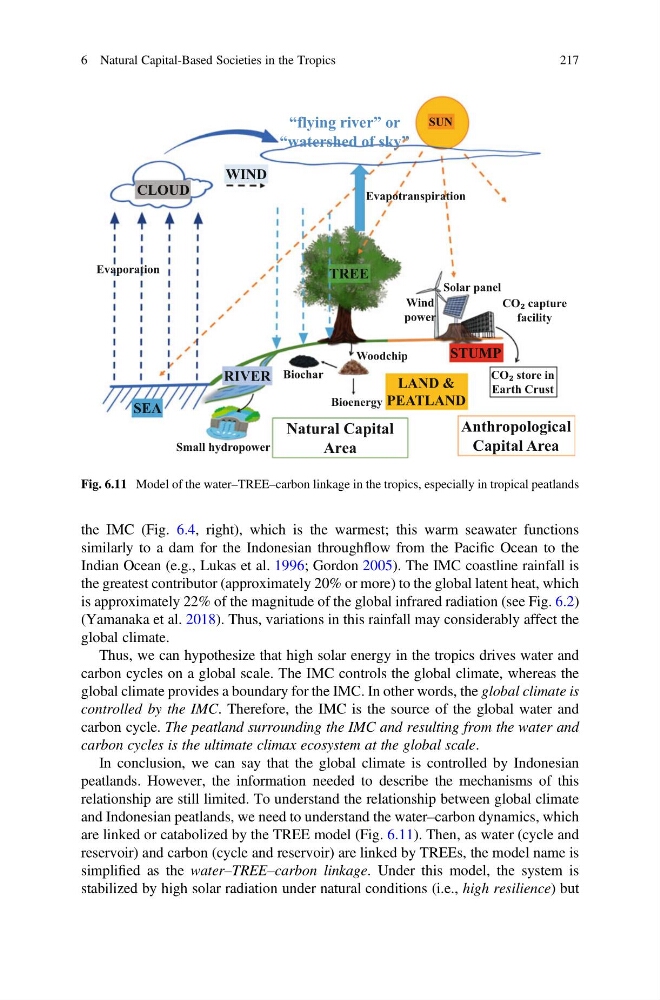
are linked or catabolized by the TREE model (Fig. 6.11). Then, as water (cycle and
reservoir) and carbon (cycle and reservoir) are linked by TREEs, the model name is
simplified as the water–TREE–carbon linkage. Under this model, the system is
stabilized by high solar radiation under natural conditions (i.e., high resilience) but
CLOUD
TREE
STUMP
RIVER
WIND
SEA
LAND &
PEATLAND
Natural Capital
Area
Anthropological
Capital Area
Wind
power
Solar panel
CO₂ ₂ capture
facility
SUN
Small hydropower
Biochar
Bioenergy
Woodchip
CO₂ ₂ store in
Earth Crust
Evapotranspiration
“flying river” or
“watershed of sky”
Evaporation
Fig. 6.11 Model of the water–TREE–carbon linkage in the tropics, especially in tropical peatlands
6 Natural Capital-Based Societies in the Tropics
217
similarly to a dam for the Indonesian throughflow from the Pacific Ocean to the
Indian Ocean (e.g., Lukas et al. 1996; Gordon 2005). The IMC coastline rainfall is
the greatest contributor (approximately 20% or more) to the global latent heat, which
is approximately 22% of the magnitude of the global infrared radiation (see Fig. 6.2)
(Yamanaka et al. 2018). Thus, variations in this rainfall may considerably affect the
global climate.
Thus, we can hypothesize that high solar energy in the tropics drives water and
carbon cycles on a global scale. The IMC controls the global climate, whereas the
global climate provides a boundary for the IMC. In other words, the global climate is
controlled by the IMC. Therefore, the IMC is the source of the global water and
carbon cycle. The peatland surrounding the IMC and resulting from the water and
carbon cycles is the ultimate climax ecosystem at the global scale.
In conclusion, we can say that the global climate is controlled by Indonesian
peatlands. However, the information needed to describe the mechanisms of this
relationship are still limited. To understand the relationship between global climate
and Indonesian peatlands, we need to understand the water–carbon dynamics, which
are linked or catabolized by the TREE model (Fig. 6.11). Then, as water (cycle and
reservoir) and carbon (cycle and reservoir) are linked by TREEs, the model name is
simplified as the water–TREE–carbon linkage. Under this model, the system is
stabilized by high solar radiation under natural conditions (i.e., high resilience) but
CLOUD
TREE
STUMP
RIVER
WIND
SEA
LAND &
PEATLAND
Natural Capital
Area
Anthropological
Capital Area
Wind
power
Solar panel
CO₂ ₂ capture
facility
SUN
Small hydropower
Biochar
Bioenergy
Woodchip
CO₂ ₂ store in
Earth Crust
Evapotranspiration
“flying river” or
“watershed of sky”
Evaporation
Fig. 6.11 Model of the water–TREE–carbon linkage in the tropics, especially in tropical peatlands
6 Natural Capital-Based Societies in the Tropics
217