

Centre of the United Nations Environment Programme (UNEP-WCMC) examined
global patterns in the three major carbon pools: aboveground biomass, belowground
biomass, and soil organic carbon. The global map produced by Ruesch and Gibbs
(2008) shows that large amounts of carbon are stored in the tropics, mostly as
biomass, and in high-latitude ecosystems where carbon stocks are largely located
in permanently frozen layers of soil (permafrost) and in peat. Additionally, the need
for an improved understanding of spatial variation in soil organic carbon stocks
(including coastal sediments) was highlighted. Soil organic carbon stocks are estimated to be two to three times larger than atmospheric carbon content, and the data
are still highly uncertain, particularly for permafrost, peatlands, and some coastal
sediments. After this UNFCCC workshop, three ecosystems have attracted attention
as high-carbon reservoir ecosystems, which are ecosystems that store high amounts
of carbon with high uncertainty.
The planetary boundaries concept presents a set of nine planetary boundaries
within which humanity can continue to develop and thrive for generations to come
(https://www.stockholmresilience.org/research/planetary-boundaries.html).
In
2009, scientists identified the nine processes that regulate the stability and resilience
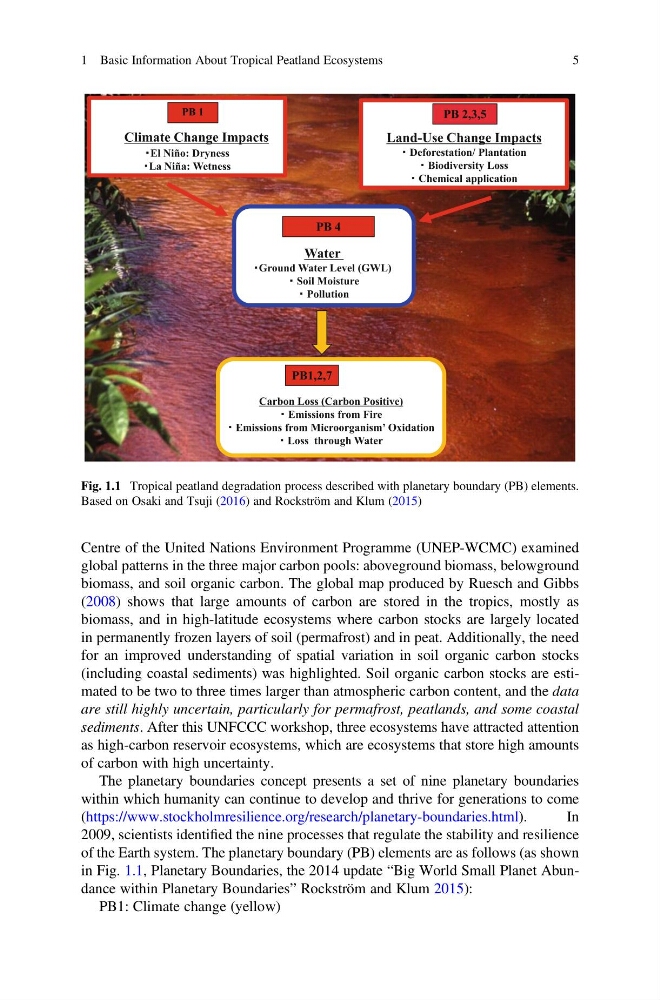
of the Earth system. The planetary boundary (PB) elements are as follows (as shown
in Fig. 1.1, Planetary Boundaries, the 2014 update “Big World Small Planet Abundance within Planetary Boundaries” Rockström and Klum 2015):
PB1: Climate change (yellow)
Fig. 1.1 Tropical peatland degradation process described with planetary boundary (PB) elements.
Based on Osaki and Tsuji (2016) and Rockström and Klum (2015)
1 Basic Information About Tropical Peatland Ecosystems
5
global patterns in the three major carbon pools: aboveground biomass, belowground
biomass, and soil organic carbon. The global map produced by Ruesch and Gibbs
(2008) shows that large amounts of carbon are stored in the tropics, mostly as
biomass, and in high-latitude ecosystems where carbon stocks are largely located
in permanently frozen layers of soil (permafrost) and in peat. Additionally, the need
for an improved understanding of spatial variation in soil organic carbon stocks
(including coastal sediments) was highlighted. Soil organic carbon stocks are estimated to be two to three times larger than atmospheric carbon content, and the data
are still highly uncertain, particularly for permafrost, peatlands, and some coastal
sediments. After this UNFCCC workshop, three ecosystems have attracted attention
as high-carbon reservoir ecosystems, which are ecosystems that store high amounts
of carbon with high uncertainty.
The planetary boundaries concept presents a set of nine planetary boundaries
within which humanity can continue to develop and thrive for generations to come
(https://www.stockholmresilience.org/research/planetary-boundaries.html).
In
2009, scientists identified the nine processes that regulate the stability and resilience
of the Earth system. The planetary boundary (PB) elements are as follows (as shown
in Fig. 1.1, Planetary Boundaries, the 2014 update “Big World Small Planet Abundance within Planetary Boundaries” Rockström and Klum 2015):
PB1: Climate change (yellow)
Fig. 1.1 Tropical peatland degradation process described with planetary boundary (PB) elements.
Based on Osaki and Tsuji (2016) and Rockström and Klum (2015)
1 Basic Information About Tropical Peatland Ecosystems
5