

3 The Standard Model of Electroweak Interactions
65
corrections are only estimated for the g 2 terms not enhanced by m 2
t /m 2
W ), and the
terms of order g 4 enhanced by the ratios m 4
t /m 4
W or m 2
t /m 2
W are also known.
In the SM the quantities W , k, for sufficiently large m t , are all
dominated by quadratic terms in m t of order G F m 2
t . The quantity m is not
independent and can expressed in terms of them. As new physics can more easily be
disentangled if not masked by large conventional m t effects, it is convenient to keep
ρ while trading W and k for two quantities with no contributions of order
G F m 2
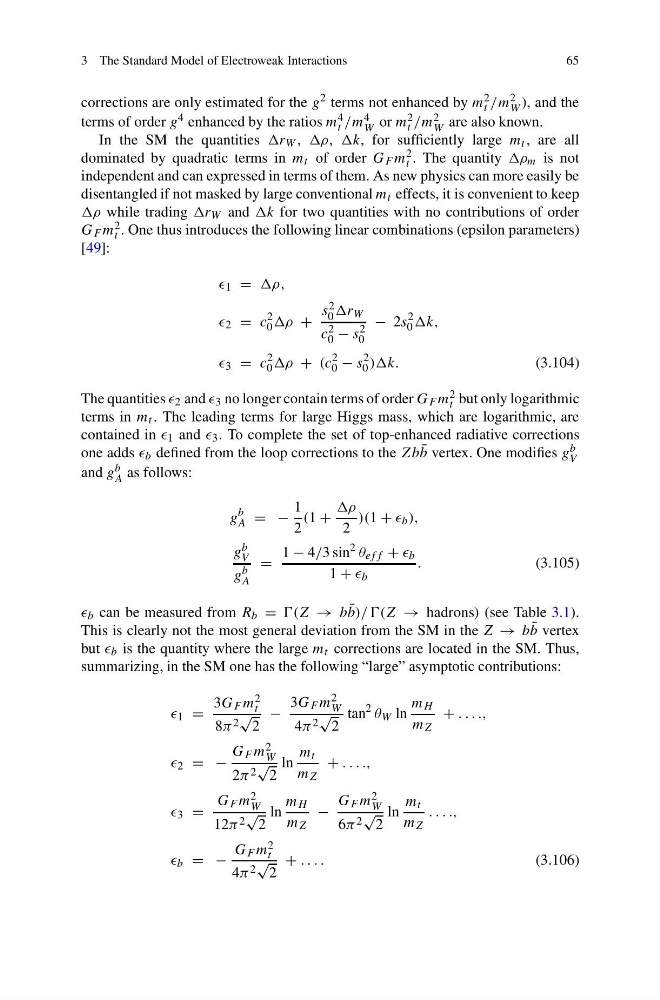
t . One thus introduces the following linear combinations (epsilon parameters)
[49]:
1 = ρ,
2 = c
2
0 +
s 2
0 W
c 2
0 − s 2
0
− 2s
2
0 k,
3 = c
2
0 + (c
2
0 − s
2
0 ))k.
(3.104)
The quantities 2 and 3 no longer contain terms of order G F m 2
t but only logarithmic
terms in m t . The leading terms for large Higgs mass, which are logarithmic, are
contained in 1 and 3 . To complete the set of top-enhanced radiative corrections
one adds b defined from the loop corrections to the Zb ¯
b vertex. One modifies g b
V
and g b
A as follows:
g
b
A = −
1
2
(1 +
ρ
2
)(1 + b ),
g b
V
g
b
A
=
1 − 4/3 sin
2 θ eff + b
1 + b
.
(3.105)
b can be measured from R b = (Z → b ¯
b)/ /(Z → hadrons) (see Table 3.1).
This is clearly not the most general deviation from the SM in the Z → b ¯
b vertex
but b is the quantity where the large m t corrections are located in the SM. Thus,
summarizing, in the SM one has the following “large” asymptotic contributions:
1 =
3G F m 2
t
8π 2
√
2
−
3G F m 2
W
4π 2
√
2
tan
2 θ W ln
m H
m Z
+ . . . .,
2 = −
G F m 2
W
2π 2
√
2
ln
m t
m Z
+ . . . .,
3 =
G F m 2
W
12π 2
√
2
ln
m H
m Z
−
G F m 2
W
6π 2
√
2
ln
m t
m Z
. . . .,
b = −
G F m 2
t
4π 2
√
2
+ . . . .
(3.106)
65
corrections are only estimated for the g 2 terms not enhanced by m 2
t /m 2
W ), and the
terms of order g 4 enhanced by the ratios m 4
t /m 4
W or m 2
t /m 2
W are also known.
In the SM the quantities W , k, for sufficiently large m t , are all
dominated by quadratic terms in m t of order G F m 2
t . The quantity m is not
independent and can expressed in terms of them. As new physics can more easily be
disentangled if not masked by large conventional m t effects, it is convenient to keep
ρ while trading W and k for two quantities with no contributions of order
G F m 2
t . One thus introduces the following linear combinations (epsilon parameters)
[49]:
1 = ρ,
2 = c
2
0 +
s 2
0 W
c 2
0 − s 2
0
− 2s
2
0 k,
3 = c
2
0 + (c
2
0 − s
2
0 ))k.
(3.104)
The quantities 2 and 3 no longer contain terms of order G F m 2
t but only logarithmic
terms in m t . The leading terms for large Higgs mass, which are logarithmic, are
contained in 1 and 3 . To complete the set of top-enhanced radiative corrections
one adds b defined from the loop corrections to the Zb ¯
b vertex. One modifies g b
V
and g b
A as follows:
g
b
A = −
1
2
(1 +
ρ
2
)(1 + b ),
g b
V
g
b
A
=
1 − 4/3 sin
2 θ eff + b
1 + b
.
(3.105)
b can be measured from R b = (Z → b ¯
b)/ /(Z → hadrons) (see Table 3.1).
This is clearly not the most general deviation from the SM in the Z → b ¯
b vertex
but b is the quantity where the large m t corrections are located in the SM. Thus,
summarizing, in the SM one has the following “large” asymptotic contributions:
1 =
3G F m 2
t
8π 2
√
2
−
3G F m 2
W
4π 2
√
2
tan
2 θ W ln
m H
m Z
+ . . . .,
2 = −
G F m 2
W
2π 2
√
2
ln
m t
m Z
+ . . . .,
3 =
G F m 2
W
12π 2
√
2
ln
m H
m Z
−
G F m 2
W
6π 2
√
2
ln
m t
m Z
. . . .,
b = −
G F m 2
t
4π 2
√
2
+ . . . .
(3.106)