

60
G. Altarelli and S. Forte
order (HO) vacuum polarization contribution (from 2-loop diagrams containing an
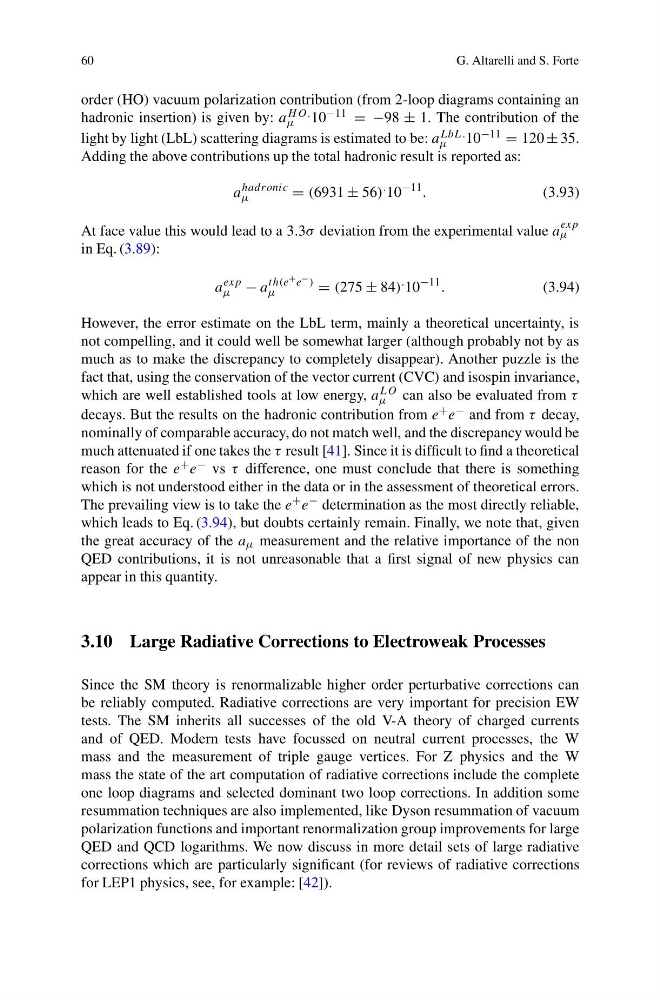
hadronic insertion) is given by: a H O.
μ 10 −11 = −98 ± 1. The contribution of the
light by light (LbL) scattering diagrams is estimated to be: a LbL.
μ
10 −11 = 120 ± 35.
Adding the above contributions up the total hadronic result is reported as:
a
hadronic
μ
= (6931 ± 56)
. 10
−11 .
(3.93)
At face value this would lead to a 3.3σ deviation from the experimental value a
exp
μ
in Eq. (3.89):
a
exp
μ − a
th(e + e − )
μ
= (275 ± 84)
. 10
−11 .
(3.94)
However, the error estimate on the LbL term, mainly a theoretical uncertainty, is
not compelling, and it could well be somewhat larger (although probably not by as
much as to make the discrepancy to completely disappear). Another puzzle is the
fact that, using the conservation of the vector current (CVC) and isospin invariance,
which are well established tools at low energy, a LO
μ can also be evaluated from τ
decays. But the results on the hadronic contribution from e + e − and from τ decay,
nominally of comparable accuracy, do not match well, and the discrepancy would be
much attenuated if one takes the τ result [41]. Since it is difficult to find a theoretical
reason for the e + e − vs τ difference, one must conclude that there is something
which is not understood either in the data or in the assessment of theoretical errors.
The prevailing view is to take the e + e − determination as the most directly reliable,
which leads to Eq. (3.94), but doubts certainly remain. Finally, we note that, given
the great accuracy of the a μ measurement and the relative importance of the non
QED contributions, it is not unreasonable that a first signal of new physics can
appear in this quantity.
3.10 Large Radiative Corrections to Electroweak Processes
Since the SM theory is renormalizable higher order perturbative corrections can
be reliably computed. Radiative corrections are very important for precision EW
tests. The SM inherits all successes of the old V-A theory of charged currents
and of QED. Modern tests have focussed on neutral current processes, the W
mass and the measurement of triple gauge vertices. For Z physics and the W
mass the state of the art computation of radiative corrections include the complete
one loop diagrams and selected dominant two loop corrections. In addition some
resummation techniques are also implemented, like Dyson resummation of vacuum
polarization functions and important renormalization group improvements for large
QED and QCD logarithms. We now discuss in more detail sets of large radiative
corrections which are particularly significant (for reviews of radiative corrections
for LEP1 physics, see, for example: [42]).
G. Altarelli and S. Forte
order (HO) vacuum polarization contribution (from 2-loop diagrams containing an
hadronic insertion) is given by: a H O.
μ 10 −11 = −98 ± 1. The contribution of the
light by light (LbL) scattering diagrams is estimated to be: a LbL.
μ
10 −11 = 120 ± 35.
Adding the above contributions up the total hadronic result is reported as:
a
hadronic
μ
= (6931 ± 56)
. 10
−11 .
(3.93)
At face value this would lead to a 3.3σ deviation from the experimental value a
exp
μ
in Eq. (3.89):
a
exp
μ − a
th(e + e − )
μ
= (275 ± 84)
. 10
−11 .
(3.94)
However, the error estimate on the LbL term, mainly a theoretical uncertainty, is
not compelling, and it could well be somewhat larger (although probably not by as
much as to make the discrepancy to completely disappear). Another puzzle is the
fact that, using the conservation of the vector current (CVC) and isospin invariance,
which are well established tools at low energy, a LO
μ can also be evaluated from τ
decays. But the results on the hadronic contribution from e + e − and from τ decay,
nominally of comparable accuracy, do not match well, and the discrepancy would be
much attenuated if one takes the τ result [41]. Since it is difficult to find a theoretical
reason for the e + e − vs τ difference, one must conclude that there is something
which is not understood either in the data or in the assessment of theoretical errors.
The prevailing view is to take the e + e − determination as the most directly reliable,
which leads to Eq. (3.94), but doubts certainly remain. Finally, we note that, given
the great accuracy of the a μ measurement and the relative importance of the non
QED contributions, it is not unreasonable that a first signal of new physics can
appear in this quantity.
3.10 Large Radiative Corrections to Electroweak Processes
Since the SM theory is renormalizable higher order perturbative corrections can
be reliably computed. Radiative corrections are very important for precision EW
tests. The SM inherits all successes of the old V-A theory of charged currents
and of QED. Modern tests have focussed on neutral current processes, the W
mass and the measurement of triple gauge vertices. For Z physics and the W
mass the state of the art computation of radiative corrections include the complete
one loop diagrams and selected dominant two loop corrections. In addition some
resummation techniques are also implemented, like Dyson resummation of vacuum
polarization functions and important renormalization group improvements for large
QED and QCD logarithms. We now discuss in more detail sets of large radiative
corrections which are particularly significant (for reviews of radiative corrections
for LEP1 physics, see, for example: [42]).