

10 The Future of Particle Physics: The LHC and Beyond
629
60
50
40
30
20
10
0
60
SM
α 1
α 2
α 3
50
40
30
20
10
0
0
5
1 0
SOFTSUSY 3.6.2
15
0
5
10
15
α
i
–1
(Q)
log 10 (Q/GeV)
SOFTSUSY 3.6.2
log 10 (Q/GeV)
MSSM: m 0 =M 1/2 =2 TeV , A 0 =0, tanβ=30
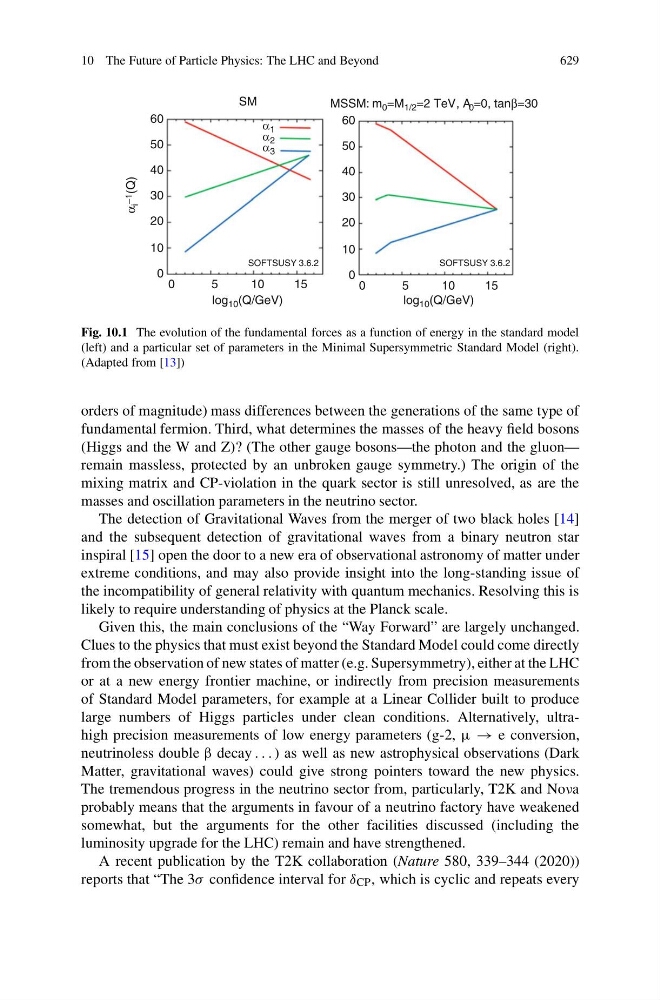
Fig. 10.1 The evolution of the fundamental forces as a function of energy in the standard model
(left) and a particular set of parameters in the Minimal Supersymmetric Standard Model (right).
(Adapted from [13])
orders of magnitude) mass differences between the generations of the same type of
fundamental fermion. Third, what determines the masses of the heavy field bosons
(Higgs and the W and Z)? (The other gauge bosons—the photon and the gluon—
remain massless, protected by an unbroken gauge symmetry.) The origin of the
mixing matrix and CP-violation in the quark sector is still unresolved, as are the
masses and oscillation parameters in the neutrino sector.
The detection of Gravitational Waves from the merger of two black holes [14]
and the subsequent detection of gravitational waves from a binary neutron star
inspiral [15] open the door to a new era of observational astronomy of matter under
extreme conditions, and may also provide insight into the long-standing issue of
the incompatibility of general relativity with quantum mechanics. Resolving this is
likely to require understanding of physics at the Planck scale.
Given this, the main conclusions of the “Way Forward” are largely unchanged.
Clues to the physics that must exist beyond the Standard Model could come directly
from the observation of new states of matter (e.g. Supersymmetry), either at the LHC
or at a new energy frontier machine, or indirectly from precision measurements
of Standard Model parameters, for example at a Linear Collider built to produce
large numbers of Higgs particles under clean conditions. Alternatively, ultrahigh precision measurements of low energy parameters (g-2, μ → e conversion,
neutrinoless double β decay . . . ) as well as new astrophysical observations (Dark
Matter, gravitational waves) could give strong pointers toward the new physics.
The tremendous progress in the neutrino sector from, particularly, T2K and Noνa
probably means that the arguments in favour of a neutrino factory have weakened
somewhat, but the arguments for the other facilities discussed (including the
luminosity upgrade for the LHC) remain and have strengthened.
A recent publication by the T2K collaboration (Nature 580, 339–344 (2020))
reports that “The 3σ confidence interval for δ CP , which is cyclic and repeats every