

9 Symmetry Violations and Quark Flavour Physics
617
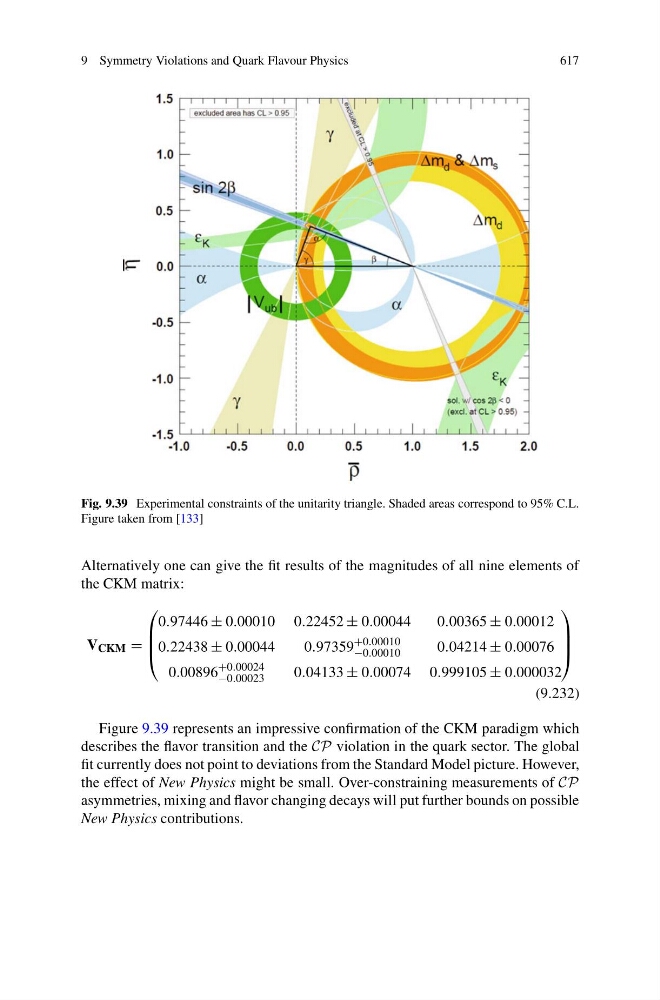
Fig. 9.39 Experimental constraints of the unitarity triangle. Shaded areas correspond to 95% C.L.
Figure taken from [133]
Alternatively one can give the fit results of the magnitudes of all nine elements of
the CKM matrix:
V CKM =
⎛
⎜
⎜
⎝
0.97446 ± 0.00010 0.22452 ± 0.00044
0.00365 ± 0.00012
0.22438 ± 0.00044
0.97359
+0.00010
−0.00010
0.04214 ± 0.00076
0.00896
+0.00024
−0.00023
0.04133 ± 0.00074 0.999105 ± 0.000032
⎞
⎟
⎟
⎠
(9.232)
Figure 9.39 represents an impressive confirmation of the CKM paradigm which
describes the flavor transition and the CP violation in the quark sector. The global
fit currently does not point to deviations from the Standard Model picture. However,
the effect of New Physics might be small. Over-constraining measurements of CP
asymmetries, mixing and flavor changing decays will put further bounds on possible
New Physics contributions.