

606
K. Kleinknecht and U. Uwer
100
50
400
200
5400
5300
5200
5100
5500
5400
5300
5200
5100
5500
m (Dh ) [MeV/ c 2 ]
LHCb
B – [ – K + ] D K
–
LHCb
B – [ – K + ] D
–
LHCb
B + [ + K – ] D K
+
B + [ + K – ] D
+
LHCb
Events / (10 MeV/
c 2
)
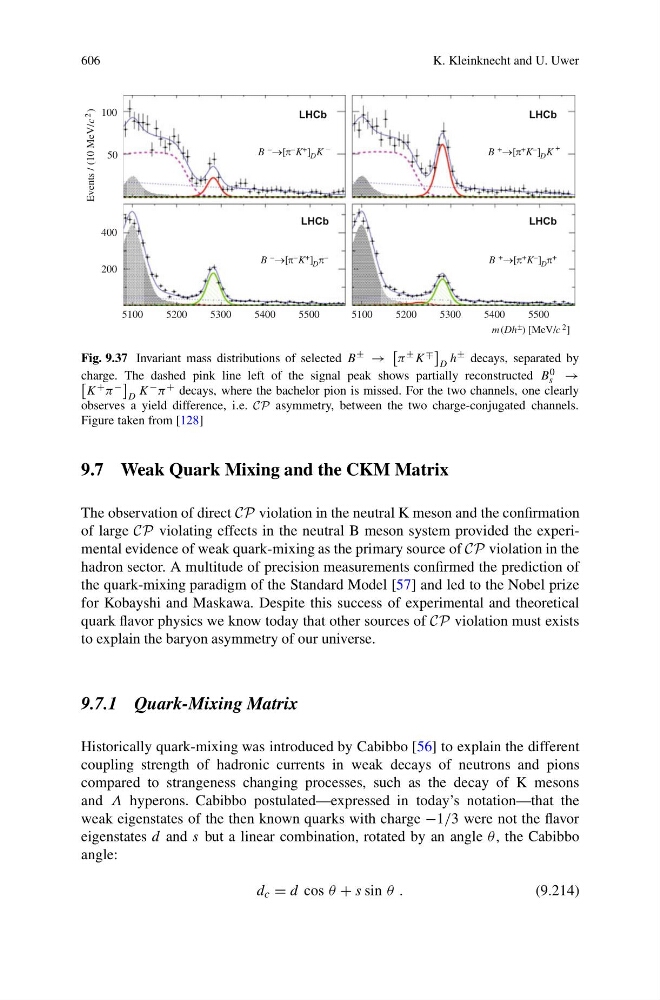
Fig. 9.37 Invariant mass distributions of selected B ± →
π ± K ∓
D
h ± decays, separated by
charge. The dashed pink line left of the signal peak shows partially reconstructed B 0
s →
K + π −
D
K − π + decays, where the bachelor pion is missed. For the two channels, one clearly
observes a yield difference, i.e. CP asymmetry, between the two charge-conjugated channels.
Figure taken from [128]
9.7 Weak Quark Mixing and the CKM Matrix
The observation of direct CP violation in the neutral K meson and the confirmation
of large CP violating effects in the neutral B meson system provided the experimental evidence of weak quark-mixing as the primary source of CP violation in the
hadron sector. A multitude of precision measurements confirmed the prediction of
the quark-mixing paradigm of the Standard Model [57] and led to the Nobel prize
for Kobayshi and Maskawa. Despite this success of experimental and theoretical
quark flavor physics we know today that other sources of CP violation must exists
to explain the baryon asymmetry of our universe.
9.7.1 Quark-Mixing Matrix
Historically quark-mixing was introduced by Cabibbo [56] to explain the different
coupling strength of hadronic currents in weak decays of neutrons and pions
compared to strangeness changing processes, such as the decay of K mesons
and Λ hyperons. Cabibbo postulated—expressed in today’s notation—that the
weak eigenstates of the then known quarks with charge −1/3 were not the flavor
eigenstates d and s but a linear combination, rotated by an angle θ , the Cabibbo
angle:
d c = d cos θ + s sin θ .
(9.214)
K. Kleinknecht and U. Uwer
100
50
400
200
5400
5300
5200
5100
5500
5400
5300
5200
5100
5500
m (Dh ) [MeV/ c 2 ]
LHCb
B – [ – K + ] D K
–
LHCb
B – [ – K + ] D
–
LHCb
B + [ + K – ] D K
+
B + [ + K – ] D
+
LHCb
Events / (10 MeV/
c 2
)
Fig. 9.37 Invariant mass distributions of selected B ± →
π ± K ∓
D
h ± decays, separated by
charge. The dashed pink line left of the signal peak shows partially reconstructed B 0
s →
K + π −
D
K − π + decays, where the bachelor pion is missed. For the two channels, one clearly
observes a yield difference, i.e. CP asymmetry, between the two charge-conjugated channels.
Figure taken from [128]
9.7 Weak Quark Mixing and the CKM Matrix
The observation of direct CP violation in the neutral K meson and the confirmation
of large CP violating effects in the neutral B meson system provided the experimental evidence of weak quark-mixing as the primary source of CP violation in the
hadron sector. A multitude of precision measurements confirmed the prediction of
the quark-mixing paradigm of the Standard Model [57] and led to the Nobel prize
for Kobayshi and Maskawa. Despite this success of experimental and theoretical
quark flavor physics we know today that other sources of CP violation must exists
to explain the baryon asymmetry of our universe.
9.7.1 Quark-Mixing Matrix
Historically quark-mixing was introduced by Cabibbo [56] to explain the different
coupling strength of hadronic currents in weak decays of neutrons and pions
compared to strangeness changing processes, such as the decay of K mesons
and Λ hyperons. Cabibbo postulated—expressed in today’s notation—that the
weak eigenstates of the then known quarks with charge −1/3 were not the flavor
eigenstates d and s but a linear combination, rotated by an angle θ , the Cabibbo
angle:
d c = d cos θ + s sin θ .
(9.214)