

9 Symmetry Violations and Quark Flavour Physics
589
dilepton events where both B mesons decay semi-leptonically. Flavor-mixing of one
of the B mesons is indicated by the presence of same-sign lepton events.
For LHCb, where the boost factor of the decaying B is not known and must
be reconstructed from the final-state particles, semi-leptonic signal decays with an
undetected neutrino present an additional complication compared to full hadronic
decays. To account for the missing neutrinos in the calculation of the proper decaytime correction factors are used.
An important performance number for the mixing measurement and even more
for CP violation measurements is the tagging power or effective tagging efficiency
Q = tag D 2
tag which corresponds to the efficiency to correctly tag the flavor of
the signal B meson. The tagging power is the product of the tagging efficiency
tag , the probability that a specific algorithm delivers tagging information, and the
square of the dilution factor D tag = 1 − 2ω, where ω is the mistag probability,
i.e. the probability that a tagging decision is wrong. At a hadron collider, B
mesons are produced independently of each other and mistag probabilities are large
(about 40%). The B-factories profit from the coherent B 0 B 0 production and mistag
probabilities of only a few percents are achieved for some tagging algorithms.
Consequently, the tagging power at the B-factories is as high as 30% while for
LHCb values only up to 6% are obtained.
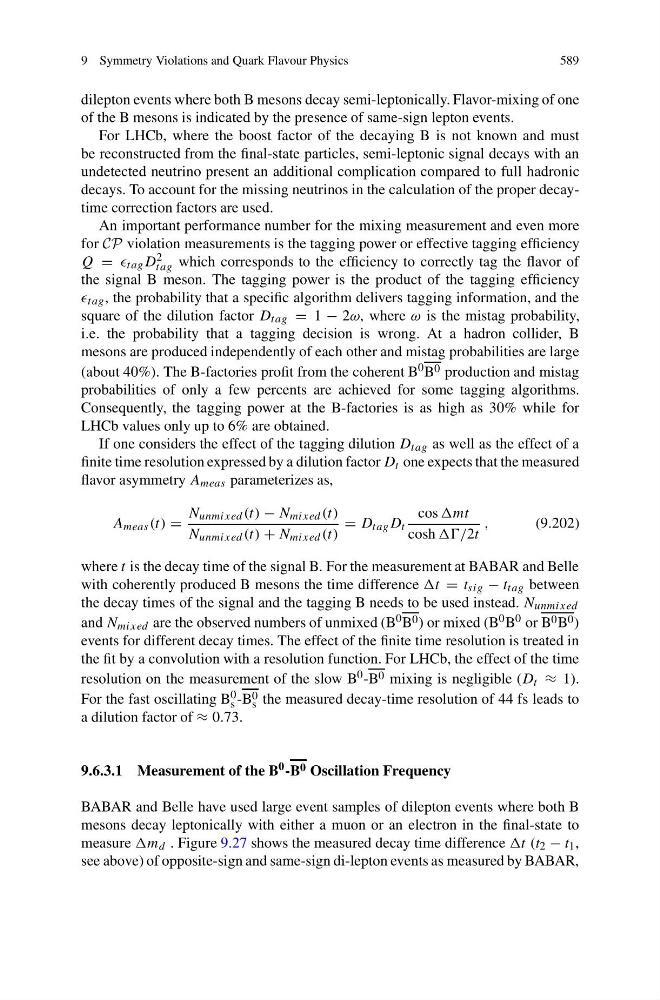
If one considers the effect of the tagging dilution D tag as well as the effect of a
finite time resolution expressed by a dilution factor D t one expects that the measured
flavor asymmetry A meas parameterizes as,
A meas (t) =
N unmixed (t) − N mixed (t)
N unmixed (t) + N mixed (t)
= D tag D t
cos mt
cosh /2t
,
(9.202)
where t is the decay time of the signal B. For the measurement at BABAR and Belle
with coherently produced B mesons the time difference = t sig − t tag between
the decay times of the signal and the tagging B needs to be used instead. N unmixed
and N mixed are the observed numbers of unmixed (B 0 B 0 ) or mixed (B 0 B 0 or B 0 B 0 )
events for different decay times. The effect of the finite time resolution is treated in
the fit by a convolution with a resolution function. For LHCb, the effect of the time
resolution on the measurement of the slow B 0 -B 0 mixing is negligible (D t ≈ 1).
For the fast oscillating B 0
s -B 0
s the measured decay-time resolution of 44 fs leads to
a dilution factor of ≈ 0.73.
9.6.3.1 Measurement of the B 0 -B 0 Oscillation Frequency
BABAR and Belle have used large event samples of dilepton events where both B
mesons decay leptonically with either a muon or an electron in the final-state to
measure d . Figure 9.27 shows the measured decay time difference (t 2 − t 1 ,
see above) of opposite-sign and same-sign di-lepton events as measured by BABAR,
589
dilepton events where both B mesons decay semi-leptonically. Flavor-mixing of one
of the B mesons is indicated by the presence of same-sign lepton events.
For LHCb, where the boost factor of the decaying B is not known and must
be reconstructed from the final-state particles, semi-leptonic signal decays with an
undetected neutrino present an additional complication compared to full hadronic
decays. To account for the missing neutrinos in the calculation of the proper decaytime correction factors are used.
An important performance number for the mixing measurement and even more
for CP violation measurements is the tagging power or effective tagging efficiency
Q = tag D 2
tag which corresponds to the efficiency to correctly tag the flavor of
the signal B meson. The tagging power is the product of the tagging efficiency
tag , the probability that a specific algorithm delivers tagging information, and the
square of the dilution factor D tag = 1 − 2ω, where ω is the mistag probability,
i.e. the probability that a tagging decision is wrong. At a hadron collider, B
mesons are produced independently of each other and mistag probabilities are large
(about 40%). The B-factories profit from the coherent B 0 B 0 production and mistag
probabilities of only a few percents are achieved for some tagging algorithms.
Consequently, the tagging power at the B-factories is as high as 30% while for
LHCb values only up to 6% are obtained.
If one considers the effect of the tagging dilution D tag as well as the effect of a
finite time resolution expressed by a dilution factor D t one expects that the measured
flavor asymmetry A meas parameterizes as,
A meas (t) =
N unmixed (t) − N mixed (t)
N unmixed (t) + N mixed (t)
= D tag D t
cos mt
cosh /2t
,
(9.202)
where t is the decay time of the signal B. For the measurement at BABAR and Belle
with coherently produced B mesons the time difference = t sig − t tag between
the decay times of the signal and the tagging B needs to be used instead. N unmixed
and N mixed are the observed numbers of unmixed (B 0 B 0 ) or mixed (B 0 B 0 or B 0 B 0 )
events for different decay times. The effect of the finite time resolution is treated in
the fit by a convolution with a resolution function. For LHCb, the effect of the time
resolution on the measurement of the slow B 0 -B 0 mixing is negligible (D t ≈ 1).
For the fast oscillating B 0
s -B 0
s the measured decay-time resolution of 44 fs leads to
a dilution factor of ≈ 0.73.
9.6.3.1 Measurement of the B 0 -B 0 Oscillation Frequency
BABAR and Belle have used large event samples of dilepton events where both B
mesons decay leptonically with either a muon or an electron in the final-state to
measure d . Figure 9.27 shows the measured decay time difference (t 2 − t 1 ,
see above) of opposite-sign and same-sign di-lepton events as measured by BABAR,