

3 The Standard Model of Electroweak Interactions
53
Z
d, s, b
c
a
W
W
W
b
c
b
b
s
s
u, t, c
u, t, c
e
e
,Z
t
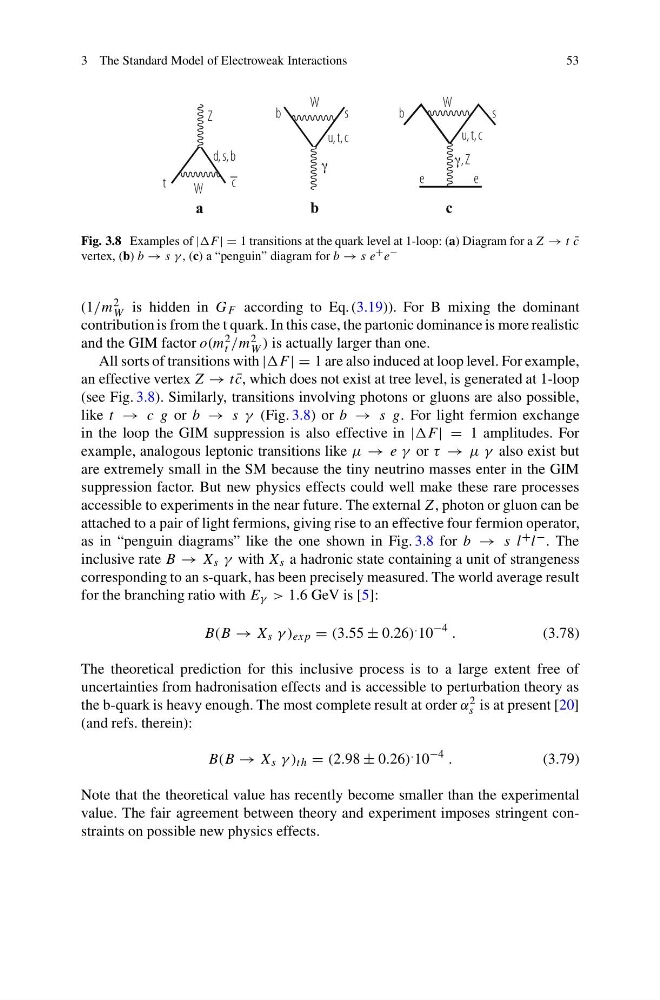
Fig. 3.8 Examples of |F | = 1 transitions at the quark level at 1-loop: (a) Diagram for a Z → t ¯
c
vertex, (b) b → s γ , (c) a “penguin” diagram for b → s e + e −
(1/m 2
W is hidden in G F according to Eq. (3.19)). For B mixing the dominant
contribution is from the t quark. In this case, the partonic dominance is more realistic
and the GIM factor o(m 2
t /m 2
W ) is actually larger than one.
All sorts of transitions with |F | = 1 are also induced at loop level. For example,
an effective vertex Z → t ¯
c, which does not exist at tree level, is generated at 1-loop
(see Fig. 3.8). Similarly, transitions involving photons or gluons are also possible,
like t → c g or b → s γ (Fig. 3.8) or b → s g. For light fermion exchange
in the loop the GIM suppression is also effective in |F | = 1 amplitudes. For
example, analogous leptonic transitions like μ → e γ or τ → μ γ also exist but
are extremely small in the SM because the tiny neutrino masses enter in the GIM
suppression factor. But new physics effects could well make these rare processes
accessible to experiments in the near future. The external Z, photon or gluon can be
attached to a pair of light fermions, giving rise to an effective four fermion operator,
as in “penguin diagrams” like the one shown in Fig. 3.8 for b → s l + l − . The
inclusive rate B → X s γ with X s a hadronic state containing a unit of strangeness
corresponding to an s-quark, has been precisely measured. The world average result
for the branching ratio with E γ > 1.6 GeV is [5]:
B(B → X s γ ) exp = (3.55 ± 0.26)
. 10
−4 .
(3.78)
The theoretical prediction for this inclusive process is to a large extent free of
uncertainties from hadronisation effects and is accessible to perturbation theory as
the b-quark is heavy enough. The most complete result at order α 2
s is at present [20]
(and refs. therein):
B(B → X s γ ) th = (2.98 ± 0.26)
. 10
−4 .
(3.79)
Note that the theoretical value has recently become smaller than the experimental
value. The fair agreement between theory and experiment imposes stringent constraints on possible new physics effects.
53
Z
d, s, b
c
a
W
W
W
b
c
b
b
s
s
u, t, c
u, t, c
e
e
,Z
t
Fig. 3.8 Examples of |F | = 1 transitions at the quark level at 1-loop: (a) Diagram for a Z → t ¯
c
vertex, (b) b → s γ , (c) a “penguin” diagram for b → s e + e −
(1/m 2
W is hidden in G F according to Eq. (3.19)). For B mixing the dominant
contribution is from the t quark. In this case, the partonic dominance is more realistic
and the GIM factor o(m 2
t /m 2
W ) is actually larger than one.
All sorts of transitions with |F | = 1 are also induced at loop level. For example,
an effective vertex Z → t ¯
c, which does not exist at tree level, is generated at 1-loop
(see Fig. 3.8). Similarly, transitions involving photons or gluons are also possible,
like t → c g or b → s γ (Fig. 3.8) or b → s g. For light fermion exchange
in the loop the GIM suppression is also effective in |F | = 1 amplitudes. For
example, analogous leptonic transitions like μ → e γ or τ → μ γ also exist but
are extremely small in the SM because the tiny neutrino masses enter in the GIM
suppression factor. But new physics effects could well make these rare processes
accessible to experiments in the near future. The external Z, photon or gluon can be
attached to a pair of light fermions, giving rise to an effective four fermion operator,
as in “penguin diagrams” like the one shown in Fig. 3.8 for b → s l + l − . The
inclusive rate B → X s γ with X s a hadronic state containing a unit of strangeness
corresponding to an s-quark, has been precisely measured. The world average result
for the branching ratio with E γ > 1.6 GeV is [5]:
B(B → X s γ ) exp = (3.55 ± 0.26)
. 10
−4 .
(3.78)
The theoretical prediction for this inclusive process is to a large extent free of
uncertainties from hadronisation effects and is accessible to perturbation theory as
the b-quark is heavy enough. The most complete result at order α 2
s is at present [20]
(and refs. therein):
B(B → X s γ ) th = (2.98 ± 0.26)
. 10
−4 .
(3.79)
Note that the theoretical value has recently become smaller than the experimental
value. The fair agreement between theory and experiment imposes stringent constraints on possible new physics effects.