

9 Symmetry Violations and Quark Flavour Physics
587
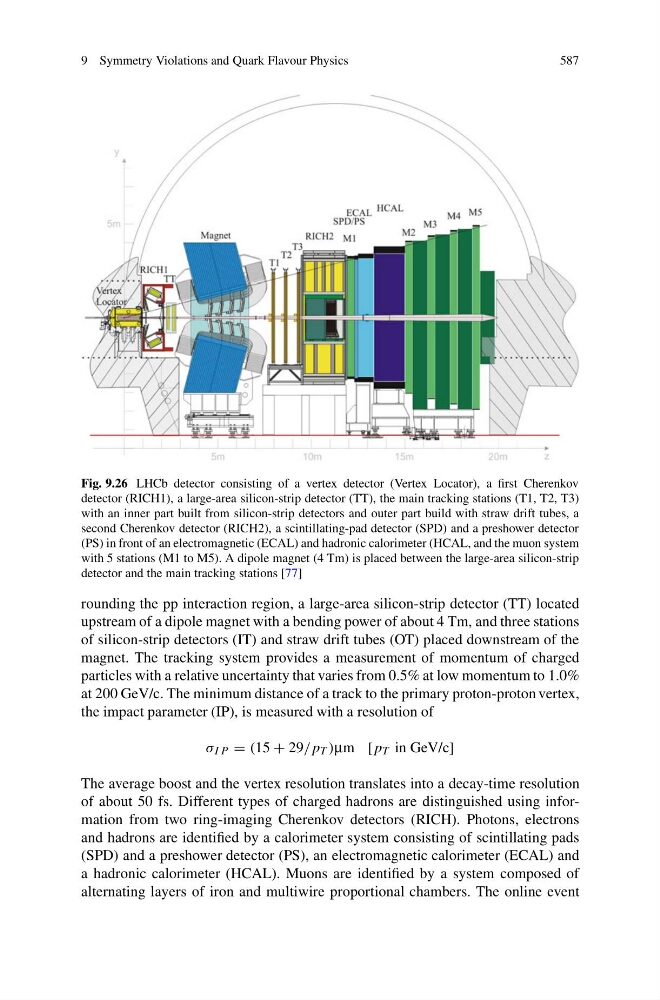
Fig. 9.26 LHCb detector consisting of a vertex detector (Vertex Locator), a first Cherenkov
detector (RICH1), a large-area silicon-strip detector (TT), the main tracking stations (T1, T2, T3)
with an inner part built from silicon-strip detectors and outer part build with straw drift tubes, a
second Cherenkov detector (RICH2), a scintillating-pad detector (SPD) and a preshower detector
(PS) in front of an electromagnetic (ECAL) and hadronic calorimeter (HCAL, and the muon system
with 5 stations (M1 to M5). A dipole magnet (4 Tm) is placed between the large-area silicon-strip
detector and the main tracking stations [77]
rounding the pp interaction region, a large-area silicon-strip detector (TT) located
upstream of a dipole magnet with a bending power of about 4 Tm, and three stations
of silicon-strip detectors (IT) and straw drift tubes (OT) placed downstream of the
magnet. The tracking system provides a measurement of momentum of charged
particles with a relative uncertainty that varies from 0.5% at low momentum to 1.0%
at 200 GeV/c. The minimum distance of a track to the primary proton-proton vertex,
the impact parameter (IP), is measured with a resolution of
σ I P = (15 + 29/p T )μm [p T in GeV/c]
The average boost and the vertex resolution translates into a decay-time resolution
of about 50 fs. Different types of charged hadrons are distinguished using information from two ring-imaging Cherenkov detectors (RICH). Photons, electrons
and hadrons are identified by a calorimeter system consisting of scintillating pads
(SPD) and a preshower detector (PS), an electromagnetic calorimeter (ECAL) and
a hadronic calorimeter (HCAL). Muons are identified by a system composed of
alternating layers of iron and multiwire proportional chambers. The online event
587
Fig. 9.26 LHCb detector consisting of a vertex detector (Vertex Locator), a first Cherenkov
detector (RICH1), a large-area silicon-strip detector (TT), the main tracking stations (T1, T2, T3)
with an inner part built from silicon-strip detectors and outer part build with straw drift tubes, a
second Cherenkov detector (RICH2), a scintillating-pad detector (SPD) and a preshower detector
(PS) in front of an electromagnetic (ECAL) and hadronic calorimeter (HCAL, and the muon system
with 5 stations (M1 to M5). A dipole magnet (4 Tm) is placed between the large-area silicon-strip
detector and the main tracking stations [77]
rounding the pp interaction region, a large-area silicon-strip detector (TT) located
upstream of a dipole magnet with a bending power of about 4 Tm, and three stations
of silicon-strip detectors (IT) and straw drift tubes (OT) placed downstream of the
magnet. The tracking system provides a measurement of momentum of charged
particles with a relative uncertainty that varies from 0.5% at low momentum to 1.0%
at 200 GeV/c. The minimum distance of a track to the primary proton-proton vertex,
the impact parameter (IP), is measured with a resolution of
σ I P = (15 + 29/p T )μm [p T in GeV/c]
The average boost and the vertex resolution translates into a decay-time resolution
of about 50 fs. Different types of charged hadrons are distinguished using information from two ring-imaging Cherenkov detectors (RICH). Photons, electrons
and hadrons are identified by a calorimeter system consisting of scintillating pads
(SPD) and a preshower detector (PS), an electromagnetic calorimeter (ECAL) and
a hadronic calorimeter (HCAL). Muons are identified by a system composed of
alternating layers of iron and multiwire proportional chambers. The online event