

562
K. Kleinknecht and U. Uwer
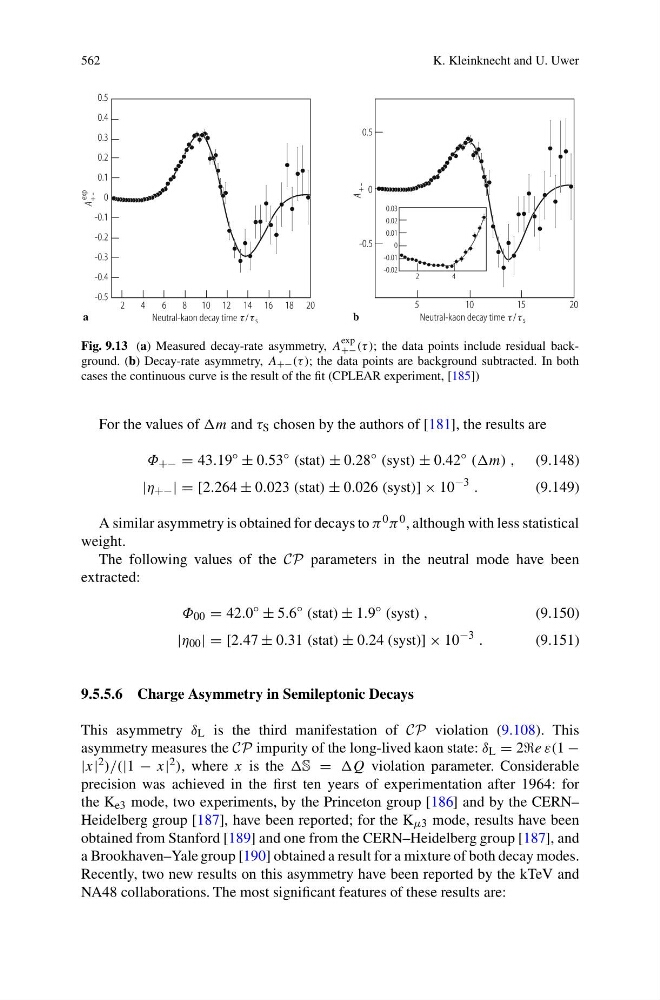
Fig. 9.13 (a) Measured decay-rate asymmetry, A
exp
+− (τ ); the data points include residual background. (b) Decay-rate asymmetry, A +− (τ ); the data points are background subtracted. In both
cases the continuous curve is the result of the fit (CPLEAR experiment, [185])
For the values of m and τ S chosen by the authors of [181], the results are
Φ +− = 43.19
◦
± 0.53
◦ (stat) ± 0.28
◦ (syst) ± 0.42
◦ ((m) , (9.148)
|η +− | = [2.264 ± 0.023 (stat) ± 0.026 (syst)] × 10
−3 .
(9.149)
A similar asymmetry is obtained for decays to π 0 π 0 , although with less statistical
weight.
The following values of the CP parameters in the neutral mode have been
extracted:
Φ 00 = 42.0
◦
± 5.6
◦ (stat) ± 1.9
◦ (syst) ,
(9.150)
|η 00 | = [2.47 ± 0.31 (stat) ± 0.24 (syst)] × 10
−3 .
(9.151)
9.5.5.6 Charge Asymmetry in Semileptonic Decays
This asymmetry δ L is the third manifestation of CP violation (9.108). This
asymmetry measures the CP impurity of the long-lived kaon state: δ L = 2e ε(1 −
|x| 2 )/(|1 − x| 2 ), where x is the S = Q violation parameter. Considerable
precision was achieved in the first ten years of experimentation after 1964: for
the K e3 mode, two experiments, by the Princeton group [186] and by the CERN–
Heidelberg group [187], have been reported; for the K μ3 mode, results have been
obtained from Stanford [189] and one from the CERN–Heidelberg group [187], and
a Brookhaven–Yale group [190] obtained a result for a mixture of both decay modes.
Recently, two new results on this asymmetry have been reported by the kTeV and
NA48 collaborations. The most significant features of these results are:
K. Kleinknecht and U. Uwer
Fig. 9.13 (a) Measured decay-rate asymmetry, A
exp
+− (τ ); the data points include residual background. (b) Decay-rate asymmetry, A +− (τ ); the data points are background subtracted. In both
cases the continuous curve is the result of the fit (CPLEAR experiment, [185])
For the values of m and τ S chosen by the authors of [181], the results are
Φ +− = 43.19
◦
± 0.53
◦ (stat) ± 0.28
◦ (syst) ± 0.42
◦ ((m) , (9.148)
|η +− | = [2.264 ± 0.023 (stat) ± 0.026 (syst)] × 10
−3 .
(9.149)
A similar asymmetry is obtained for decays to π 0 π 0 , although with less statistical
weight.
The following values of the CP parameters in the neutral mode have been
extracted:
Φ 00 = 42.0
◦
± 5.6
◦ (stat) ± 1.9
◦ (syst) ,
(9.150)
|η 00 | = [2.47 ± 0.31 (stat) ± 0.24 (syst)] × 10
−3 .
(9.151)
9.5.5.6 Charge Asymmetry in Semileptonic Decays
This asymmetry δ L is the third manifestation of CP violation (9.108). This
asymmetry measures the CP impurity of the long-lived kaon state: δ L = 2e ε(1 −
|x| 2 )/(|1 − x| 2 ), where x is the S = Q violation parameter. Considerable
precision was achieved in the first ten years of experimentation after 1964: for
the K e3 mode, two experiments, by the Princeton group [186] and by the CERN–
Heidelberg group [187], have been reported; for the K μ3 mode, results have been
obtained from Stanford [189] and one from the CERN–Heidelberg group [187], and
a Brookhaven–Yale group [190] obtained a result for a mixture of both decay modes.
Recently, two new results on this asymmetry have been reported by the kTeV and
NA48 collaborations. The most significant features of these results are: