

9 Symmetry Violations and Quark Flavour Physics
553
K Target
L
K Train Displacement
S
Proton beam dump
vacuum
He
muon veto
K Collimator
K Target
K Collimator
K Collimator
K Train
K Anticounter
L
50 m
50 cm
0
sweeping magnets
S
S
L
S
S
Kevlar window
liquid argon
calorimeter
Anticounter rings
transition radiation detector
beam dump
drift chamber 1
drift chamber 2
hadron
counters
calorimeter
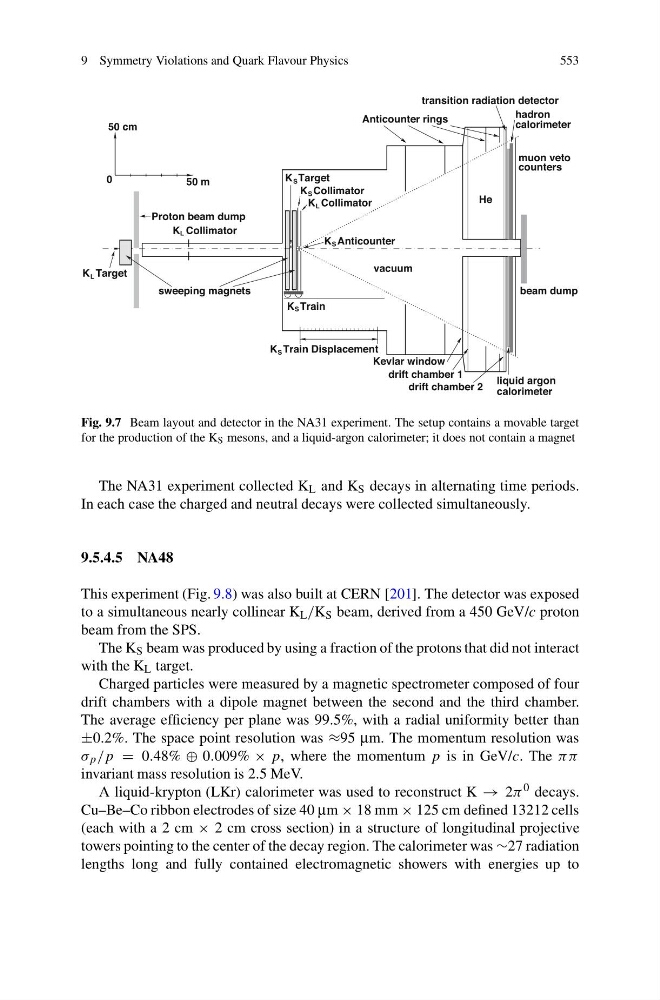
Fig. 9.7 Beam layout and detector in the NA31 experiment. The setup contains a movable target
for the production of the K S mesons, and a liquid-argon calorimeter; it does not contain a magnet
The NA31 experiment collected K L and K S decays in alternating time periods.
In each case the charged and neutral decays were collected simultaneously.
9.5.4.5 NA48
This experiment (Fig. 9.8) was also built at CERN [201]. The detector was exposed
to a simultaneous nearly collinear K L /K S beam, derived from a 450 GeV/c proton
beam from the SPS.
The K S beam was produced by using a fraction of the protons that did not interact
with the K L target.
Charged particles were measured by a magnetic spectrometer composed of four
drift chambers with a dipole magnet between the second and the third chamber.
The average efficiency per plane was 99.5%, with a radial uniformity better than
±0.2%. The space point resolution was ≈95 μm. The momentum resolution was
σ p /p = 0.48% ⊕ 0.009% × p, where the momentum p is in GeV/c. The ππ
invariant mass resolution is 2.5 MeV.
A liquid-krypton (LKr) calorimeter was used to reconstruct K → 2π 0 decays.
Cu–Be–Co ribbon electrodes of size 40 μm × 18 mm × 125 cm defined 13212 cells
(each with a 2 cm × 2 cm cross section) in a structure of longitudinal projective
towers pointing to the center of the decay region. The calorimeter was ∼27 radiation
lengths long and fully contained electromagnetic showers with energies up to
553
K Target
L
K Train Displacement
S
Proton beam dump
vacuum
He
muon veto
K Collimator
K Target
K Collimator
K Collimator
K Train
K Anticounter
L
50 m
50 cm
0
sweeping magnets
S
S
L
S
S
Kevlar window
liquid argon
calorimeter
Anticounter rings
transition radiation detector
beam dump
drift chamber 1
drift chamber 2
hadron
counters
calorimeter
Fig. 9.7 Beam layout and detector in the NA31 experiment. The setup contains a movable target
for the production of the K S mesons, and a liquid-argon calorimeter; it does not contain a magnet
The NA31 experiment collected K L and K S decays in alternating time periods.
In each case the charged and neutral decays were collected simultaneously.
9.5.4.5 NA48
This experiment (Fig. 9.8) was also built at CERN [201]. The detector was exposed
to a simultaneous nearly collinear K L /K S beam, derived from a 450 GeV/c proton
beam from the SPS.
The K S beam was produced by using a fraction of the protons that did not interact
with the K L target.
Charged particles were measured by a magnetic spectrometer composed of four
drift chambers with a dipole magnet between the second and the third chamber.
The average efficiency per plane was 99.5%, with a radial uniformity better than
±0.2%. The space point resolution was ≈95 μm. The momentum resolution was
σ p /p = 0.48% ⊕ 0.009% × p, where the momentum p is in GeV/c. The ππ
invariant mass resolution is 2.5 MeV.
A liquid-krypton (LKr) calorimeter was used to reconstruct K → 2π 0 decays.
Cu–Be–Co ribbon electrodes of size 40 μm × 18 mm × 125 cm defined 13212 cells
(each with a 2 cm × 2 cm cross section) in a structure of longitudinal projective
towers pointing to the center of the decay region. The calorimeter was ∼27 radiation
lengths long and fully contained electromagnetic showers with energies up to