

9 Symmetry Violations and Quark Flavour Physics
551
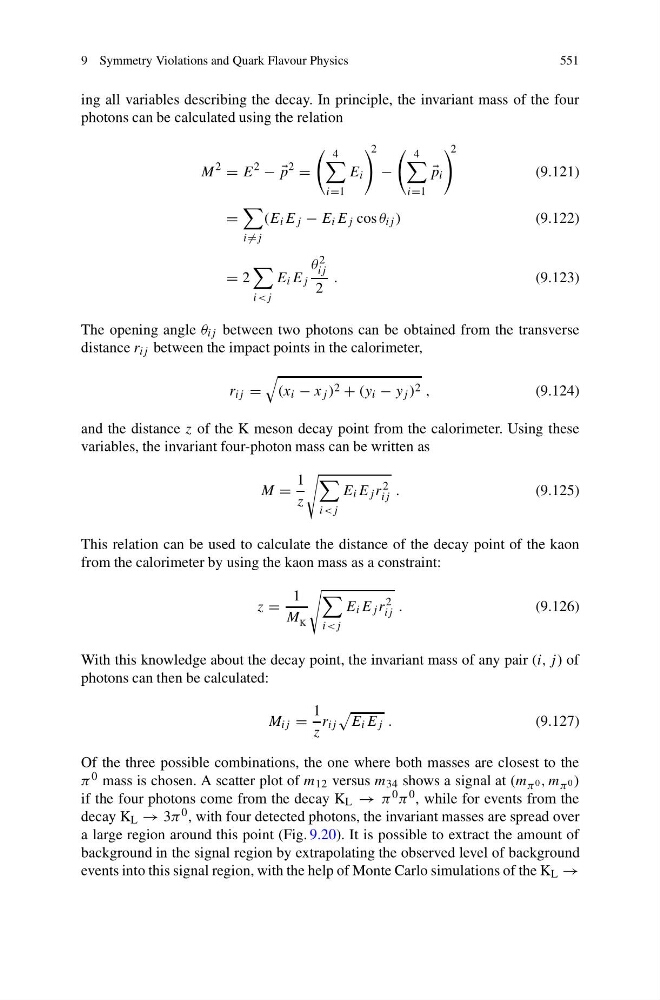
ing all variables describing the decay. In principle, the invariant mass of the four
photons can be calculated using the relation
M
2
= E
2
− −
p
2
=
4
i=1
E i
2
−
4
i=1
p i
2
(9.121)
=
i =j
(E i E j − E i E j cos θ ij )
(9.122)
= 2
i
θ 2
ij
2
.
(9.123)
The opening angle θ ij between two photons can be obtained from the transverse
distance r ij between the impact points in the calorimeter,
r ij =
(x i − x j ) 2 + (y i − y j ) 2 ,
(9.124)
and the distance z of the K meson decay point from the calorimeter. Using these
variables, the invariant four-photon mass can be written as
M =
1
z
i
ij .
(9.125)
This relation can be used to calculate the distance of the decay point of the kaon
from the calorimeter by using the kaon mass as a constraint:
z =
1
M K
i
ij .
(9.126)
With this knowledge about the decay point, the invariant mass of any pair (i, j ) of
photons can then be calculated:
M ij =
1
z
r ij
E i E j .
(9.127)
Of the three possible combinations, the one where both masses are closest to the
π 0 mass is chosen. A scatter plot of m 12 versus m 34 shows a signal at (m π 0 , m π 0 )
if the four photons come from the decay K L → π 0 π 0 , while for events from the
decay K L → 3π 0 , with four detected photons, the invariant masses are spread over
a large region around this point (Fig. 9.20). It is possible to extract the amount of
background in the signal region by extrapolating the observed level of background
events into this signal region, with the help of Monte Carlo simulations of the K L →
551
ing all variables describing the decay. In principle, the invariant mass of the four
photons can be calculated using the relation
M
2
= E
2
− −
p
2
=
4
i=1
E i
2
−
4
i=1
p i
2
(9.121)
=
i =j
(E i E j − E i E j cos θ ij )
(9.122)
= 2
i
θ 2
ij
2
.
(9.123)
The opening angle θ ij between two photons can be obtained from the transverse
distance r ij between the impact points in the calorimeter,
r ij =
(x i − x j ) 2 + (y i − y j ) 2 ,
(9.124)
and the distance z of the K meson decay point from the calorimeter. Using these
variables, the invariant four-photon mass can be written as
M =
1
z
i
ij .
(9.125)
This relation can be used to calculate the distance of the decay point of the kaon
from the calorimeter by using the kaon mass as a constraint:
z =
1
M K
i
ij .
(9.126)
With this knowledge about the decay point, the invariant mass of any pair (i, j ) of
photons can then be calculated:
M ij =
1
z
r ij
E i E j .
(9.127)
Of the three possible combinations, the one where both masses are closest to the
π 0 mass is chosen. A scatter plot of m 12 versus m 34 shows a signal at (m π 0 , m π 0 )
if the four photons come from the decay K L → π 0 π 0 , while for events from the
decay K L → 3π 0 , with four detected photons, the invariant masses are spread over
a large region around this point (Fig. 9.20). It is possible to extract the amount of
background in the signal region by extrapolating the observed level of background
events into this signal region, with the help of Monte Carlo simulations of the K L →