

9 Symmetry Violations and Quark Flavour Physics
549
9.5.4 Detection of K 0 Decays
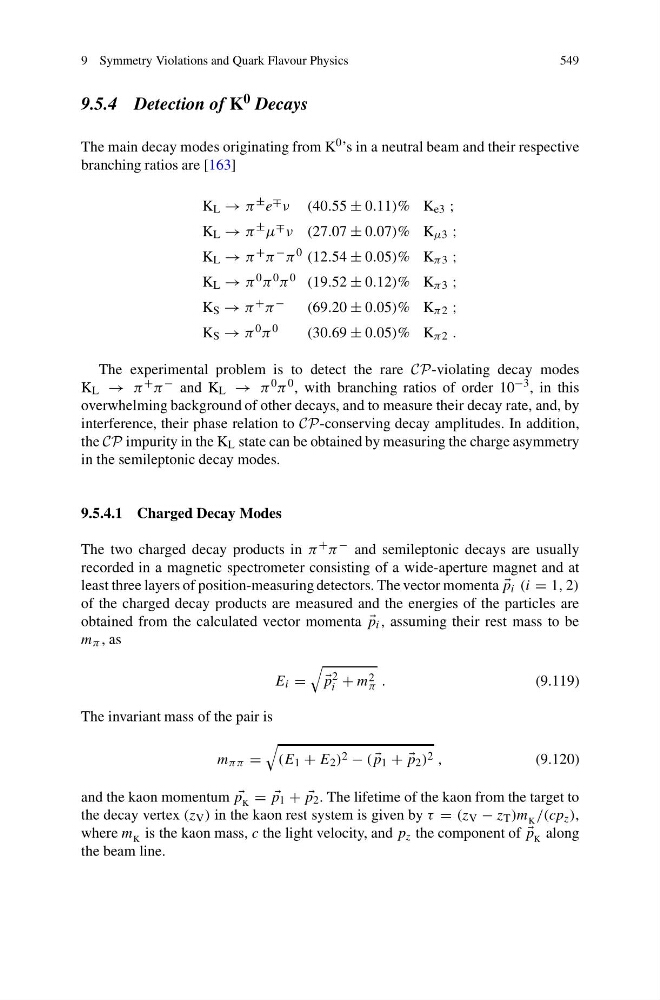
The main decay modes originating from K 0 ’s in a neutral beam and their respective
branching ratios are [163]
K L → π ± e ∓ ν (40.55 ± 0.11)% K e3 ;
K L → π ± μ ∓ ν (27.07 ± 0.07)% K μ3 ;
K L → π + π − π 0 (12.54 ± 0.05)% K π3 ;
K L → π 0 π 0 π 0 (19.52 ± 0.12)% K π3 ;
K S → π + π −
(69.20 ± 0.05)% K π2 ;
K S → π 0 π 0
(30.69 ± 0.05)% K π2 .
The experimental problem is to detect the rare CP-violating decay modes
K L → π + π − and K L → π 0 π 0 , with branching ratios of order 10 −3 , in this
overwhelming background of other decays, and to measure their decay rate, and, by
interference, their phase relation to CP-conserving decay amplitudes. In addition,
the CP impurity in the K L state can be obtained by measuring the charge asymmetry
in the semileptonic decay modes.
9.5.4.1 Charged Decay Modes
The two charged decay products in π + π − and semileptonic decays are usually
recorded in a magnetic spectrometer consisting of a wide-aperture magnet and at
least three layers of position-measuring detectors. The vector momenta
p i (i = 1, 2)
of the charged decay products are measured and the energies of the particles are
obtained from the calculated vector momenta
p i , assuming their rest mass to be
m π , as
E i =
p 2
i + m 2
π .
(9.119)
The invariant mass of the pair is
m ππ =
(E 1 + E 2 ) 2 − (
p 1 + +
p 2 ) 2 ,
(9.120)
and the kaon momentum
p K = =
p 1 + +
p 2 . The lifetime of the kaon from the target to
the decay vertex (z V ) in the kaon rest system is given by τ = (z V − z T )m K /(cp z ),
where m K is the kaon mass, c the light velocity, and p z the component of
p K along
the beam line.
549
9.5.4 Detection of K 0 Decays
The main decay modes originating from K 0 ’s in a neutral beam and their respective
branching ratios are [163]
K L → π ± e ∓ ν (40.55 ± 0.11)% K e3 ;
K L → π ± μ ∓ ν (27.07 ± 0.07)% K μ3 ;
K L → π + π − π 0 (12.54 ± 0.05)% K π3 ;
K L → π 0 π 0 π 0 (19.52 ± 0.12)% K π3 ;
K S → π + π −
(69.20 ± 0.05)% K π2 ;
K S → π 0 π 0
(30.69 ± 0.05)% K π2 .
The experimental problem is to detect the rare CP-violating decay modes
K L → π + π − and K L → π 0 π 0 , with branching ratios of order 10 −3 , in this
overwhelming background of other decays, and to measure their decay rate, and, by
interference, their phase relation to CP-conserving decay amplitudes. In addition,
the CP impurity in the K L state can be obtained by measuring the charge asymmetry
in the semileptonic decay modes.
9.5.4.1 Charged Decay Modes
The two charged decay products in π + π − and semileptonic decays are usually
recorded in a magnetic spectrometer consisting of a wide-aperture magnet and at
least three layers of position-measuring detectors. The vector momenta
p i (i = 1, 2)
of the charged decay products are measured and the energies of the particles are
obtained from the calculated vector momenta
p i , assuming their rest mass to be
m π , as
E i =
p 2
i + m 2
π .
(9.119)
The invariant mass of the pair is
m ππ =
(E 1 + E 2 ) 2 − (
p 1 + +
p 2 ) 2 ,
(9.120)
and the kaon momentum
p K = =
p 1 + +
p 2 . The lifetime of the kaon from the target to
the decay vertex (z V ) in the kaon rest system is given by τ = (z V − z T )m K /(cp z ),
where m K is the kaon mass, c the light velocity, and p z the component of
p K along
the beam line.