

520
K. Kleinknecht and U. Uwer
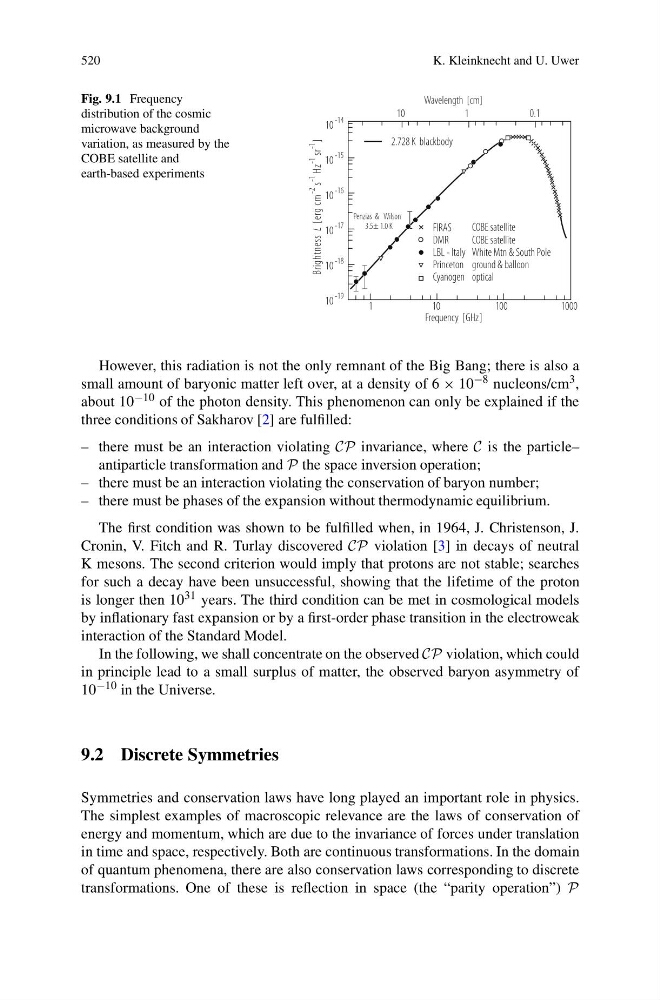
Fig. 9.1 Frequency
distribution of the cosmic
microwave background
variation, as measured by the
COBE satellite and
earth-based experiments
FIRAS
COBE satellite
DMR
COBE satellite
LBL - Italy White Mtn & South Pole
Princeton ground & balloon
Cyanogen optical
2.728 K blackbody
10
10
10
10
10
10
-14
-15
-16
-17
-18
-19
1
10
100
10
1
0.1
Wavelength [cm]
Frequency [GHz]
s
s
e
n
t
h
g
i
r
B m
c
g
r
e
[ ]
r
s
z H
s
L
1
-
1
- 1
-
2
-
Penzias & Wilson
3.5± 1.0 K
1000
However, this radiation is not the only remnant of the Big Bang; there is also a
small amount of baryonic matter left over, at a density of 6 × 10 −8 nucleons/cm 3 ,
about 10 −10 of the photon density. This phenomenon can only be explained if the
three conditions of Sakharov [2] are fulfilled:
– there must be an interaction violating CP invariance, where C is the particle–
antiparticle transformation and P the space inversion operation;
– there must be an interaction violating the conservation of baryon number;
– there must be phases of the expansion without thermodynamic equilibrium.
The first condition was shown to be fulfilled when, in 1964, J. Christenson, J.
Cronin, V. Fitch and R. Turlay discovered CP violation [3] in decays of neutral
K mesons. The second criterion would imply that protons are not stable; searches
for such a decay have been unsuccessful, showing that the lifetime of the proton
is longer then 10 31 years. The third condition can be met in cosmological models
by inflationary fast expansion or by a first-order phase transition in the electroweak
interaction of the Standard Model.
In the following, we shall concentrate on the observed CP violation, which could
in principle lead to a small surplus of matter, the observed baryon asymmetry of
10 −10 in the Universe.
9.2 Discrete Symmetries
Symmetries and conservation laws have long played an important role in physics.
The simplest examples of macroscopic relevance are the laws of conservation of
energy and momentum, which are due to the invariance of forces under translation
in time and space, respectively. Both are continuous transformations. In the domain
of quantum phenomena, there are also conservation laws corresponding to discrete
transformations. One of these is reflection in space (the “parity operation”) P
K. Kleinknecht and U. Uwer
Fig. 9.1 Frequency
distribution of the cosmic
microwave background
variation, as measured by the
COBE satellite and
earth-based experiments
FIRAS
COBE satellite
DMR
COBE satellite
LBL - Italy White Mtn & South Pole
Princeton ground & balloon
Cyanogen optical
2.728 K blackbody
10
10
10
10
10
10
-14
-15
-16
-17
-18
-19
1
10
100
10
1
0.1
Wavelength [cm]
Frequency [GHz]
s
s
e
n
t
h
g
i
r
B m
c
g
r
e
[ ]
r
s
z H
s
L
1
-
1
- 1
-
2
-
Penzias & Wilson
3.5± 1.0 K
1000
However, this radiation is not the only remnant of the Big Bang; there is also a
small amount of baryonic matter left over, at a density of 6 × 10 −8 nucleons/cm 3 ,
about 10 −10 of the photon density. This phenomenon can only be explained if the
three conditions of Sakharov [2] are fulfilled:
– there must be an interaction violating CP invariance, where C is the particle–
antiparticle transformation and P the space inversion operation;
– there must be an interaction violating the conservation of baryon number;
– there must be phases of the expansion without thermodynamic equilibrium.
The first condition was shown to be fulfilled when, in 1964, J. Christenson, J.
Cronin, V. Fitch and R. Turlay discovered CP violation [3] in decays of neutral
K mesons. The second criterion would imply that protons are not stable; searches
for such a decay have been unsuccessful, showing that the lifetime of the proton
is longer then 10 31 years. The third condition can be met in cosmological models
by inflationary fast expansion or by a first-order phase transition in the electroweak
interaction of the Standard Model.
In the following, we shall concentrate on the observed CP violation, which could
in principle lead to a small surplus of matter, the observed baryon asymmetry of
10 −10 in the Universe.
9.2 Discrete Symmetries
Symmetries and conservation laws have long played an important role in physics.
The simplest examples of macroscopic relevance are the laws of conservation of
energy and momentum, which are due to the invariance of forces under translation
in time and space, respectively. Both are continuous transformations. In the domain
of quantum phenomena, there are also conservation laws corresponding to discrete
transformations. One of these is reflection in space (the “parity operation”) P