

8 Beyond the Standard Model
499
symmetry group of the low energy Lagrangian consists of four dimensional general
coordinate invariance as well as a U(1) four dimensional gauge symmetry. This
result is obtained in the following manner [3].
The basic five dimensional gravitational action is thus given by:
ˆ
S =
1
2 ˆ
κ 2
d
5
ˆ
x
− ˆ
g ˆ
R
(8.127)
With ˆ
κ 2 being the five dimensional Newton constant. The action ˆ
S is invariant
under the fivedimensional general coordinate transformations
δ ˆ
g ˆ
μ ˆ
ν = ∂ ˆ
μ
ˆ
ξ
ˆ
ρ
ˆ
g ˆ
ρ ˆ
ν + ∂ ˆ
ν
ˆ
ξ
ˆ
ρ
ˆ
g ˆ
ρ ˆ
μ + ˆ
ξ
ˆ
ρ ∂ ˆ
ρ ˆ
g ˆ
μ ˆ
ν
(8.128)
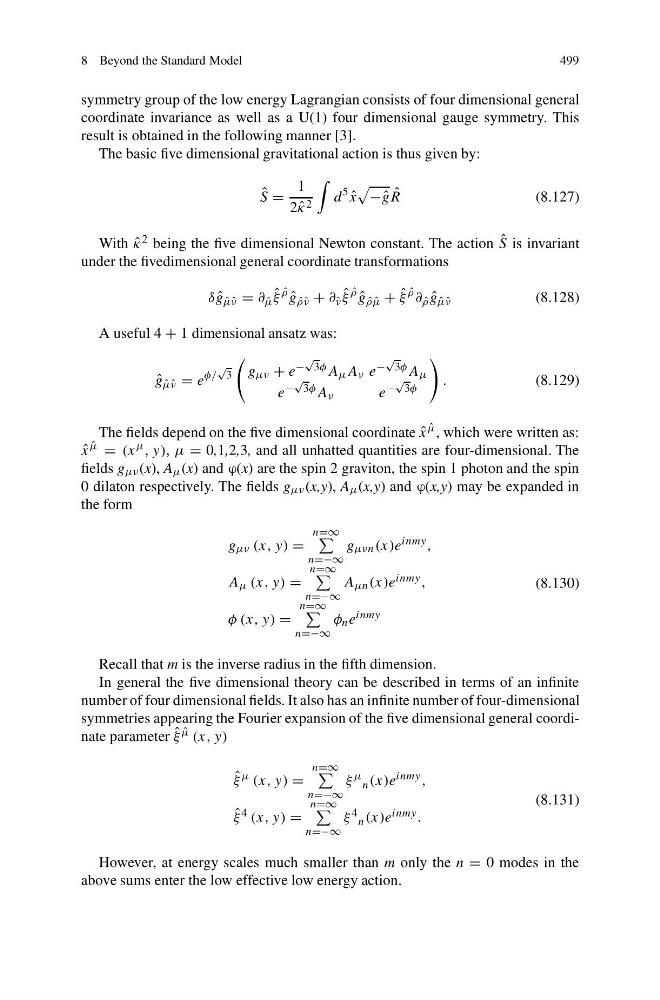
A useful 4 + 1 dimensional ansatz was:
ˆ
g ˆ
μˆ ν = e
φ/
√
3
g μν + e −
√
3φ A μ A ν e −
√
3φ A μ
e −
√
3φ A ν
e −
√
3φ
.
(8.129)
The fields depend on the five dimensional coordinate ˆ
x ˆ
μ , which were written as:
ˆ
x ˆ
μ = (x
μ , y), μ = 0,1,2,3, and all unhatted quantities are four-dimensional. The
fields g μν (x), A μ (x) and ϕ(x) are the spin 2 graviton, the spin 1 photon and the spin
0 dilaton respectively. The fields g μν (x,y), A μ (x,y) and ϕ(x,y) may be expanded in
the form
g μν (x, y) =
n=∞
n=−∞
g μνn (x)e inmy ,
A μ (x, y) =
n=∞
n=−∞
A μn (x)e inmy ,
φ (x, y) =
n=∞
n=−∞
φ n e inmy
(8.130)
Recall that m is the inverse radius in the fifth dimension.
In general the five dimensional theory can be described in terms of an infinite
number of four dimensional fields. It also has an infinite number of four-dimensional
symmetries appearing the Fourier expansion of the five dimensional general coordinate parameter ˆ
ξ ˆ
μ (x, y)
ˆ
ξ μ (x, y) =
n=∞
n=−∞
ξ μ
n (x)e inmy ,
ˆ
ξ 4 (x, y) =
n=∞
n=−∞
ξ 4
n (x)e inmy .
(8.131)
However, at energy scales much smaller than m only the n = 0 modes in the
above sums enter the low effective low energy action.
499
symmetry group of the low energy Lagrangian consists of four dimensional general
coordinate invariance as well as a U(1) four dimensional gauge symmetry. This
result is obtained in the following manner [3].
The basic five dimensional gravitational action is thus given by:
ˆ
S =
1
2 ˆ
κ 2
d
5
ˆ
x
− ˆ
g ˆ
R
(8.127)
With ˆ
κ 2 being the five dimensional Newton constant. The action ˆ
S is invariant
under the fivedimensional general coordinate transformations
δ ˆ
g ˆ
μ ˆ
ν = ∂ ˆ
μ
ˆ
ξ
ˆ
ρ
ˆ
g ˆ
ρ ˆ
ν + ∂ ˆ
ν
ˆ
ξ
ˆ
ρ
ˆ
g ˆ
ρ ˆ
μ + ˆ
ξ
ˆ
ρ ∂ ˆ
ρ ˆ
g ˆ
μ ˆ
ν
(8.128)
A useful 4 + 1 dimensional ansatz was:
ˆ
g ˆ
μˆ ν = e
φ/
√
3
g μν + e −
√
3φ A μ A ν e −
√
3φ A μ
e −
√
3φ A ν
e −
√
3φ
.
(8.129)
The fields depend on the five dimensional coordinate ˆ
x ˆ
μ , which were written as:
ˆ
x ˆ
μ = (x
μ , y), μ = 0,1,2,3, and all unhatted quantities are four-dimensional. The
fields g μν (x), A μ (x) and ϕ(x) are the spin 2 graviton, the spin 1 photon and the spin
0 dilaton respectively. The fields g μν (x,y), A μ (x,y) and ϕ(x,y) may be expanded in
the form
g μν (x, y) =
n=∞
n=−∞
g μνn (x)e inmy ,
A μ (x, y) =
n=∞
n=−∞
A μn (x)e inmy ,
φ (x, y) =
n=∞
n=−∞
φ n e inmy
(8.130)
Recall that m is the inverse radius in the fifth dimension.
In general the five dimensional theory can be described in terms of an infinite
number of four dimensional fields. It also has an infinite number of four-dimensional
symmetries appearing the Fourier expansion of the five dimensional general coordinate parameter ˆ
ξ ˆ
μ (x, y)
ˆ
ξ μ (x, y) =
n=∞
n=−∞
ξ μ
n (x)e inmy ,
ˆ
ξ 4 (x, y) =
n=∞
n=−∞
ξ 4
n (x)e inmy .
(8.131)
However, at energy scales much smaller than m only the n = 0 modes in the
above sums enter the low effective low energy action.