

8 Beyond the Standard Model
495
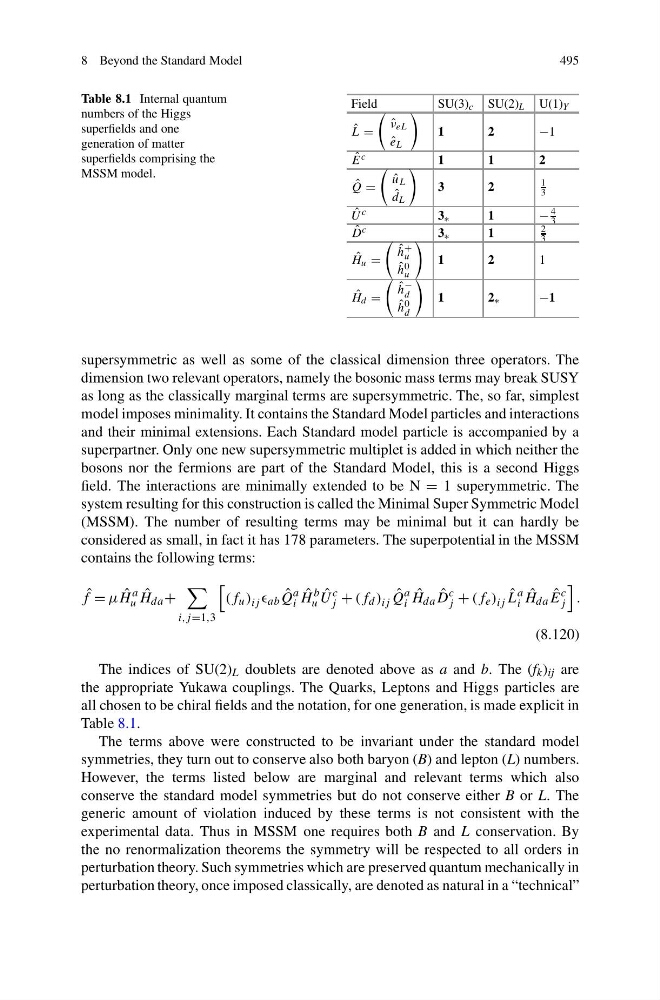
Table 8.1 Internal quantum
numbers of the Higgs
superfields and one
generation of matter
superfields comprising the
MSSM model.
Field
SU(3) c SU(2) L U(1) Y
ˆ
L =
ˆ
ν eL
ˆ
e L
1
2
−1
ˆ
E c
1
1
2
ˆ
Q =
ˆ
u L
ˆ
d L
3
2
1
3
ˆ
U c
3 ∗
1
−
4
3
ˆ
D c
3 ∗
1
2
3
ˆ
H u =
ˆ
h +
u
ˆ
h 0
u
1
2
1
ˆ
H d =
ˆ
h
−
d
ˆ
h
0
d
1
2 ∗
−1
supersymmetric as well as some of the classical dimension three operators. The
dimension two relevant operators, namely the bosonic mass terms may break SUSY
as long as the classically marginal terms are supersymmetric. The, so far, simplest
model imposes minimality. It contains the Standard Model particles and interactions
and their minimal extensions. Each Standard model particle is accompanied by a
superpartner. Only one new supersymmetric multiplet is added in which neither the
bosons nor the fermions are part of the Standard Model, this is a second Higgs
field. The interactions are minimally extended to be N = 1 superymmetric. The
system resulting for this construction is called the Minimal Super Symmetric Model
(MSSM). The number of resulting terms may be minimal but it can hardly be
considered as small, in fact it has 178 parameters. The superpotential in the MSSM
contains the following terms:
ˆ
f = μ ˆ
H
a
u
ˆ
H da +
i,j =1,3
(f u ) ij ab ˆ
Q
a
i
ˆ
H
b
u
ˆ
U
c
j + (f d ) ij ˆ
Q
a
i
ˆ
H da ˆ
D
c
j + (f e ) ij ˆ
L
a
i
ˆ
H da ˆ
E
c
j
.
(8.120)
The indices of SU(2) L doublets are denoted above as a and b. The (f k ) ij are
the appropriate Yukawa couplings. The Quarks, Leptons and Higgs particles are
all chosen to be chiral fields and the notation, for one generation, is made explicit in
Table 8.1.
The terms above were constructed to be invariant under the standard model
symmetries, they turn out to conserve also both baryon (B) and lepton (L) numbers.
However, the terms listed below are marginal and relevant terms which also
conserve the standard model symmetries but do not conserve either B or L. The
generic amount of violation induced by these terms is not consistent with the
experimental data. Thus in MSSM one requires both B and L conservation. By
the no renormalization theorems the symmetry will be respected to all orders in
perturbation theory. Such symmetries which are preserved quantum mechanically in
perturbation theory, once imposed classically, are denoted as natural in a “technical”
495
Table 8.1 Internal quantum
numbers of the Higgs
superfields and one
generation of matter
superfields comprising the
MSSM model.
Field
SU(3) c SU(2) L U(1) Y
ˆ
L =
ˆ
ν eL
ˆ
e L
1
2
−1
ˆ
E c
1
1
2
ˆ
Q =
ˆ
u L
ˆ
d L
3
2
1
3
ˆ
U c
3 ∗
1
−
4
3
ˆ
D c
3 ∗
1
2
3
ˆ
H u =
ˆ
h +
u
ˆ
h 0
u
1
2
1
ˆ
H d =
ˆ
h
−
d
ˆ
h
0
d
1
2 ∗
−1
supersymmetric as well as some of the classical dimension three operators. The
dimension two relevant operators, namely the bosonic mass terms may break SUSY
as long as the classically marginal terms are supersymmetric. The, so far, simplest
model imposes minimality. It contains the Standard Model particles and interactions
and their minimal extensions. Each Standard model particle is accompanied by a
superpartner. Only one new supersymmetric multiplet is added in which neither the
bosons nor the fermions are part of the Standard Model, this is a second Higgs
field. The interactions are minimally extended to be N = 1 superymmetric. The
system resulting for this construction is called the Minimal Super Symmetric Model
(MSSM). The number of resulting terms may be minimal but it can hardly be
considered as small, in fact it has 178 parameters. The superpotential in the MSSM
contains the following terms:
ˆ
f = μ ˆ
H
a
u
ˆ
H da +
i,j =1,3
(f u ) ij ab ˆ
Q
a
i
ˆ
H
b
u
ˆ
U
c
j + (f d ) ij ˆ
Q
a
i
ˆ
H da ˆ
D
c
j + (f e ) ij ˆ
L
a
i
ˆ
H da ˆ
E
c
j
.
(8.120)
The indices of SU(2) L doublets are denoted above as a and b. The (f k ) ij are
the appropriate Yukawa couplings. The Quarks, Leptons and Higgs particles are
all chosen to be chiral fields and the notation, for one generation, is made explicit in
Table 8.1.
The terms above were constructed to be invariant under the standard model
symmetries, they turn out to conserve also both baryon (B) and lepton (L) numbers.
However, the terms listed below are marginal and relevant terms which also
conserve the standard model symmetries but do not conserve either B or L. The
generic amount of violation induced by these terms is not consistent with the
experimental data. Thus in MSSM one requires both B and L conservation. By
the no renormalization theorems the symmetry will be respected to all orders in
perturbation theory. Such symmetries which are preserved quantum mechanically in
perturbation theory, once imposed classically, are denoted as natural in a “technical”