

486
E. Rabinovici
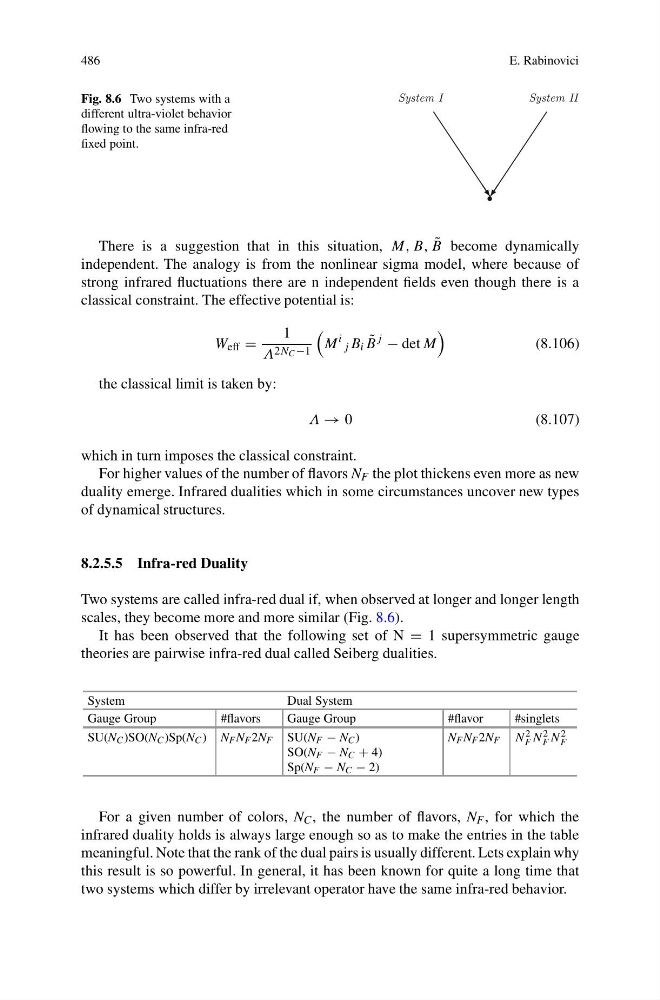
Fig. 8.6 Two systems with a
different ultra-violet behavior
flowing to the same infra-red
fixed point.
There is a suggestion that in this situation, M, B, ˜
B become dynamically
independent. The analogy is from the nonlinear sigma model, where because of
strong infrared fluctuations there are n independent fields even though there is a
classical constraint. The effective potential is:
W eff =
1
Λ 2N C −1
M
i
j B i ˜
B
j
− det M
(8.106)
the classical limit is taken by:
Λ → 0
(8.107)
which in turn imposes the classical constraint.
For higher values of the number of flavors N F the plot thickens even more as new
duality emerge. Infrared dualities which in some circumstances uncover new types
of dynamical structures.
8.2.5.5 Infra-red Duality
Two systems are called infra-red dual if, when observed at longer and longer length
scales, they become more and more similar (Fig. 8.6).
It has been observed that the following set of N = 1 supersymmetric gauge
theories are pairwise infra-red dual called Seiberg dualities.
System
Dual System
Gauge Group
#flavors
Gauge Group
#flavor
#singlets
SU(N C )SO(N C )Sp(N C ) N F N F 2N F SU(N F − N C )
SO(N F − N C + 4)
Sp(N F − N C − 2)
N F N F 2N F N 2
F N 2
F N 2
F
For a given number of colors, N C , the number of flavors, N F , for which the
infrared duality holds is always large enough so as to make the entries in the table
meaningful. Note that the rank of the dual pairs is usually different. Lets explain why
this result is so powerful. In general, it has been known for quite a long time that
two systems which differ by irrelevant operator have the same infra-red behavior.
E. Rabinovici
Fig. 8.6 Two systems with a
different ultra-violet behavior
flowing to the same infra-red
fixed point.
There is a suggestion that in this situation, M, B, ˜
B become dynamically
independent. The analogy is from the nonlinear sigma model, where because of
strong infrared fluctuations there are n independent fields even though there is a
classical constraint. The effective potential is:
W eff =
1
Λ 2N C −1
M
i
j B i ˜
B
j
− det M
(8.106)
the classical limit is taken by:
Λ → 0
(8.107)
which in turn imposes the classical constraint.
For higher values of the number of flavors N F the plot thickens even more as new
duality emerge. Infrared dualities which in some circumstances uncover new types
of dynamical structures.
8.2.5.5 Infra-red Duality
Two systems are called infra-red dual if, when observed at longer and longer length
scales, they become more and more similar (Fig. 8.6).
It has been observed that the following set of N = 1 supersymmetric gauge
theories are pairwise infra-red dual called Seiberg dualities.
System
Dual System
Gauge Group
#flavors
Gauge Group
#flavor
#singlets
SU(N C )SO(N C )Sp(N C ) N F N F 2N F SU(N F − N C )
SO(N F − N C + 4)
Sp(N F − N C − 2)
N F N F 2N F N 2
F N 2
F N 2
F
For a given number of colors, N C , the number of flavors, N F , for which the
infrared duality holds is always large enough so as to make the entries in the table
meaningful. Note that the rank of the dual pairs is usually different. Lets explain why
this result is so powerful. In general, it has been known for quite a long time that
two systems which differ by irrelevant operator have the same infra-red behavior.