

484
E. Rabinovici
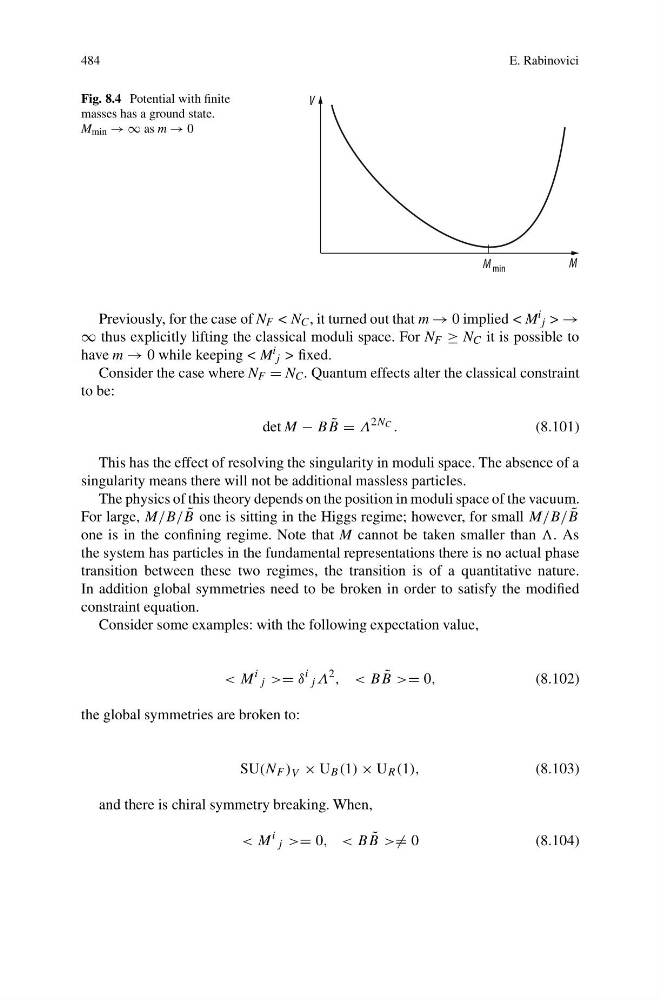
Fig. 8.4 Potential with finite
masses has a ground state.
M min → ∞ as m → 0
V
M
M min
Previously, for the case of N F < N C , it turned out that m → 0 implied < M i j > →
∞ thus explicitly lifting the classical moduli space. For N F ≥ N C it is possible to
have m → 0 while keeping < M i j > fixed.
Consider the case where N F = N C . Quantum effects alter the classical constraint
to be:
det M − B ˜
B = Λ
2N C .
(8.101)
This has the effect of resolving the singularity in moduli space. The absence of a
singularity means there will not be additional massless particles.
The physics of this theory depends on the position in moduli space of the vacuum.
For large, M/B/ ˜
B one is sitting in the Higgs regime; however, for small M/B/ ˜
B
one is in the confining regime. Note that M cannot be taken smaller than . As
the system has particles in the fundamental representations there is no actual phase
transition between these two regimes, the transition is of a quantitative nature.
In addition global symmetries need to be broken in order to satisfy the modified
constraint equation.
Consider some examples: with the following expectation value,
< M
i
j >= δ
i
j Λ
2 , < B ˜
B >= 0,
(8.102)
the global symmetries are broken to:
SU(N F ) V × U B (1) × U R (1),
(8.103)
and there is chiral symmetry breaking. When,
< M
i
j >= 0, < B ˜
B > = 0
(8.104)
E. Rabinovici
Fig. 8.4 Potential with finite
masses has a ground state.
M min → ∞ as m → 0
V
M
M min
Previously, for the case of N F < N C , it turned out that m → 0 implied < M i j > →
∞ thus explicitly lifting the classical moduli space. For N F ≥ N C it is possible to
have m → 0 while keeping < M i j > fixed.
Consider the case where N F = N C . Quantum effects alter the classical constraint
to be:
det M − B ˜
B = Λ
2N C .
(8.101)
This has the effect of resolving the singularity in moduli space. The absence of a
singularity means there will not be additional massless particles.
The physics of this theory depends on the position in moduli space of the vacuum.
For large, M/B/ ˜
B one is sitting in the Higgs regime; however, for small M/B/ ˜
B
one is in the confining regime. Note that M cannot be taken smaller than . As
the system has particles in the fundamental representations there is no actual phase
transition between these two regimes, the transition is of a quantitative nature.
In addition global symmetries need to be broken in order to satisfy the modified
constraint equation.
Consider some examples: with the following expectation value,
< M
i
j >= δ
i
j Λ
2 , < B ˜
B >= 0,
(8.102)
the global symmetries are broken to:
SU(N F ) V × U B (1) × U R (1),
(8.103)
and there is chiral symmetry breaking. When,
< M
i
j >= 0, < B ˜
B > = 0
(8.104)