

478
E. Rabinovici
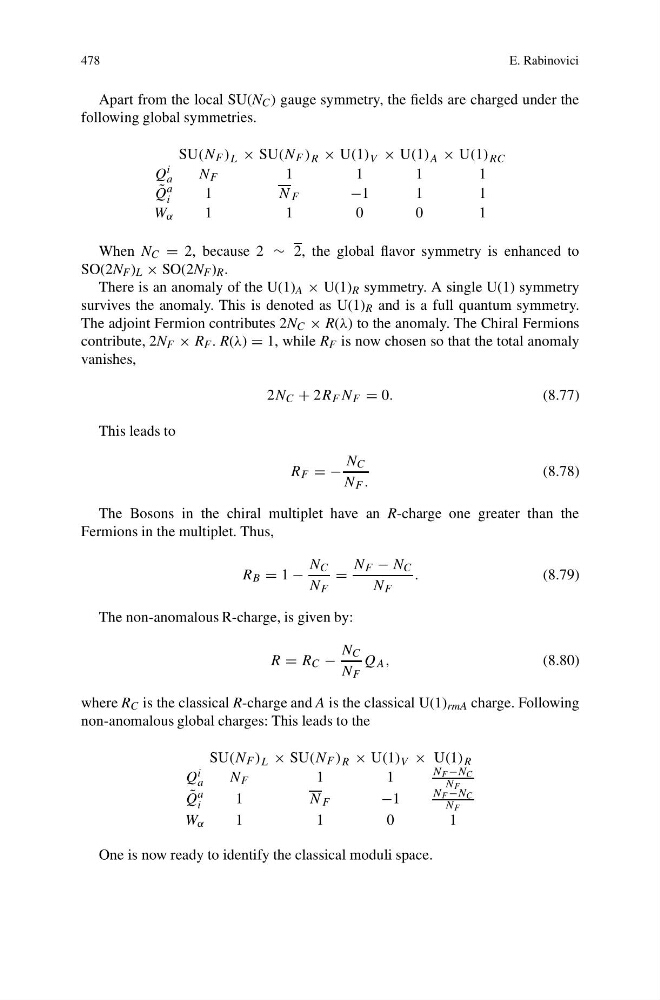
Apart from the local SU(N C ) gauge symmetry, the fields are charged under the
following global symmetries.
SU(N F ) L × SU(N F ) R × U(1) V × U(1) A × U(1) RC
Q i
a
N F
1
1
1
1
˜
Q
a
i
1
N F
−1
1
1
W α
1
1
0
0
1
When N C = 2, because 2 ∼ 2, the global flavor symmetry is enhanced to
SO(2N F ) L × SO(2N F ) R .
There is an anomaly of the U(1) A × U(1) R symmetry. A single U(1) symmetry
survives the anomaly. This is denoted as U(1) R and is a full quantum symmetry.
The adjoint Fermion contributes 2N C × R(λ) to the anomaly. The Chiral Fermions
contribute, 2N F × R F . R(λ) = 1, while R F is now chosen so that the total anomaly
vanishes,
2N C + 2R F N F = 0.
(8.77)
This leads to
R F = −
N C
N F .
(8.78)
The Bosons in the chiral multiplet have an R-charge one greater than the
Fermions in the multiplet. Thus,
R B = 1 −
N C
N F
=
N F − N C
N F
.
(8.79)
The non-anomalous R-charge, is given by:
R = R C −
N C
N F
Q A ,
(8.80)
where R C is the classical R-charge and A is the classical U(1) rmA charge. Following
non-anomalous global charges: This leads to the
SU(N F ) L × SU(N F ) R × U(1) V × U(1) R
Q i
a
N F
1
1
N F −N C
N F
˜
Q
a
i
1
N F
−1
N F −N C
N F
W α
1
1
0
1
One is now ready to identify the classical moduli space.
E. Rabinovici
Apart from the local SU(N C ) gauge symmetry, the fields are charged under the
following global symmetries.
SU(N F ) L × SU(N F ) R × U(1) V × U(1) A × U(1) RC
Q i
a
N F
1
1
1
1
˜
Q
a
i
1
N F
−1
1
1
W α
1
1
0
0
1
When N C = 2, because 2 ∼ 2, the global flavor symmetry is enhanced to
SO(2N F ) L × SO(2N F ) R .
There is an anomaly of the U(1) A × U(1) R symmetry. A single U(1) symmetry
survives the anomaly. This is denoted as U(1) R and is a full quantum symmetry.
The adjoint Fermion contributes 2N C × R(λ) to the anomaly. The Chiral Fermions
contribute, 2N F × R F . R(λ) = 1, while R F is now chosen so that the total anomaly
vanishes,
2N C + 2R F N F = 0.
(8.77)
This leads to
R F = −
N C
N F .
(8.78)
The Bosons in the chiral multiplet have an R-charge one greater than the
Fermions in the multiplet. Thus,
R B = 1 −
N C
N F
=
N F − N C
N F
.
(8.79)
The non-anomalous R-charge, is given by:
R = R C −
N C
N F
Q A ,
(8.80)
where R C is the classical R-charge and A is the classical U(1) rmA charge. Following
non-anomalous global charges: This leads to the
SU(N F ) L × SU(N F ) R × U(1) V × U(1) R
Q i
a
N F
1
1
N F −N C
N F
˜
Q
a
i
1
N F
−1
N F −N C
N F
W α
1
1
0
1
One is now ready to identify the classical moduli space.