

476
E. Rabinovici
( <<1)
T
( >>1)
T
( ~1)
T
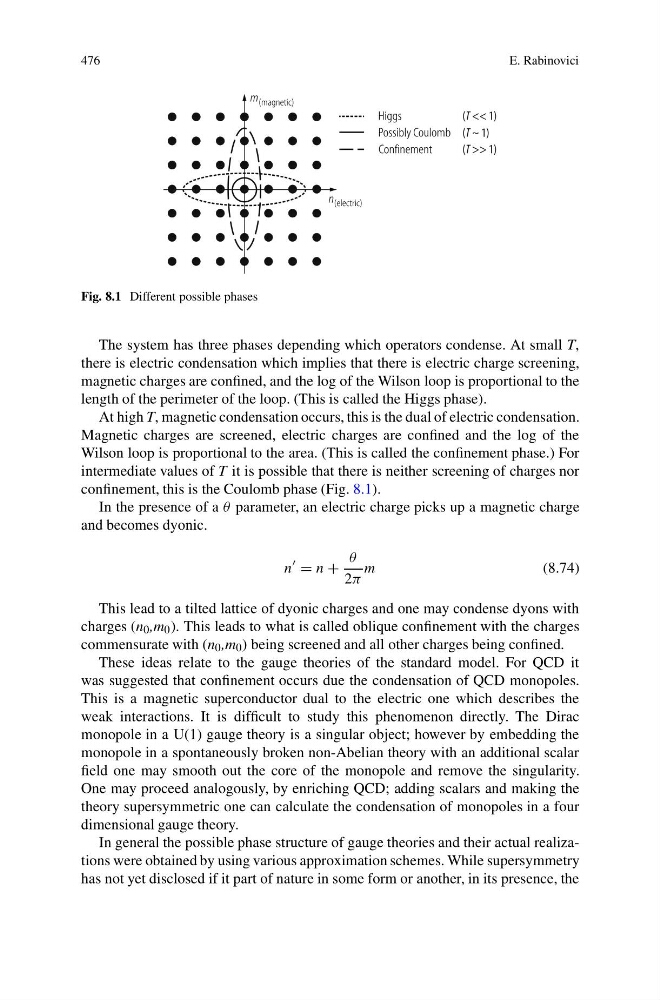
Fig. 8.1 Different possible phases
The system has three phases depending which operators condense. At small T,
there is electric condensation which implies that there is electric charge screening,
magnetic charges are confined, and the log of the Wilson loop is proportional to the
length of the perimeter of the loop. (This is called the Higgs phase).
At high T, magnetic condensation occurs, this is the dual of electric condensation.
Magnetic charges are screened, electric charges are confined and the log of the
Wilson loop is proportional to the area. (This is called the confinement phase.) For
intermediate values of T it is possible that there is neither screening of charges nor
confinement, this is the Coulomb phase (Fig. 8.1).
In the presence of a θ parameter, an electric charge picks up a magnetic charge
and becomes dyonic.
n
= n +
θ
2π
m
(8.74)
This lead to a tilted lattice of dyonic charges and one may condense dyons with
charges (n 0 ,m 0 ). This leads to what is called oblique confinement with the charges
commensurate with (n 0 ,m 0 ) being screened and all other charges being confined.
These ideas relate to the gauge theories of the standard model. For QCD it
was suggested that confinement occurs due the condensation of QCD monopoles.
This is a magnetic superconductor dual to the electric one which describes the
weak interactions. It is difficult to study this phenomenon directly. The Dirac
monopole in a U(1) gauge theory is a singular object; however by embedding the
monopole in a spontaneously broken non-Abelian theory with an additional scalar
field one may smooth out the core of the monopole and remove the singularity.
One may proceed analogously, by enriching QCD; adding scalars and making the
theory supersymmetric one can calculate the condensation of monopoles in a four
dimensional gauge theory.
In general the possible phase structure of gauge theories and their actual realizations were obtained by using various approximation schemes. While supersymmetry
has not yet disclosed if it part of nature in some form or another, in its presence, the
E. Rabinovici
( <<1)
T
( >>1)
T
( ~1)
T
Fig. 8.1 Different possible phases
The system has three phases depending which operators condense. At small T,
there is electric condensation which implies that there is electric charge screening,
magnetic charges are confined, and the log of the Wilson loop is proportional to the
length of the perimeter of the loop. (This is called the Higgs phase).
At high T, magnetic condensation occurs, this is the dual of electric condensation.
Magnetic charges are screened, electric charges are confined and the log of the
Wilson loop is proportional to the area. (This is called the confinement phase.) For
intermediate values of T it is possible that there is neither screening of charges nor
confinement, this is the Coulomb phase (Fig. 8.1).
In the presence of a θ parameter, an electric charge picks up a magnetic charge
and becomes dyonic.
n
= n +
θ
2π
m
(8.74)
This lead to a tilted lattice of dyonic charges and one may condense dyons with
charges (n 0 ,m 0 ). This leads to what is called oblique confinement with the charges
commensurate with (n 0 ,m 0 ) being screened and all other charges being confined.
These ideas relate to the gauge theories of the standard model. For QCD it
was suggested that confinement occurs due the condensation of QCD monopoles.
This is a magnetic superconductor dual to the electric one which describes the
weak interactions. It is difficult to study this phenomenon directly. The Dirac
monopole in a U(1) gauge theory is a singular object; however by embedding the
monopole in a spontaneously broken non-Abelian theory with an additional scalar
field one may smooth out the core of the monopole and remove the singularity.
One may proceed analogously, by enriching QCD; adding scalars and making the
theory supersymmetric one can calculate the condensation of monopoles in a four
dimensional gauge theory.
In general the possible phase structure of gauge theories and their actual realizations were obtained by using various approximation schemes. While supersymmetry
has not yet disclosed if it part of nature in some form or another, in its presence, the