

404
R. Stock
The WA98 SPS data, with thermal radiation enhancement indicated in the
interval 1.5 < p T < 3.5 GeV/c, thus remained as the sole evidence until,
more recently, the PHENIX experiment gained low p T data [246] exploiting the
fact that any source of real photons emits also virtual photons γ ∗ leading to
internal conversion to an e + e − pair (the Dalitz effect). To identify this yield the
invariant mass distribution of e + e − pairs is analyzed outside the phase space limits
of π 0 Dalitz decay; the decay pairs of all remaining hadron sources (η, ,) is
subtracted as a “cocktail”. The remaining pair yield is then converted assuming
γ ∗
dir /γ ∗
inclusive = γ dir /γ inclusive (see ref. [246] for detail), thus finally obtaining data
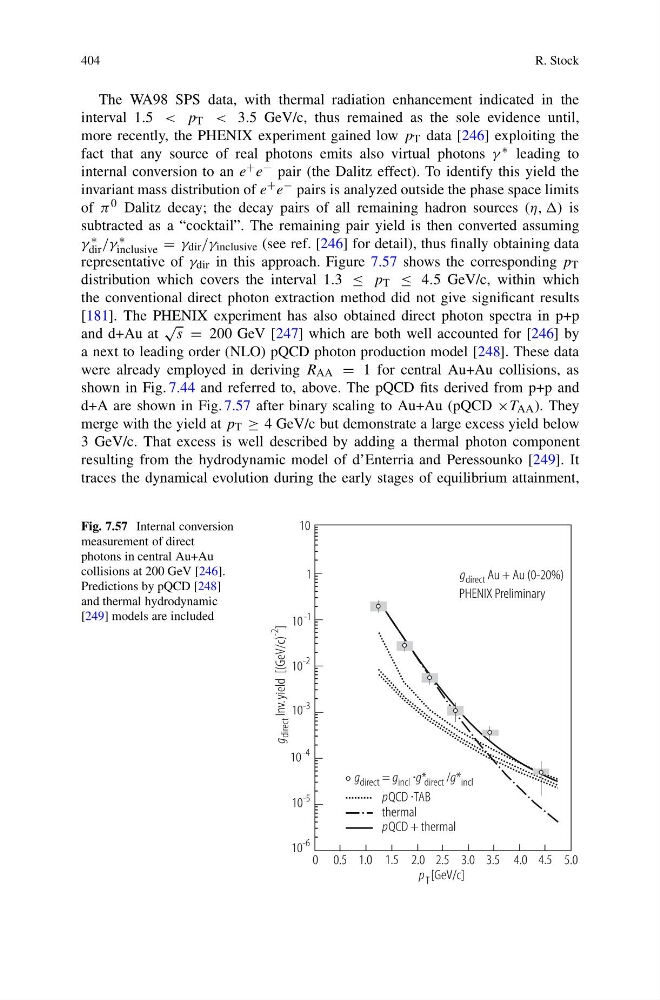
representative of γ dir in this approach. Figure 7.57 shows the corresponding p T
distribution which covers the interval 1.3 ≤ p T ≤ 4.5 GeV/c, within which
the conventional direct photon extraction method did not give significant results
[181]. The PHENIX experiment has also obtained direct photon spectra in p+p
and d+Au at
√
s = 200 GeV [247] which are both well accounted for [246] by
a next to leading order (NLO) pQCD photon production model [248]. These data
were already employed in deriving R AA = 1 for central Au+Au collisions, as
shown in Fig. 7.44 and referred to, above. The pQCD fits derived from p+p and
d+A are shown in Fig. 7.57 after binary scaling to Au+Au (pQCD ×T AA ). They
merge with the yield at p T ≥ 4 GeV/c but demonstrate a large excess yield below
3 GeV/c. That excess is well described by adding a thermal photon component
resulting from the hydrodynamic model of d’Enterria and Peressounko [249]. It
traces the dynamical evolution during the early stages of equilibrium attainment,
Fig. 7.57 Internal conversion
measurement of direct
photons in central Au+Au
collisions at 200 GeV [246].
Predictions by pQCD [248]
and thermal hydrodynamic
[249] models are included
R. Stock
The WA98 SPS data, with thermal radiation enhancement indicated in the
interval 1.5 < p T < 3.5 GeV/c, thus remained as the sole evidence until,
more recently, the PHENIX experiment gained low p T data [246] exploiting the
fact that any source of real photons emits also virtual photons γ ∗ leading to
internal conversion to an e + e − pair (the Dalitz effect). To identify this yield the
invariant mass distribution of e + e − pairs is analyzed outside the phase space limits
of π 0 Dalitz decay; the decay pairs of all remaining hadron sources (η, ,) is
subtracted as a “cocktail”. The remaining pair yield is then converted assuming
γ ∗
dir /γ ∗
inclusive = γ dir /γ inclusive (see ref. [246] for detail), thus finally obtaining data
representative of γ dir in this approach. Figure 7.57 shows the corresponding p T
distribution which covers the interval 1.3 ≤ p T ≤ 4.5 GeV/c, within which
the conventional direct photon extraction method did not give significant results
[181]. The PHENIX experiment has also obtained direct photon spectra in p+p
and d+Au at
√
s = 200 GeV [247] which are both well accounted for [246] by
a next to leading order (NLO) pQCD photon production model [248]. These data
were already employed in deriving R AA = 1 for central Au+Au collisions, as
shown in Fig. 7.44 and referred to, above. The pQCD fits derived from p+p and
d+A are shown in Fig. 7.57 after binary scaling to Au+Au (pQCD ×T AA ). They
merge with the yield at p T ≥ 4 GeV/c but demonstrate a large excess yield below
3 GeV/c. That excess is well described by adding a thermal photon component
resulting from the hydrodynamic model of d’Enterria and Peressounko [249]. It
traces the dynamical evolution during the early stages of equilibrium attainment,
Fig. 7.57 Internal conversion
measurement of direct
photons in central Au+Au
collisions at 200 GeV [246].
Predictions by pQCD [248]
and thermal hydrodynamic
[249] models are included