

398
R. Stock
photon signal thus becomes more promising the higher the initial temperature T i
which might reach up to 500–600 MeV at LHC energy.
Similar to photons, in medium created lepton pairs [225] escape essentially unattenuated as was shown for the Drell-Yan process, qq → LL by CERN experiment
NA38/NA50 [226]. Thermal di-lepton production in the mass region ≤ 1 GeV is
largely mediated by light vector mesons. Among these, the ρ meson is of particular
interest due to its short lifetime (1.3 fm/c), making it an ideal tracer (via its inmedium di-lepton decay) for the modification of hadrons composed of light quarks,
in the vicinity of T = T c . This modification signal is thus complementary to the
heavy quark charmonium J// suppression (break up) effect that sets in at T ≥ 1.5–
2T c (see below). Moreover, in addition to the deconfinement breakup mechanism
by QCD plasma Debye screening of the color force potential acting on the cc pair
[41], the QCD chiral symmetry restoration mechanism [227] can be studied via
in-medium modification of the ρ spectral function as T → T c . Note that the in
vacuum ρ mass and width properties are owed to non-perturbative QCD condensate
structures [1, 228] which spontaneously break the chiral symmetry of the QCD
Lagrangian, at T → 0. These properties should change, in the vicinity of T c , and be
reflected in modifications of the di-electron or di-myon decay spectra—unlike the
suppression effect on the J// which simply dissolves primordial cc pairs before
they can hadronize, a yes-no-effect whose onset with
√
s or centrality serves as a
plasma thermometer, by observing R AA or R CP < 1.
7.6.1 Charmonium Suppression
Due to the high charm and bottom quark masses, the “quarkonium” states of cc and
bb can be described in non-relativistic potential theory [229, 230], using
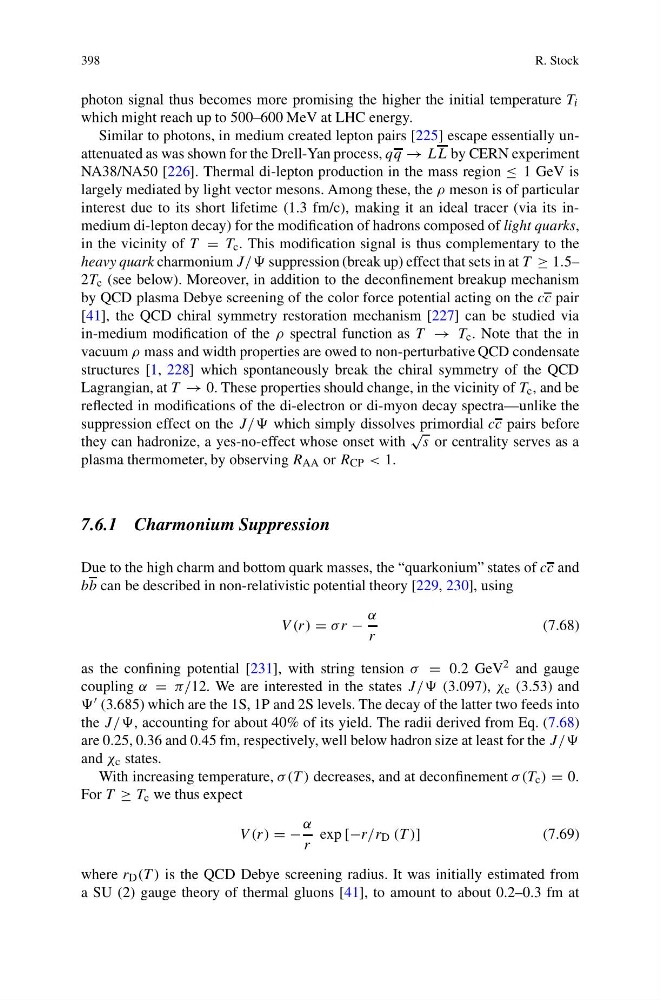
V (r) = σ r −
α
r
(7.68)
as the confining potential [231], with string tension σ = 0.2 GeV 2 and gauge
coupling α = π/12. We are interested in the states J// (3.097), χ c (3.53) and
(3.685) which are the 1S, 1P and 2S levels. The decay of the latter two feeds into
the J//, accounting for about 40% of its yield. The radii derived from Eq. (7.68)
are 0.25, 0.36 and 0.45 fm, respectively, well below hadron size at least for the J//
and χ c states.
With increasing temperature, σ (T ) decreases, and at deconfinement σ (T c ) = 0.
For T ≥ T c we thus expect
V (r) = −
α
r
exp [−r/r D (T )]
(7.69)
where r D (T ) is the QCD Debye screening radius. It was initially estimated from
a SU (2) gauge theory of thermal gluons [41], to amount to about 0.2–0.3 fm at
R. Stock
photon signal thus becomes more promising the higher the initial temperature T i
which might reach up to 500–600 MeV at LHC energy.
Similar to photons, in medium created lepton pairs [225] escape essentially unattenuated as was shown for the Drell-Yan process, qq → LL by CERN experiment
NA38/NA50 [226]. Thermal di-lepton production in the mass region ≤ 1 GeV is
largely mediated by light vector mesons. Among these, the ρ meson is of particular
interest due to its short lifetime (1.3 fm/c), making it an ideal tracer (via its inmedium di-lepton decay) for the modification of hadrons composed of light quarks,
in the vicinity of T = T c . This modification signal is thus complementary to the
heavy quark charmonium J// suppression (break up) effect that sets in at T ≥ 1.5–
2T c (see below). Moreover, in addition to the deconfinement breakup mechanism
by QCD plasma Debye screening of the color force potential acting on the cc pair
[41], the QCD chiral symmetry restoration mechanism [227] can be studied via
in-medium modification of the ρ spectral function as T → T c . Note that the in
vacuum ρ mass and width properties are owed to non-perturbative QCD condensate
structures [1, 228] which spontaneously break the chiral symmetry of the QCD
Lagrangian, at T → 0. These properties should change, in the vicinity of T c , and be
reflected in modifications of the di-electron or di-myon decay spectra—unlike the
suppression effect on the J// which simply dissolves primordial cc pairs before
they can hadronize, a yes-no-effect whose onset with
√
s or centrality serves as a
plasma thermometer, by observing R AA or R CP < 1.
7.6.1 Charmonium Suppression
Due to the high charm and bottom quark masses, the “quarkonium” states of cc and
bb can be described in non-relativistic potential theory [229, 230], using
V (r) = σ r −
α
r
(7.68)
as the confining potential [231], with string tension σ = 0.2 GeV 2 and gauge
coupling α = π/12. We are interested in the states J// (3.097), χ c (3.53) and
(3.685) which are the 1S, 1P and 2S levels. The decay of the latter two feeds into
the J//, accounting for about 40% of its yield. The radii derived from Eq. (7.68)
are 0.25, 0.36 and 0.45 fm, respectively, well below hadron size at least for the J//
and χ c states.
With increasing temperature, σ (T ) decreases, and at deconfinement σ (T c ) = 0.
For T ≥ T c we thus expect
V (r) = −
α
r
exp [−r/r D (T )]
(7.69)
where r D (T ) is the QCD Debye screening radius. It was initially estimated from
a SU (2) gauge theory of thermal gluons [41], to amount to about 0.2–0.3 fm at