

7 Relativistic Nucleus-Nucleus Collisions and the QCD Matter Phase Diagram
389
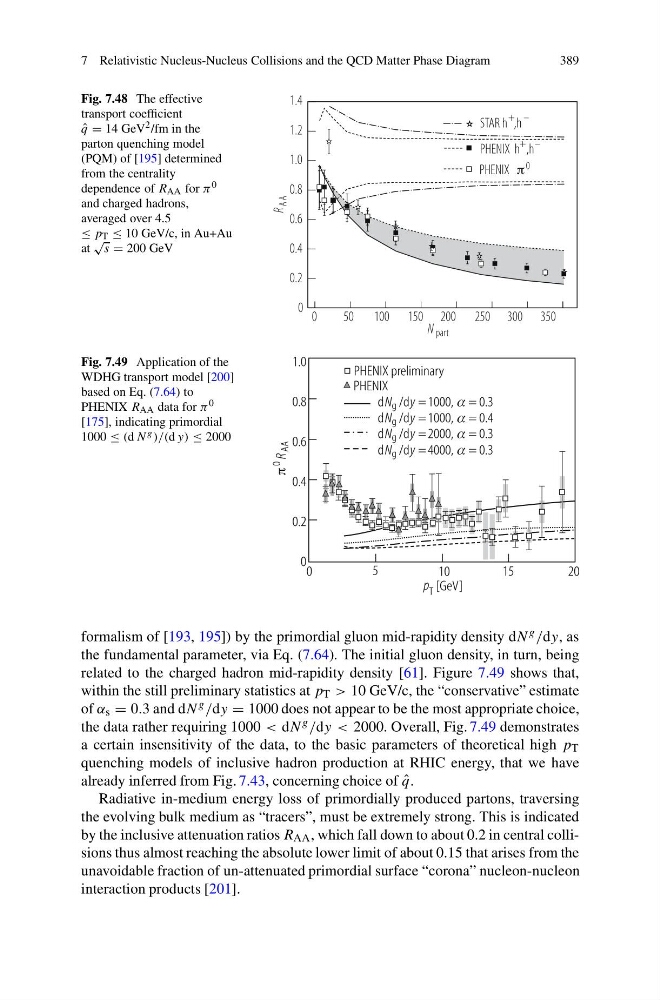
Fig. 7.48 The effective
transport coefficient
ˆ
q = 14 GeV 2 /fm in the
parton quenching model
(PQM) of [195] determined
from the centrality
dependence of R AA for π 0
and charged hadrons,
averaged over 4.5
≤ p T ≤ 10 GeV/c, in Au+Au
at
√
s = 200 GeV
1.4
1.2
1.0
0.8
0.6
0.4
0.2
0 0
50 100 150 200 250 300 350
N part
R A
A
STAR h ,h
+ –
PHENIX h ,h
+ –
PHENIX 0
Fig. 7.49 Application of the
WDHG transport model [200]
based on Eq. (7.64) to
PHENIX R AA data for π 0
[175], indicating primordial
1000 ≤ (d N g )/(d y) ≤ 2000
formalism of [193, 195]) by the primordial gluon mid-rapidity density dN g /dy, as
the fundamental parameter, via Eq. (7.64). The initial gluon density, in turn, being
related to the charged hadron mid-rapidity density [61]. Figure 7.49 shows that,
within the still preliminary statistics at p T > 10 GeV/c, the “conservative” estimate
of α s = 0.3 and dN g /dy = 1000 does not appear to be the most appropriate choice,
the data rather requiring 1000 < dN g /dy < 2000. Overall, Fig. 7.49 demonstrates
a certain insensitivity of the data, to the basic parameters of theoretical high p T
quenching models of inclusive hadron production at RHIC energy, that we have
already inferred from Fig. 7.43, concerning choice of ˆ
q.
Radiative in-medium energy loss of primordially produced partons, traversing
the evolving bulk medium as “tracers”, must be extremely strong. This is indicated
by the inclusive attenuation ratios R AA , which fall down to about 0.2 in central collisions thus almost reaching the absolute lower limit of about 0.15 that arises from the
unavoidable fraction of un-attenuated primordial surface “corona” nucleon-nucleon
interaction products [201].
389
Fig. 7.48 The effective
transport coefficient
ˆ
q = 14 GeV 2 /fm in the
parton quenching model
(PQM) of [195] determined
from the centrality
dependence of R AA for π 0
and charged hadrons,
averaged over 4.5
≤ p T ≤ 10 GeV/c, in Au+Au
at
√
s = 200 GeV
1.4
1.2
1.0
0.8
0.6
0.4
0.2
0 0
50 100 150 200 250 300 350
N part
R A
A
STAR h ,h
+ –
PHENIX h ,h
+ –
PHENIX 0
Fig. 7.49 Application of the
WDHG transport model [200]
based on Eq. (7.64) to
PHENIX R AA data for π 0
[175], indicating primordial
1000 ≤ (d N g )/(d y) ≤ 2000
formalism of [193, 195]) by the primordial gluon mid-rapidity density dN g /dy, as
the fundamental parameter, via Eq. (7.64). The initial gluon density, in turn, being
related to the charged hadron mid-rapidity density [61]. Figure 7.49 shows that,
within the still preliminary statistics at p T > 10 GeV/c, the “conservative” estimate
of α s = 0.3 and dN g /dy = 1000 does not appear to be the most appropriate choice,
the data rather requiring 1000 < dN g /dy < 2000. Overall, Fig. 7.49 demonstrates
a certain insensitivity of the data, to the basic parameters of theoretical high p T
quenching models of inclusive hadron production at RHIC energy, that we have
already inferred from Fig. 7.43, concerning choice of ˆ
q.
Radiative in-medium energy loss of primordially produced partons, traversing
the evolving bulk medium as “tracers”, must be extremely strong. This is indicated
by the inclusive attenuation ratios R AA , which fall down to about 0.2 in central collisions thus almost reaching the absolute lower limit of about 0.15 that arises from the
unavoidable fraction of un-attenuated primordial surface “corona” nucleon-nucleon
interaction products [201].