

386
R. Stock
where ρ is the color charge density of scattering centers, σ the effective binary
cross section for interaction of the considered leading parton at scale q 2 (which
may depend on quark flavor), and
q 2
T
as above. Obviously, both σ and
q 2
T
refer to
detailed, intrinsic properties of the QCD medium, globally described by density ρ.
The leading parton cross section with in-medium color charges should depend on
the implied resolution scale, Q 2 =
q 2
T
, and can thus be obtained from perturbative
QCD [186–188] only if Q 2 > Q 2
sat , the saturation scale that we discussed in
Sect. 7.2. Likewise,
q 2
T
itself reflects a medium property, the effective range of the
color force, which is different in confined and deconfined media. Hadron size limits
the force range in the former case, such that ˆ
q is minimal in ground state hadronic
matter also, of course, due to the small energy density ρ = ρ 0 = 0.15 GeV/fm 3
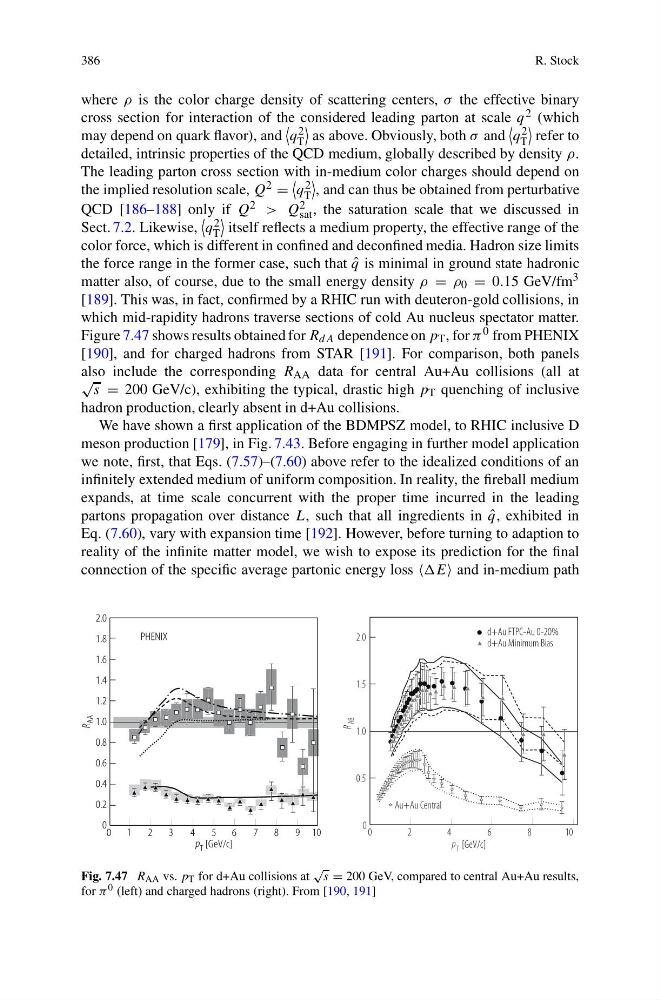
[189]. This was, in fact, confirmed by a RHIC run with deuteron-gold collisions, in
which mid-rapidity hadrons traverse sections of cold Au nucleus spectator matter.
Figure 7.47 shows results obtained for R dA dependence on p T , for π 0 from PHENIX
[190], and for charged hadrons from STAR [191]. For comparison, both panels
also include the corresponding R AA data for central Au+Au collisions (all at
√
s = 200 GeV/c), exhibiting the typical, drastic high p T quenching of inclusive
hadron production, clearly absent in d+Au collisions.
We have shown a first application of the BDMPSZ model, to RHIC inclusive D
meson production [179], in Fig. 7.43. Before engaging in further model application
we note, first, that Eqs. (7.57)–(7.60) above refer to the idealized conditions of an
infinitely extended medium of uniform composition. In reality, the fireball medium
expands, at time scale concurrent with the proper time incurred in the leading
partons propagation over distance L, such that all ingredients in ˆ
q, exhibited in
Eq. (7.60), vary with expansion time [192]. However, before turning to adaption to
reality of the infinite matter model, we wish to expose its prediction for the final
connection of the specific average partonic energy loss and in-medium path
p T [GeV/c]
R B
A
2.0
1.5
1.0
0.5
0 0
2
4
6
8
1 0
Au+Au Central
d+Au FTPC-Au 0-20%
d+Au Minimum Bias
Fig. 7.47 R AA vs. p T for d+Au collisions at
√
s = 200 GeV, compared to central Au+Au results,
for π 0 (left) and charged hadrons (right). From [190, 191]
R. Stock
where ρ is the color charge density of scattering centers, σ the effective binary
cross section for interaction of the considered leading parton at scale q 2 (which
may depend on quark flavor), and
q 2
T
as above. Obviously, both σ and
q 2
T
refer to
detailed, intrinsic properties of the QCD medium, globally described by density ρ.
The leading parton cross section with in-medium color charges should depend on
the implied resolution scale, Q 2 =
q 2
T
, and can thus be obtained from perturbative
QCD [186–188] only if Q 2 > Q 2
sat , the saturation scale that we discussed in
Sect. 7.2. Likewise,
q 2
T
itself reflects a medium property, the effective range of the
color force, which is different in confined and deconfined media. Hadron size limits
the force range in the former case, such that ˆ
q is minimal in ground state hadronic
matter also, of course, due to the small energy density ρ = ρ 0 = 0.15 GeV/fm 3
[189]. This was, in fact, confirmed by a RHIC run with deuteron-gold collisions, in
which mid-rapidity hadrons traverse sections of cold Au nucleus spectator matter.
Figure 7.47 shows results obtained for R dA dependence on p T , for π 0 from PHENIX
[190], and for charged hadrons from STAR [191]. For comparison, both panels
also include the corresponding R AA data for central Au+Au collisions (all at
√
s = 200 GeV/c), exhibiting the typical, drastic high p T quenching of inclusive
hadron production, clearly absent in d+Au collisions.
We have shown a first application of the BDMPSZ model, to RHIC inclusive D
meson production [179], in Fig. 7.43. Before engaging in further model application
we note, first, that Eqs. (7.57)–(7.60) above refer to the idealized conditions of an
infinitely extended medium of uniform composition. In reality, the fireball medium
expands, at time scale concurrent with the proper time incurred in the leading
partons propagation over distance L, such that all ingredients in ˆ
q, exhibited in
Eq. (7.60), vary with expansion time [192]. However, before turning to adaption to
reality of the infinite matter model, we wish to expose its prediction for the final
connection of the specific average partonic energy loss and in-medium path
p T [GeV/c]
R B
A
2.0
1.5
1.0
0.5
0 0
2
4
6
8
1 0
Au+Au Central
d+Au FTPC-Au 0-20%
d+Au Minimum Bias
Fig. 7.47 R AA vs. p T for d+Au collisions at
√
s = 200 GeV, compared to central Au+Au results,
for π 0 (left) and charged hadrons (right). From [190, 191]