

7 Relativistic Nucleus-Nucleus Collisions and the QCD Matter Phase Diagram
379
transverse energy and multiplicity density, also giving birth to hadrons, and to the
elliptic expansion flow signal.
An alternative approach toward QCD plasma diagnostics exploits the idea
[41, 172] of implanting partonic products of primordial high Q 2 processes into the
evolving bulk medium, that could serve as “tracers” of the surrounding, co-traveling
matter. The ideal situation, of being able to scatter well defined partons, or electrons,
from a plasma fireball, is approximated by employing primordially formed charmanticharm quark pairs [41], or leading partons from primordial di-jet production
[172]. Both processes are firmly anchored in perturbative QCD and well studied in
elementary collisions (where such partons are directly released into vacuum), which
thus serve as a reference in an analysis that quantifies the in-medium modification
of such tracer partons. Not a surprise, in view of our above inferences, from elliptic
flow, of a high temperature, strongly coupled primordial medium: these in-medium
modifications are quite dramatic, leading to a suppression of J// production from
primordial cc pairs (Sect. 7.6), and to high p T hadron and jet quenching, the subject
of this chapter.
7.5.1 High p T Inclusive Hadron Production Quenching
At top RHIC energy,
√
s = 200 GeV, di-jet production from primordial hard pQCD
parton-parton collisions (of partons from the initial baryonic structure functions) is
the source of “leading” partons, with E T up to about 30 GeV. They are derived from
the inclusive cross section arising if the A+A collision is considered, first, as an
incoherent superposition of independent nucleon-nucleon collisions, as enveloped
within the target-projectile nucleon densities. In this framework, the pQCD cross
section for producing an E T parton in A+B takes the form of “factorization” [173]
dσ
dE T dy
=
a,b
x a
dx a
x b
dx b f a/A (x a )f b/B (x b )
dσ ab
dE T dy
(7.51)
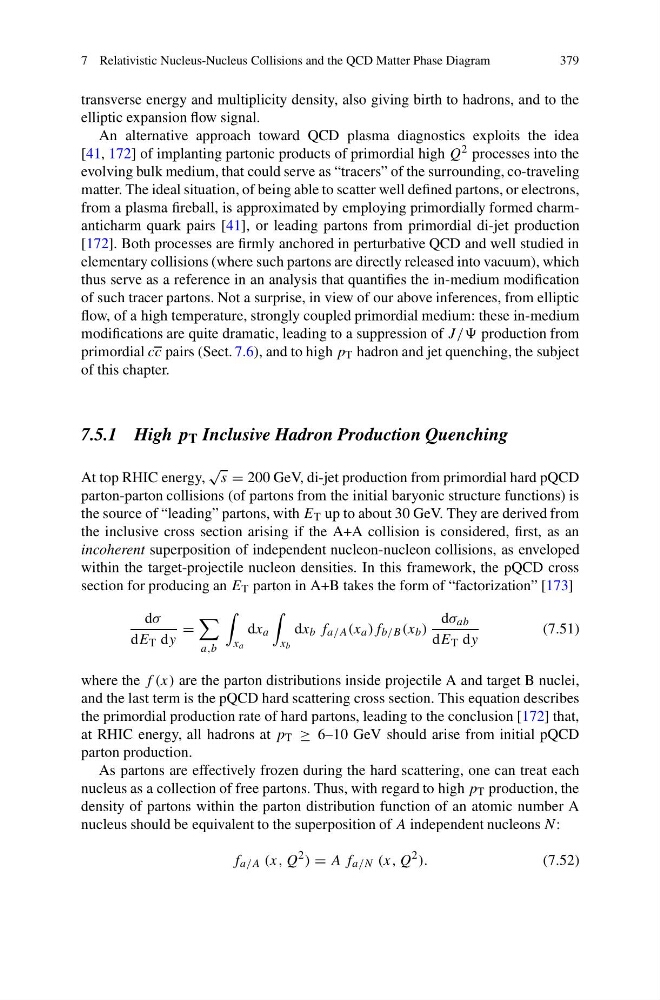
where the f (x) are the parton distributions inside projectile A and target B nuclei,
and the last term is the pQCD hard scattering cross section. This equation describes
the primordial production rate of hard partons, leading to the conclusion [172] that,
at RHIC energy, all hadrons at p T ≥ 6–10 GeV should arise from initial pQCD
parton production.
As partons are effectively frozen during the hard scattering, one can treat each
nucleus as a collection of free partons. Thus, with regard to high p T production, the
density of partons within the parton distribution function of an atomic number A
nucleus should be equivalent to the superposition of A independent nucleons N:
f a/A (x, Q
2 ) = A f a/N (x, Q
2 ).
(7.52)
379
transverse energy and multiplicity density, also giving birth to hadrons, and to the
elliptic expansion flow signal.
An alternative approach toward QCD plasma diagnostics exploits the idea
[41, 172] of implanting partonic products of primordial high Q 2 processes into the
evolving bulk medium, that could serve as “tracers” of the surrounding, co-traveling
matter. The ideal situation, of being able to scatter well defined partons, or electrons,
from a plasma fireball, is approximated by employing primordially formed charmanticharm quark pairs [41], or leading partons from primordial di-jet production
[172]. Both processes are firmly anchored in perturbative QCD and well studied in
elementary collisions (where such partons are directly released into vacuum), which
thus serve as a reference in an analysis that quantifies the in-medium modification
of such tracer partons. Not a surprise, in view of our above inferences, from elliptic
flow, of a high temperature, strongly coupled primordial medium: these in-medium
modifications are quite dramatic, leading to a suppression of J// production from
primordial cc pairs (Sect. 7.6), and to high p T hadron and jet quenching, the subject
of this chapter.
7.5.1 High p T Inclusive Hadron Production Quenching
At top RHIC energy,
√
s = 200 GeV, di-jet production from primordial hard pQCD
parton-parton collisions (of partons from the initial baryonic structure functions) is
the source of “leading” partons, with E T up to about 30 GeV. They are derived from
the inclusive cross section arising if the A+A collision is considered, first, as an
incoherent superposition of independent nucleon-nucleon collisions, as enveloped
within the target-projectile nucleon densities. In this framework, the pQCD cross
section for producing an E T parton in A+B takes the form of “factorization” [173]
dσ
dE T dy
=
a,b
x a
dx a
x b
dx b f a/A (x a )f b/B (x b )
dσ ab
dE T dy
(7.51)
where the f (x) are the parton distributions inside projectile A and target B nuclei,
and the last term is the pQCD hard scattering cross section. This equation describes
the primordial production rate of hard partons, leading to the conclusion [172] that,
at RHIC energy, all hadrons at p T ≥ 6–10 GeV should arise from initial pQCD
parton production.
As partons are effectively frozen during the hard scattering, one can treat each
nucleus as a collection of free partons. Thus, with regard to high p T production, the
density of partons within the parton distribution function of an atomic number A
nucleus should be equivalent to the superposition of A independent nucleons N:
f a/A (x, Q
2 ) = A f a/N (x, Q
2 ).
(7.52)