

370
R. Stock
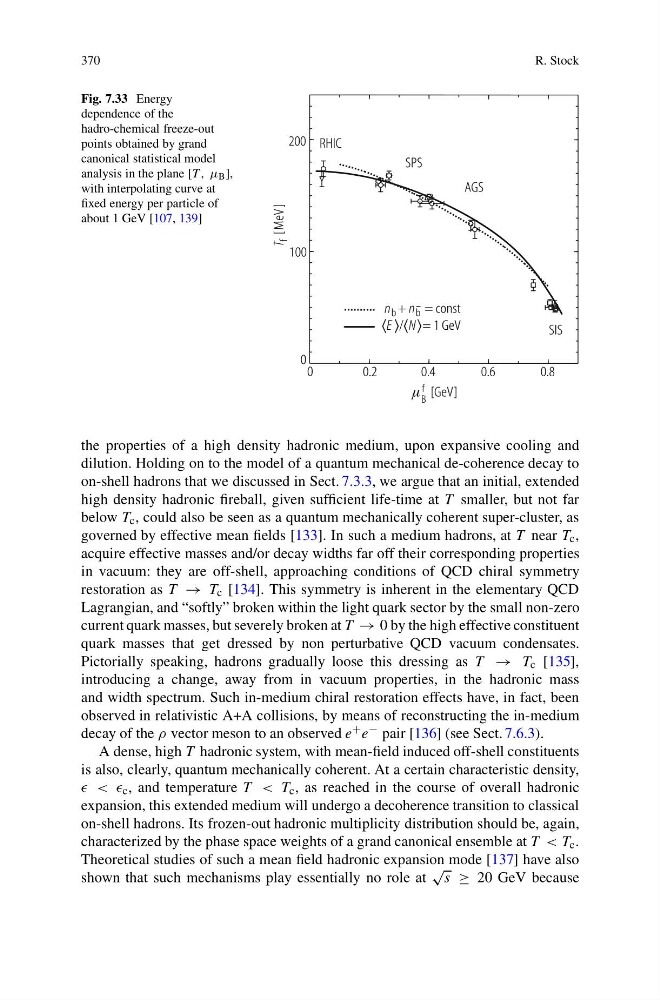
Fig. 7.33 Energy
dependence of the
hadro-chemical freeze-out
points obtained by grand
canonical statistical model
analysis in the plane [T , μ B ],
with interpolating curve at
fixed energy per particle of
about 1 GeV [107, 139]
the properties of a high density hadronic medium, upon expansive cooling and
dilution. Holding on to the model of a quantum mechanical de-coherence decay to
on-shell hadrons that we discussed in Sect. 7.3.3, we argue that an initial, extended
high density hadronic fireball, given sufficient life-time at T smaller, but not far
below T c , could also be seen as a quantum mechanically coherent super-cluster, as
governed by effective mean fields [133]. In such a medium hadrons, at T near T c ,
acquire effective masses and/or decay widths far off their corresponding properties
in vacuum: they are off-shell, approaching conditions of QCD chiral symmetry
restoration as T → T c [134]. This symmetry is inherent in the elementary QCD
Lagrangian, and “softly” broken within the light quark sector by the small non-zero
current quark masses, but severely broken at T → 0 by the high effective constituent
quark masses that get dressed by non perturbative QCD vacuum condensates.
Pictorially speaking, hadrons gradually loose this dressing as T → T c [135],
introducing a change, away from in vacuum properties, in the hadronic mass
and width spectrum. Such in-medium chiral restoration effects have, in fact, been
observed in relativistic A+A collisions, by means of reconstructing the in-medium
decay of the ρ vector meson to an observed e + e − pair [136] (see Sect. 7.6.3).
A dense, high T hadronic system, with mean-field induced off-shell constituents
is also, clearly, quantum mechanically coherent. At a certain characteristic density,
< < c , and temperature T < T c , as reached in the course of overall hadronic
expansion, this extended medium will undergo a decoherence transition to classical
on-shell hadrons. Its frozen-out hadronic multiplicity distribution should be, again,
characterized by the phase space weights of a grand canonical ensemble at T < T c .
Theoretical studies of such a mean field hadronic expansion mode [137] have also
shown that such mechanisms play essentially no role at
√
s ≥ 20 GeV because
R. Stock
Fig. 7.33 Energy
dependence of the
hadro-chemical freeze-out
points obtained by grand
canonical statistical model
analysis in the plane [T , μ B ],
with interpolating curve at
fixed energy per particle of
about 1 GeV [107, 139]
the properties of a high density hadronic medium, upon expansive cooling and
dilution. Holding on to the model of a quantum mechanical de-coherence decay to
on-shell hadrons that we discussed in Sect. 7.3.3, we argue that an initial, extended
high density hadronic fireball, given sufficient life-time at T smaller, but not far
below T c , could also be seen as a quantum mechanically coherent super-cluster, as
governed by effective mean fields [133]. In such a medium hadrons, at T near T c ,
acquire effective masses and/or decay widths far off their corresponding properties
in vacuum: they are off-shell, approaching conditions of QCD chiral symmetry
restoration as T → T c [134]. This symmetry is inherent in the elementary QCD
Lagrangian, and “softly” broken within the light quark sector by the small non-zero
current quark masses, but severely broken at T → 0 by the high effective constituent
quark masses that get dressed by non perturbative QCD vacuum condensates.
Pictorially speaking, hadrons gradually loose this dressing as T → T c [135],
introducing a change, away from in vacuum properties, in the hadronic mass
and width spectrum. Such in-medium chiral restoration effects have, in fact, been
observed in relativistic A+A collisions, by means of reconstructing the in-medium
decay of the ρ vector meson to an observed e + e − pair [136] (see Sect. 7.6.3).
A dense, high T hadronic system, with mean-field induced off-shell constituents
is also, clearly, quantum mechanically coherent. At a certain characteristic density,
< < c , and temperature T < T c , as reached in the course of overall hadronic
expansion, this extended medium will undergo a decoherence transition to classical
on-shell hadrons. Its frozen-out hadronic multiplicity distribution should be, again,
characterized by the phase space weights of a grand canonical ensemble at T < T c .
Theoretical studies of such a mean field hadronic expansion mode [137] have also
shown that such mechanisms play essentially no role at
√
s ≥ 20 GeV because