

368
R. Stock
involves an idealization because in the real Pb+Pb collision the intersecting dilute
surface sections of the nuclear density profiles will lead to a significant contribution
of single-scattering NN collisions, outside the central high density fireball. The
leading hadron properties of such “corona collisions” result in wider proper rapidity
distributions, quite different from those of the central fireball decay hadrons.
Their contribution will thus be prominent near target/projectile rapidity, and will
feature a canonically suppressed strangeness. The one-fireball assumption, although
inevitable at small y, does not quite resemble the physical reality. This may
explain the need for an additional strangeness suppression factor in the GC oneparticle partition function (Eq. (7.32)) that has, unfortunately, also been labeled γ s
but expresses physics reasons quite different from the extra suppression factor that
reflects micro-canonical phase space constraints in elementary collisions. It turns
out that all GC analysis of central A+A collisions at low
√
s, and addressed to total
4π multiplicities, requires a γ s of 0.7–0.85 [19]; in the fit of Fig. 7.25 γ s = 0.84.
At RHIC, ≈ 11 i , and such difficulties disappear: γ s ≈ 1 at midrapidity
and, moreover, the wide gap permits a SHM analysis which is differential in y.
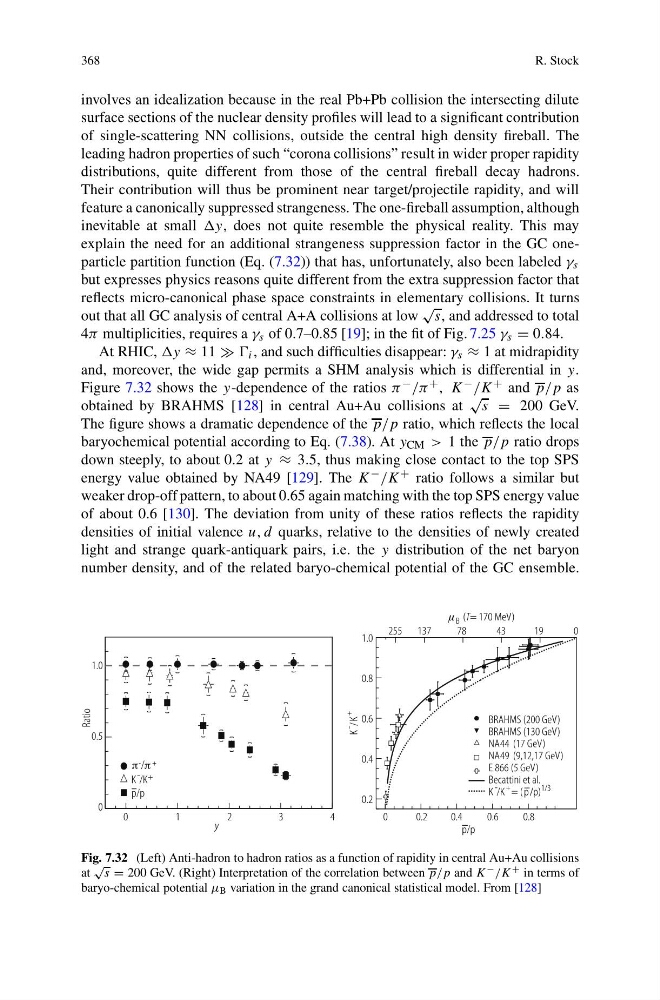
Figure 7.32 shows the y-dependence of the ratios π − /π + , K − /K + and p/p as
obtained by BRAHMS [128] in central Au+Au collisions at
√
s = 200 GeV.
The figure shows a dramatic dependence of the p/p ratio, which reflects the local
baryochemical potential according to Eq. (7.38). At y CM > 1 the p/p ratio drops
down steeply, to about 0.2 at y ≈ 3.5, thus making close contact to the top SPS
energy value obtained by NA49 [129]. The K − /K + ratio follows a similar but
weaker drop-off pattern, to about 0.65 again matching with the top SPS energy value
of about 0.6 [130]. The deviation from unity of these ratios reflects the rapidity
densities of initial valence u, d quarks, relative to the densities of newly created
light and strange quark-antiquark pairs, i.e. the y distribution of the net baryon
number density, and of the related baryo-chemical potential of the GC ensemble.
Fig. 7.32 (Left) Anti-hadron to hadron ratios as a function of rapidity in central Au+Au collisions
at
√
s = 200 GeV. (Right) Interpretation of the correlation between p/p and K − /K + in terms of
baryo-chemical potential μ B variation in the grand canonical statistical model. From [128]
R. Stock
involves an idealization because in the real Pb+Pb collision the intersecting dilute
surface sections of the nuclear density profiles will lead to a significant contribution
of single-scattering NN collisions, outside the central high density fireball. The
leading hadron properties of such “corona collisions” result in wider proper rapidity
distributions, quite different from those of the central fireball decay hadrons.
Their contribution will thus be prominent near target/projectile rapidity, and will
feature a canonically suppressed strangeness. The one-fireball assumption, although
inevitable at small y, does not quite resemble the physical reality. This may
explain the need for an additional strangeness suppression factor in the GC oneparticle partition function (Eq. (7.32)) that has, unfortunately, also been labeled γ s
but expresses physics reasons quite different from the extra suppression factor that
reflects micro-canonical phase space constraints in elementary collisions. It turns
out that all GC analysis of central A+A collisions at low
√
s, and addressed to total
4π multiplicities, requires a γ s of 0.7–0.85 [19]; in the fit of Fig. 7.25 γ s = 0.84.
At RHIC, ≈ 11 i , and such difficulties disappear: γ s ≈ 1 at midrapidity
and, moreover, the wide gap permits a SHM analysis which is differential in y.
Figure 7.32 shows the y-dependence of the ratios π − /π + , K − /K + and p/p as
obtained by BRAHMS [128] in central Au+Au collisions at
√
s = 200 GeV.
The figure shows a dramatic dependence of the p/p ratio, which reflects the local
baryochemical potential according to Eq. (7.38). At y CM > 1 the p/p ratio drops
down steeply, to about 0.2 at y ≈ 3.5, thus making close contact to the top SPS
energy value obtained by NA49 [129]. The K − /K + ratio follows a similar but
weaker drop-off pattern, to about 0.65 again matching with the top SPS energy value
of about 0.6 [130]. The deviation from unity of these ratios reflects the rapidity
densities of initial valence u, d quarks, relative to the densities of newly created
light and strange quark-antiquark pairs, i.e. the y distribution of the net baryon
number density, and of the related baryo-chemical potential of the GC ensemble.
Fig. 7.32 (Left) Anti-hadron to hadron ratios as a function of rapidity in central Au+Au collisions
at
√
s = 200 GeV. (Right) Interpretation of the correlation between p/p and K − /K + in terms of
baryo-chemical potential μ B variation in the grand canonical statistical model. From [128]