

366
R. Stock
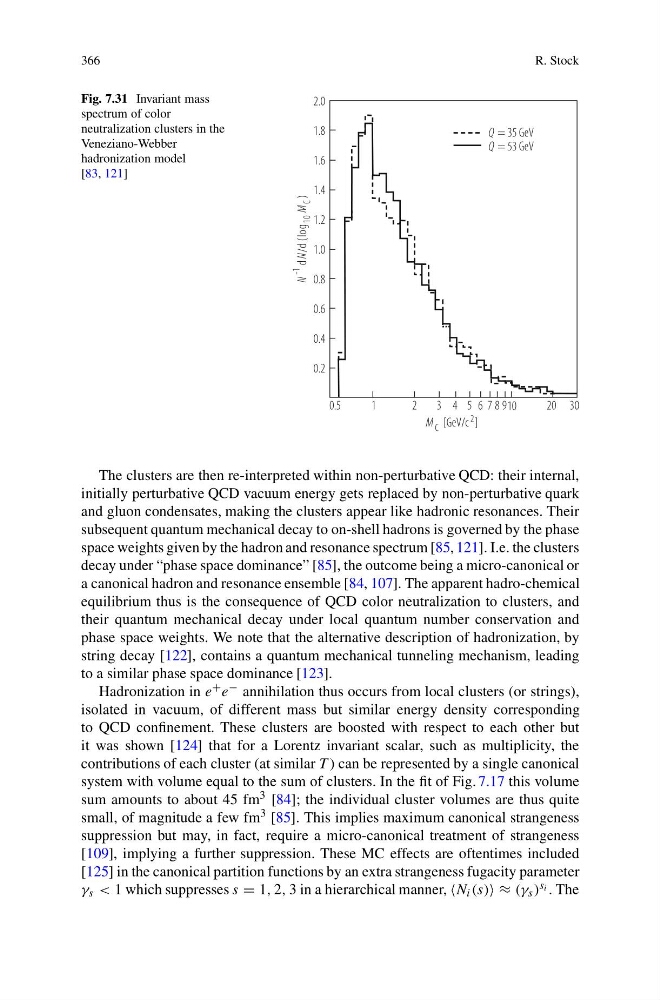
Fig. 7.31 Invariant mass
spectrum of color
neutralization clusters in the
Veneziano-Webber
hadronization model
[83, 121]
0.5
1
2
3 4 5 6 8 910
20 30
M C
2
[GeV/c ]
Q
Q
= 35 GeV
= 53 GeV
M
N N
1
- C
0
1
)
g
o
l
(
d
/
d
2.0
1.8
1.6
1.4
1.2
1.0
0.8
0.6
0.4
0.2
7
The clusters are then re-interpreted within non-perturbative QCD: their internal,
initially perturbative QCD vacuum energy gets replaced by non-perturbative quark
and gluon condensates, making the clusters appear like hadronic resonances. Their
subsequent quantum mechanical decay to on-shell hadrons is governed by the phase
space weights given by the hadron and resonance spectrum [85, 121]. I.e. the clusters
decay under “phase space dominance” [85], the outcome being a micro-canonical or
a canonical hadron and resonance ensemble [84, 107]. The apparent hadro-chemical
equilibrium thus is the consequence of QCD color neutralization to clusters, and
their quantum mechanical decay under local quantum number conservation and
phase space weights. We note that the alternative description of hadronization, by
string decay [122], contains a quantum mechanical tunneling mechanism, leading
to a similar phase space dominance [123].
Hadronization in e + e − annihilation thus occurs from local clusters (or strings),
isolated in vacuum, of different mass but similar energy density corresponding
to QCD confinement. These clusters are boosted with respect to each other but
it was shown [124] that for a Lorentz invariant scalar, such as multiplicity, the
contributions of each cluster (at similar T ) can be represented by a single canonical
system with volume equal to the sum of clusters. In the fit of Fig. 7.17 this volume
sum amounts to about 45 fm 3 [84]; the individual cluster volumes are thus quite
small, of magnitude a few fm 3 [85]. This implies maximum canonical strangeness
suppression but may, in fact, require a micro-canonical treatment of strangeness
[109], implying a further suppression. These MC effects are oftentimes included
[125] in the canonical partition functions by an extra strangeness fugacity parameter
γ s < 1 which suppresses s = 1, 2, 3 in a hierarchical manner, N i (s) ≈ (γ s ) s i . The
R. Stock
Fig. 7.31 Invariant mass
spectrum of color
neutralization clusters in the
Veneziano-Webber
hadronization model
[83, 121]
0.5
1
2
3 4 5 6 8 910
20 30
M C
2
[GeV/c ]
Q
Q
= 35 GeV
= 53 GeV
M
N N
1
- C
0
1
)
g
o
l
(
d
/
d
2.0
1.8
1.6
1.4
1.2
1.0
0.8
0.6
0.4
0.2
7
The clusters are then re-interpreted within non-perturbative QCD: their internal,
initially perturbative QCD vacuum energy gets replaced by non-perturbative quark
and gluon condensates, making the clusters appear like hadronic resonances. Their
subsequent quantum mechanical decay to on-shell hadrons is governed by the phase
space weights given by the hadron and resonance spectrum [85, 121]. I.e. the clusters
decay under “phase space dominance” [85], the outcome being a micro-canonical or
a canonical hadron and resonance ensemble [84, 107]. The apparent hadro-chemical
equilibrium thus is the consequence of QCD color neutralization to clusters, and
their quantum mechanical decay under local quantum number conservation and
phase space weights. We note that the alternative description of hadronization, by
string decay [122], contains a quantum mechanical tunneling mechanism, leading
to a similar phase space dominance [123].
Hadronization in e + e − annihilation thus occurs from local clusters (or strings),
isolated in vacuum, of different mass but similar energy density corresponding
to QCD confinement. These clusters are boosted with respect to each other but
it was shown [124] that for a Lorentz invariant scalar, such as multiplicity, the
contributions of each cluster (at similar T ) can be represented by a single canonical
system with volume equal to the sum of clusters. In the fit of Fig. 7.17 this volume
sum amounts to about 45 fm 3 [84]; the individual cluster volumes are thus quite
small, of magnitude a few fm 3 [85]. This implies maximum canonical strangeness
suppression but may, in fact, require a micro-canonical treatment of strangeness
[109], implying a further suppression. These MC effects are oftentimes included
[125] in the canonical partition functions by an extra strangeness fugacity parameter
γ s < 1 which suppresses s = 1, 2, 3 in a hierarchical manner, N i (s) ≈ (γ s ) s i . The