

28
G. Altarelli and S. Forte
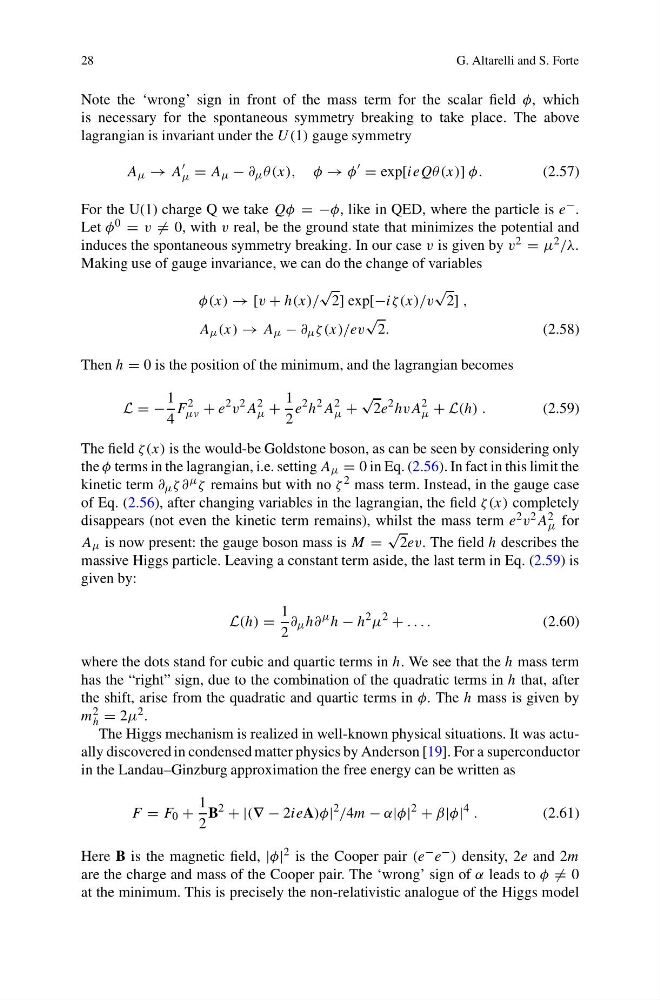
Note the ‘wrong’ sign in front of the mass term for the scalar field φ, which
is necessary for the spontaneous symmetry breaking to take place. The above
lagrangian is invariant under the U(1) gauge symmetry
A μ → A
μ = A μ − ∂ μ θ(x), φ → φ
= exp[ieQθ(x)] φ.
(2.57)
For the U(1) charge Q we take Qφ = −φ, like in QED, where the particle is e − .
Let φ 0 = v = 0, with v real, be the ground state that minimizes the potential and
induces the spontaneous symmetry breaking. In our case v is given by v 2 = μ 2 /λ.
Making use of gauge invariance, we can do the change of variables
φ(x) → [v + h(x)/
√
2] exp[−iζ(x)/v
√
2] ,
A μ (x) → A μ − ∂ μ ζ(x)/ev
√
2.
(2.58)
Then h = 0 is the position of the minimum, and the lagrangian becomes
L = −
1
4
F
2
μν + e
2 v
2 A
2
μ +
1
2
e
2 h
2 A
2
μ +
√
2e
2 hvA
2
μ + L(h) .
(2.59)
The field ζ(x) is the would-be Goldstone boson, as can be seen by considering only
the φ terms in the lagrangian, i.e. setting A μ = 0 in Eq. (2.56). In fact in this limit the
kinetic term ∂ μ ζ ∂ μ ζ remains but with no ζ 2 mass term. Instead, in the gauge case
of Eq. (2.56), after changing variables in the lagrangian, the field ζ(x) completely
disappears (not even the kinetic term remains), whilst the mass term e 2 v 2 A 2
μ for
A μ is now present: the gauge boson mass is M =
√
2ev. The field h describes the
massive Higgs particle. Leaving a constant term aside, the last term in Eq. (2.59) is
given by:
L(h) =
1
2
∂ μ h∂
μ h − h
2 μ
2
+ . . . .
(2.60)
where the dots stand for cubic and quartic terms in h. We see that the h mass term
has the “right” sign, due to the combination of the quadratic terms in h that, after
the shift, arise from the quadratic and quartic terms in φ. The h mass is given by
m 2
h = 2μ 2 .
The Higgs mechanism is realized in well-known physical situations. It was actually discovered in condensed matter physics by Anderson [19]. For a superconductor
in the Landau–Ginzburg approximation the free energy can be written as
F = F 0 +
1
2
B
2
+ |(∇ − 2ieA)φ|
2 /4m − α|φ|
2
+ β|φ|
4 .
(2.61)
Here B is the magnetic field, |φ| 2 is the Cooper pair (e − e − ) density, 2e and 2m
are the charge and mass of the Cooper pair. The ‘wrong’ sign of α leads to φ = 0
at the minimum. This is precisely the non-relativistic analogue of the Higgs model
G. Altarelli and S. Forte
Note the ‘wrong’ sign in front of the mass term for the scalar field φ, which
is necessary for the spontaneous symmetry breaking to take place. The above
lagrangian is invariant under the U(1) gauge symmetry
A μ → A
μ = A μ − ∂ μ θ(x), φ → φ
= exp[ieQθ(x)] φ.
(2.57)
For the U(1) charge Q we take Qφ = −φ, like in QED, where the particle is e − .
Let φ 0 = v = 0, with v real, be the ground state that minimizes the potential and
induces the spontaneous symmetry breaking. In our case v is given by v 2 = μ 2 /λ.
Making use of gauge invariance, we can do the change of variables
φ(x) → [v + h(x)/
√
2] exp[−iζ(x)/v
√
2] ,
A μ (x) → A μ − ∂ μ ζ(x)/ev
√
2.
(2.58)
Then h = 0 is the position of the minimum, and the lagrangian becomes
L = −
1
4
F
2
μν + e
2 v
2 A
2
μ +
1
2
e
2 h
2 A
2
μ +
√
2e
2 hvA
2
μ + L(h) .
(2.59)
The field ζ(x) is the would-be Goldstone boson, as can be seen by considering only
the φ terms in the lagrangian, i.e. setting A μ = 0 in Eq. (2.56). In fact in this limit the
kinetic term ∂ μ ζ ∂ μ ζ remains but with no ζ 2 mass term. Instead, in the gauge case
of Eq. (2.56), after changing variables in the lagrangian, the field ζ(x) completely
disappears (not even the kinetic term remains), whilst the mass term e 2 v 2 A 2
μ for
A μ is now present: the gauge boson mass is M =
√
2ev. The field h describes the
massive Higgs particle. Leaving a constant term aside, the last term in Eq. (2.59) is
given by:
L(h) =
1
2
∂ μ h∂
μ h − h
2 μ
2
+ . . . .
(2.60)
where the dots stand for cubic and quartic terms in h. We see that the h mass term
has the “right” sign, due to the combination of the quadratic terms in h that, after
the shift, arise from the quadratic and quartic terms in φ. The h mass is given by
m 2
h = 2μ 2 .
The Higgs mechanism is realized in well-known physical situations. It was actually discovered in condensed matter physics by Anderson [19]. For a superconductor
in the Landau–Ginzburg approximation the free energy can be written as
F = F 0 +
1
2
B
2
+ |(∇ − 2ieA)φ|
2 /4m − α|φ|
2
+ β|φ|
4 .
(2.61)
Here B is the magnetic field, |φ| 2 is the Cooper pair (e − e − ) density, 2e and 2m
are the charge and mass of the Cooper pair. The ‘wrong’ sign of α leads to φ = 0
at the minimum. This is precisely the non-relativistic analogue of the Higgs model