

7 Relativistic Nucleus-Nucleus Collisions and the QCD Matter Phase Diagram
345
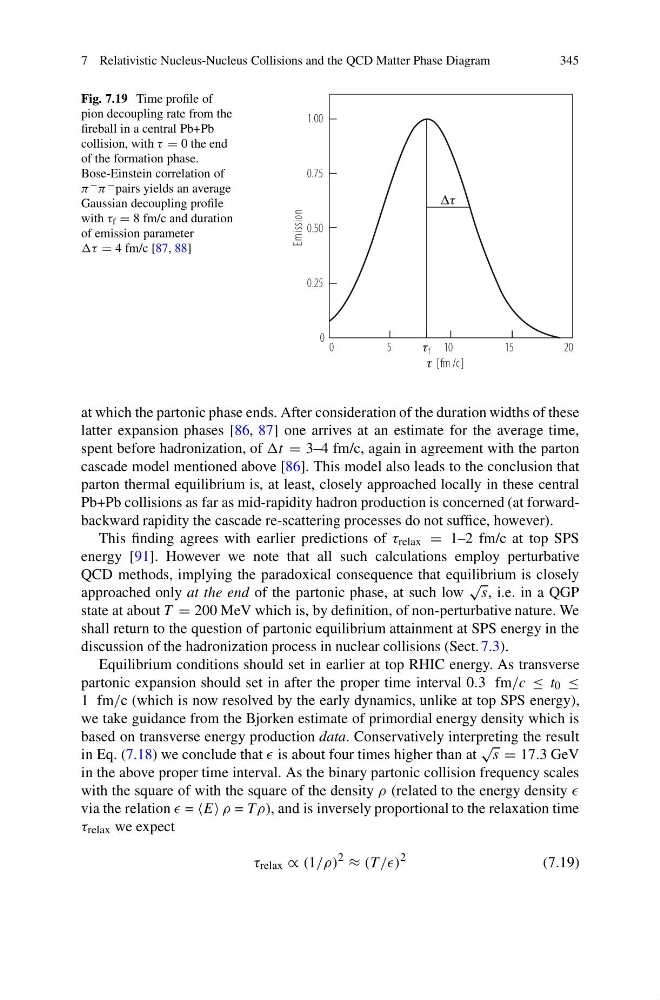
Fig. 7.19 Time profile of
pion decoupling rate from the
fireball in a central Pb+Pb
collision, with τ = 0 the end
of the formation phase.
Bose-Einstein correlation of
π − π − pairs yields an average
Gaussian decoupling profile
with τ f = 8 fm/c and duration
of emission parameter
= 4 fm/c [87, 88]
1.00
0.75
0.50
0.25
0
0
5
10
15
20
f
n
o
i
s
s
i
m E
[fm /c]
at which the partonic phase ends. After consideration of the duration widths of these
latter expansion phases [86, 87] one arrives at an estimate for the average time,
spent before hadronization, of = 3–4 fm/c, again in agreement with the parton
cascade model mentioned above [86]. This model also leads to the conclusion that
parton thermal equilibrium is, at least, closely approached locally in these central
Pb+Pb collisions as far as mid-rapidity hadron production is concerned (at forwardbackward rapidity the cascade re-scattering processes do not suffice, however).
This finding agrees with earlier predictions of τ relax = 1–2 fm/c at top SPS
energy [91]. However we note that all such calculations employ perturbative
QCD methods, implying the paradoxical consequence that equilibrium is closely
approached only at the end of the partonic phase, at such low
√
s, i.e. in a QGP
state at about T = 200 MeV which is, by definition, of non-perturbative nature. We
shall return to the question of partonic equilibrium attainment at SPS energy in the
discussion of the hadronization process in nuclear collisions (Sect. 7.3).
Equilibrium conditions should set in earlier at top RHIC energy. As transverse
partonic expansion should set in after the proper time interval 0.3 fm/c ≤ t 0 ≤
1 fm/c (which is now resolved by the early dynamics, unlike at top SPS energy),
we take guidance from the Bjorken estimate of primordial energy density which is
based on transverse energy production data. Conservatively interpreting the result
in Eq. (7.18) we conclude that is about four times higher than at
√
s = 17.3 GeV
in the above proper time interval. As the binary partonic collision frequency scales
with the square of with the square of the density ρ (related to the energy density
via the relation = E ρ = Tρ), and is inversely proportional to the relaxation time
τ relax we expect
τ relax ∝ (1/ρ)
2
≈ (T //)
2
(7.19)
345
Fig. 7.19 Time profile of
pion decoupling rate from the
fireball in a central Pb+Pb
collision, with τ = 0 the end
of the formation phase.
Bose-Einstein correlation of
π − π − pairs yields an average
Gaussian decoupling profile
with τ f = 8 fm/c and duration
of emission parameter
= 4 fm/c [87, 88]
1.00
0.75
0.50
0.25
0
0
5
10
15
20
f
n
o
i
s
s
i
m E
[fm /c]
at which the partonic phase ends. After consideration of the duration widths of these
latter expansion phases [86, 87] one arrives at an estimate for the average time,
spent before hadronization, of = 3–4 fm/c, again in agreement with the parton
cascade model mentioned above [86]. This model also leads to the conclusion that
parton thermal equilibrium is, at least, closely approached locally in these central
Pb+Pb collisions as far as mid-rapidity hadron production is concerned (at forwardbackward rapidity the cascade re-scattering processes do not suffice, however).
This finding agrees with earlier predictions of τ relax = 1–2 fm/c at top SPS
energy [91]. However we note that all such calculations employ perturbative
QCD methods, implying the paradoxical consequence that equilibrium is closely
approached only at the end of the partonic phase, at such low
√
s, i.e. in a QGP
state at about T = 200 MeV which is, by definition, of non-perturbative nature. We
shall return to the question of partonic equilibrium attainment at SPS energy in the
discussion of the hadronization process in nuclear collisions (Sect. 7.3).
Equilibrium conditions should set in earlier at top RHIC energy. As transverse
partonic expansion should set in after the proper time interval 0.3 fm/c ≤ t 0 ≤
1 fm/c (which is now resolved by the early dynamics, unlike at top SPS energy),
we take guidance from the Bjorken estimate of primordial energy density which is
based on transverse energy production data. Conservatively interpreting the result
in Eq. (7.18) we conclude that is about four times higher than at
√
s = 17.3 GeV
in the above proper time interval. As the binary partonic collision frequency scales
with the square of with the square of the density ρ (related to the energy density
via the relation = E ρ = Tρ), and is inversely proportional to the relaxation time
τ relax we expect
τ relax ∝ (1/ρ)
2
≈ (T //)
2
(7.19)