

7 Relativistic Nucleus-Nucleus Collisions and the QCD Matter Phase Diagram
343
between position and momentum initially imprinted on the system will survive all
further expansive evolution of the initial “firetube”, and is well recovered in the
expansion pattern of the finally released hadrons of modest p T as we shall show
when discussing radial flow and pion pair Bose-Einstein momentum correlation (see
Sects. 7.2.6 and 7.7).
In order to proceed to a more quantitative description of the primordial dynamics
(that occurs onward from τ 0 for as long the time period of predominantly longitudinal expansion might extend) we return to the Bjorken estimate of energy density,
corresponding to this picture [45], as implied by Eq. (7.1), which we now recast as
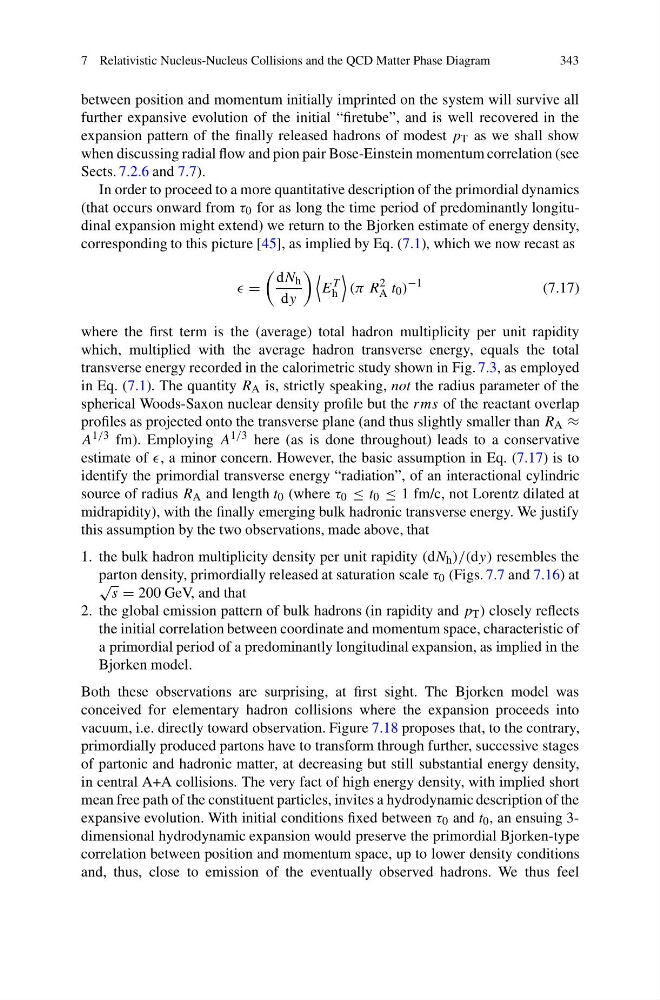
=
dN h
dy
E
T
h
(π R
2
A t 0 )
−1
(7.17)
where the first term is the (average) total hadron multiplicity per unit rapidity
which, multiplied with the average hadron transverse energy, equals the total
transverse energy recorded in the calorimetric study shown in Fig. 7.3, as employed
in Eq. (7.1). The quantity R A is, strictly speaking, not the radius parameter of the
spherical Woods-Saxon nuclear density profile but the rms of the reactant overlap
profiles as projected onto the transverse plane (and thus slightly smaller than R A ≈
A 1/3 fm). Employing A 1/3 here (as is done throughout) leads to a conservative
estimate of , a minor concern. However, the basic assumption in Eq. (7.17) is to
identify the primordial transverse energy “radiation”, of an interactional cylindric
source of radius R A and length t 0 (where τ 0 ≤ t 0 ≤ 1 fm/c, not Lorentz dilated at
midrapidity), with the finally emerging bulk hadronic transverse energy. We justify
this assumption by the two observations, made above, that
1. the bulk hadron multiplicity density per unit rapidity (dN h )/(dy) resembles the
parton density, primordially released at saturation scale τ 0 (Figs. 7.7 and 7.16) at
√
s = 200 GeV, and that
2. the global emission pattern of bulk hadrons (in rapidity and p T ) closely reflects
the initial correlation between coordinate and momentum space, characteristic of
a primordial period of a predominantly longitudinal expansion, as implied in the
Bjorken model.
Both these observations are surprising, at first sight. The Bjorken model was
conceived for elementary hadron collisions where the expansion proceeds into
vacuum, i.e. directly toward observation. Figure 7.18 proposes that, to the contrary,
primordially produced partons have to transform through further, successive stages
of partonic and hadronic matter, at decreasing but still substantial energy density,
in central A+A collisions. The very fact of high energy density, with implied short
mean free path of the constituent particles, invites a hydrodynamic description of the
expansive evolution. With initial conditions fixed between τ 0 and t 0 , an ensuing 3dimensional hydrodynamic expansion would preserve the primordial Bjorken-type
correlation between position and momentum space, up to lower density conditions
and, thus, close to emission of the eventually observed hadrons. We thus feel
343
between position and momentum initially imprinted on the system will survive all
further expansive evolution of the initial “firetube”, and is well recovered in the
expansion pattern of the finally released hadrons of modest p T as we shall show
when discussing radial flow and pion pair Bose-Einstein momentum correlation (see
Sects. 7.2.6 and 7.7).
In order to proceed to a more quantitative description of the primordial dynamics
(that occurs onward from τ 0 for as long the time period of predominantly longitudinal expansion might extend) we return to the Bjorken estimate of energy density,
corresponding to this picture [45], as implied by Eq. (7.1), which we now recast as
=
dN h
dy
E
T
h
(π R
2
A t 0 )
−1
(7.17)
where the first term is the (average) total hadron multiplicity per unit rapidity
which, multiplied with the average hadron transverse energy, equals the total
transverse energy recorded in the calorimetric study shown in Fig. 7.3, as employed
in Eq. (7.1). The quantity R A is, strictly speaking, not the radius parameter of the
spherical Woods-Saxon nuclear density profile but the rms of the reactant overlap
profiles as projected onto the transverse plane (and thus slightly smaller than R A ≈
A 1/3 fm). Employing A 1/3 here (as is done throughout) leads to a conservative
estimate of , a minor concern. However, the basic assumption in Eq. (7.17) is to
identify the primordial transverse energy “radiation”, of an interactional cylindric
source of radius R A and length t 0 (where τ 0 ≤ t 0 ≤ 1 fm/c, not Lorentz dilated at
midrapidity), with the finally emerging bulk hadronic transverse energy. We justify
this assumption by the two observations, made above, that
1. the bulk hadron multiplicity density per unit rapidity (dN h )/(dy) resembles the
parton density, primordially released at saturation scale τ 0 (Figs. 7.7 and 7.16) at
√
s = 200 GeV, and that
2. the global emission pattern of bulk hadrons (in rapidity and p T ) closely reflects
the initial correlation between coordinate and momentum space, characteristic of
a primordial period of a predominantly longitudinal expansion, as implied in the
Bjorken model.
Both these observations are surprising, at first sight. The Bjorken model was
conceived for elementary hadron collisions where the expansion proceeds into
vacuum, i.e. directly toward observation. Figure 7.18 proposes that, to the contrary,
primordially produced partons have to transform through further, successive stages
of partonic and hadronic matter, at decreasing but still substantial energy density,
in central A+A collisions. The very fact of high energy density, with implied short
mean free path of the constituent particles, invites a hydrodynamic description of the
expansive evolution. With initial conditions fixed between τ 0 and t 0 , an ensuing 3dimensional hydrodynamic expansion would preserve the primordial Bjorken-type
correlation between position and momentum space, up to lower density conditions
and, thus, close to emission of the eventually observed hadrons. We thus feel