

7 Relativistic Nucleus-Nucleus Collisions and the QCD Matter Phase Diagram
313
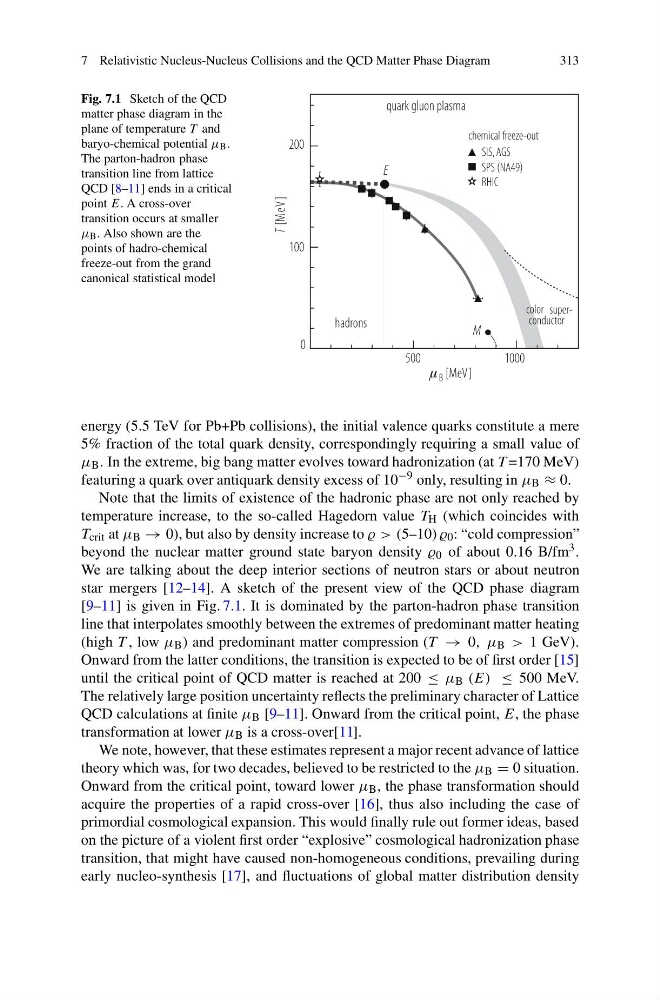
Fig. 7.1 Sketch of the QCD
matter phase diagram in the
plane of temperature T and
baryo-chemical potential μ B .
The parton-hadron phase
transition line from lattice
QCD [8–11] ends in a critical
point E. A cross-over
transition occurs at smaller
μ B . Also shown are the
points of hadro-chemical
freeze-out from the grand
canonical statistical model
500
1000
0
100
200
hadrons
quark gluon plasma
chemical freeze-out
SIS, AGS
SPS (NA49)
RHIC
E
M
color superconductor
B [MeV]
T ]
V
e
M
[
energy (5.5 TeV for Pb+Pb collisions), the initial valence quarks constitute a mere
5% fraction of the total quark density, correspondingly requiring a small value of
μ B . In the extreme, big bang matter evolves toward hadronization (at T =170 MeV)
featuring a quark over antiquark density excess of 10 −9 only, resulting in μ B ≈ 0.
Note that the limits of existence of the hadronic phase are not only reached by
temperature increase, to the so-called Hagedorn value T H (which coincides with
T crit at μ B → 0), but also by density increase to > (5–10) ) 0 : “cold compression”
beyond the nuclear matter ground state baryon density 0 of about 0.16 B/fm 3 .
We are talking about the deep interior sections of neutron stars or about neutron
star mergers [12–14]. A sketch of the present view of the QCD phase diagram
[9–11] is given in Fig. 7.1. It is dominated by the parton-hadron phase transition
line that interpolates smoothly between the extremes of predominant matter heating
(high T , low μ B ) and predominant matter compression (T → 0, μ B > 1 GeV).
Onward from the latter conditions, the transition is expected to be of first order [15]
until the critical point of QCD matter is reached at 200 ≤ μ B (E) ≤ 500 MeV.
The relatively large position uncertainty reflects the preliminary character of Lattice
QCD calculations at finite μ B [9–11]. Onward from the critical point, E, the phase
transformation at lower μ B is a cross-over[11].
We note, however, that these estimates represent a major recent advance of lattice
theory which was, for two decades, believed to be restricted to the μ B = 0 situation.
Onward from the critical point, toward lower μ B , the phase transformation should
acquire the properties of a rapid cross-over [16], thus also including the case of
primordial cosmological expansion. This would finally rule out former ideas, based
on the picture of a violent first order “explosive” cosmological hadronization phase
transition, that might have caused non-homogeneous conditions, prevailing during
early nucleo-synthesis [17], and fluctuations of global matter distribution density
313
Fig. 7.1 Sketch of the QCD
matter phase diagram in the
plane of temperature T and
baryo-chemical potential μ B .
The parton-hadron phase
transition line from lattice
QCD [8–11] ends in a critical
point E. A cross-over
transition occurs at smaller
μ B . Also shown are the
points of hadro-chemical
freeze-out from the grand
canonical statistical model
500
1000
0
100
200
hadrons
quark gluon plasma
chemical freeze-out
SIS, AGS
SPS (NA49)
RHIC
E
M
color superconductor
B [MeV]
T ]
V
e
M
[
energy (5.5 TeV for Pb+Pb collisions), the initial valence quarks constitute a mere
5% fraction of the total quark density, correspondingly requiring a small value of
μ B . In the extreme, big bang matter evolves toward hadronization (at T =170 MeV)
featuring a quark over antiquark density excess of 10 −9 only, resulting in μ B ≈ 0.
Note that the limits of existence of the hadronic phase are not only reached by
temperature increase, to the so-called Hagedorn value T H (which coincides with
T crit at μ B → 0), but also by density increase to > (5–10) ) 0 : “cold compression”
beyond the nuclear matter ground state baryon density 0 of about 0.16 B/fm 3 .
We are talking about the deep interior sections of neutron stars or about neutron
star mergers [12–14]. A sketch of the present view of the QCD phase diagram
[9–11] is given in Fig. 7.1. It is dominated by the parton-hadron phase transition
line that interpolates smoothly between the extremes of predominant matter heating
(high T , low μ B ) and predominant matter compression (T → 0, μ B > 1 GeV).
Onward from the latter conditions, the transition is expected to be of first order [15]
until the critical point of QCD matter is reached at 200 ≤ μ B (E) ≤ 500 MeV.
The relatively large position uncertainty reflects the preliminary character of Lattice
QCD calculations at finite μ B [9–11]. Onward from the critical point, E, the phase
transformation at lower μ B is a cross-over[11].
We note, however, that these estimates represent a major recent advance of lattice
theory which was, for two decades, believed to be restricted to the μ B = 0 situation.
Onward from the critical point, toward lower μ B , the phase transformation should
acquire the properties of a rapid cross-over [16], thus also including the case of
primordial cosmological expansion. This would finally rule out former ideas, based
on the picture of a violent first order “explosive” cosmological hadronization phase
transition, that might have caused non-homogeneous conditions, prevailing during
early nucleo-synthesis [17], and fluctuations of global matter distribution density