

24
G. Altarelli and S. Forte
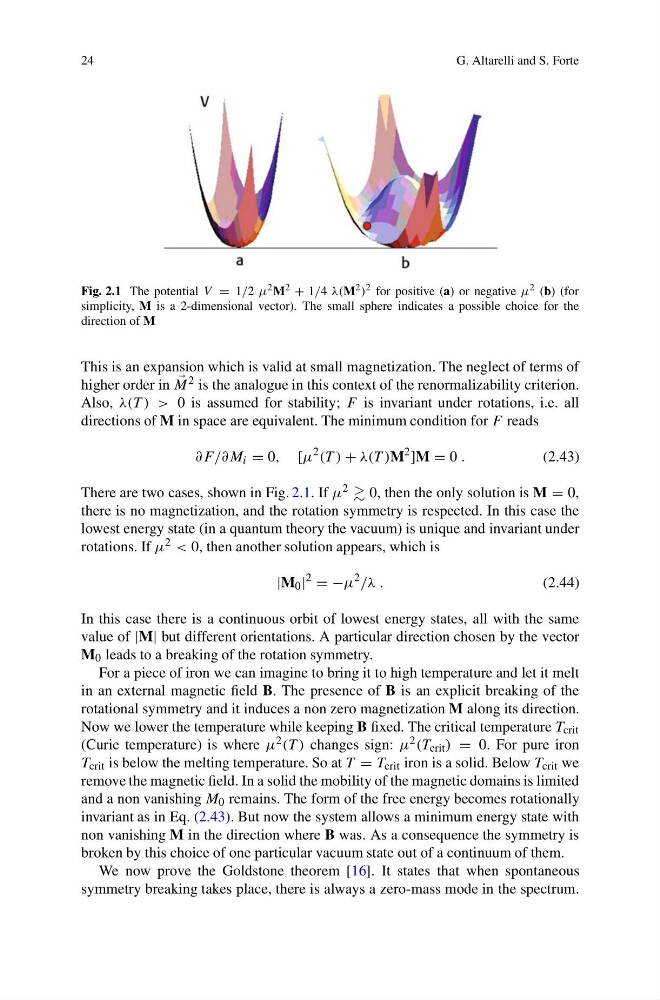
Fig. 2.1 The potential V = 1/2 μ 2 M 2 + 1/4 λ(M 2 ) 2 for positive (a) or negative μ 2 (b) (for
simplicity, M is a 2-dimensional vector). The small sphere indicates a possible choice for the
direction of M
This is an expansion which is valid at small magnetization. The neglect of terms of
higher order in
M 2 is the analogue in this context of the renormalizability criterion.
Also, λ(T ) > 0 is assumed for stability; F is invariant under rotations, i.e. all
directions of M in space are equivalent. The minimum condition for F reads
∂F/∂M i = 0, [μ
2 (T ) + λ(T )M
2
]M = 0 .
(2.43)
There are two cases, shown in Fig. 2.1. If μ 2 0, then the only solution is M = 0,
there is no magnetization, and the rotation symmetry is respected. In this case the
lowest energy state (in a quantum theory the vacuum) is unique and invariant under
rotations. If μ 2 < 0, then another solution appears, which is
|M 0 |
2
= −μ
2 /λ .
(2.44)
In this case there is a continuous orbit of lowest energy states, all with the same
value of |M| but different orientations. A particular direction chosen by the vector
M 0 leads to a breaking of the rotation symmetry.
For a piece of iron we can imagine to bring it to high temperature and let it melt
in an external magnetic field B. The presence of B is an explicit breaking of the
rotational symmetry and it induces a non zero magnetization M along its direction.
Now we lower the temperature while keeping B fixed. The critical temperature T crit
(Curie temperature) is where μ 2 (T ) changes sign: μ 2 (T crit ) = 0. For pure iron
T crit is below the melting temperature. So at T = T crit iron is a solid. Below T crit we
remove the magnetic field. In a solid the mobility of the magnetic domains is limited
and a non vanishing M 0 remains. The form of the free energy becomes rotationally
invariant as in Eq. (2.43). But now the system allows a minimum energy state with
non vanishing M in the direction where B was. As a consequence the symmetry is
broken by this choice of one particular vacuum state out of a continuum of them.
We now prove the Goldstone theorem [16]. It states that when spontaneous
symmetry breaking takes place, there is always a zero-mass mode in the spectrum.
G. Altarelli and S. Forte
Fig. 2.1 The potential V = 1/2 μ 2 M 2 + 1/4 λ(M 2 ) 2 for positive (a) or negative μ 2 (b) (for
simplicity, M is a 2-dimensional vector). The small sphere indicates a possible choice for the
direction of M
This is an expansion which is valid at small magnetization. The neglect of terms of
higher order in
M 2 is the analogue in this context of the renormalizability criterion.
Also, λ(T ) > 0 is assumed for stability; F is invariant under rotations, i.e. all
directions of M in space are equivalent. The minimum condition for F reads
∂F/∂M i = 0, [μ
2 (T ) + λ(T )M
2
]M = 0 .
(2.43)
There are two cases, shown in Fig. 2.1. If μ 2 0, then the only solution is M = 0,
there is no magnetization, and the rotation symmetry is respected. In this case the
lowest energy state (in a quantum theory the vacuum) is unique and invariant under
rotations. If μ 2 < 0, then another solution appears, which is
|M 0 |
2
= −μ
2 /λ .
(2.44)
In this case there is a continuous orbit of lowest energy states, all with the same
value of |M| but different orientations. A particular direction chosen by the vector
M 0 leads to a breaking of the rotation symmetry.
For a piece of iron we can imagine to bring it to high temperature and let it melt
in an external magnetic field B. The presence of B is an explicit breaking of the
rotational symmetry and it induces a non zero magnetization M along its direction.
Now we lower the temperature while keeping B fixed. The critical temperature T crit
(Curie temperature) is where μ 2 (T ) changes sign: μ 2 (T crit ) = 0. For pure iron
T crit is below the melting temperature. So at T = T crit iron is a solid. Below T crit we
remove the magnetic field. In a solid the mobility of the magnetic domains is limited
and a non vanishing M 0 remains. The form of the free energy becomes rotationally
invariant as in Eq. (2.43). But now the system allows a minimum energy state with
non vanishing M in the direction where B was. As a consequence the symmetry is
broken by this choice of one particular vacuum state out of a continuum of them.
We now prove the Goldstone theorem [16]. It states that when spontaneous
symmetry breaking takes place, there is always a zero-mass mode in the spectrum.