

300
P. Jenni and T. S. Virdee
6.7.4 Combining the Results
6.7.4.1 Mass of the Observed State
The mass of the Higgs boson is measured using the two decay channels that give
the best mass resolutions namely H → γγ and H → ZZ ( ∗ ) → 4 l. ATLAS and
CMS have combined their results from Run 1 [53]. The results were obtained from
a simultaneous fit to the reconstructed invariant mass peaks in the two channels
and for the two experiments. The measured masses from the individual channels
and the two experiments were found to be consistent amongst themselves. The
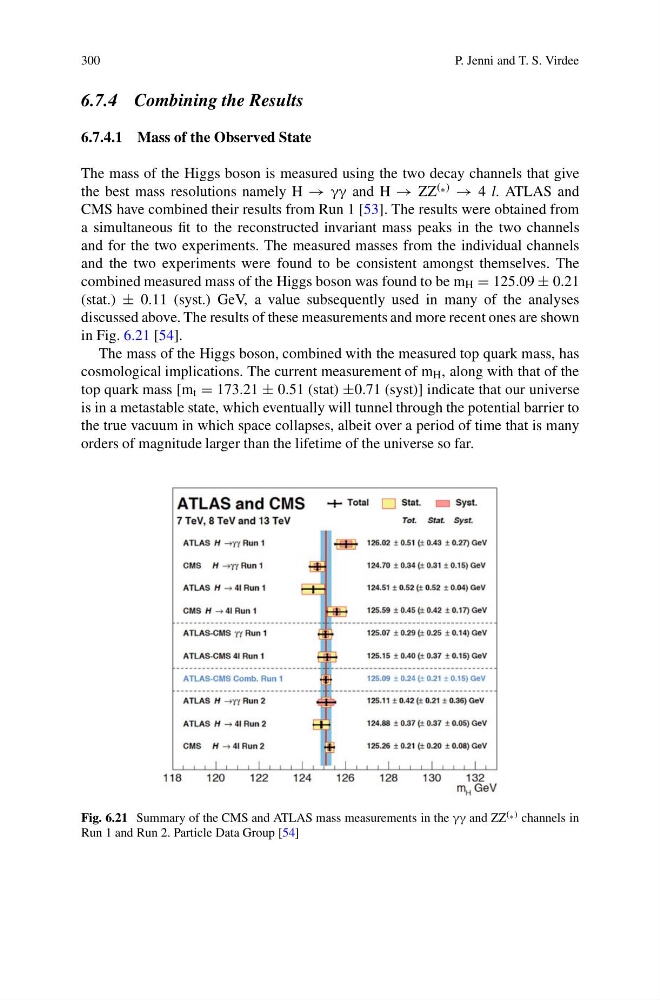
combined measured mass of the Higgs boson was found to be m H = 125.09 ± 0.21
(stat.) ± 0.11 (syst.) GeV, a value subsequently used in many of the analyses
discussed above. The results of these measurements and more recent ones are shown
in Fig. 6.21 [54].
The mass of the Higgs boson, combined with the measured top quark mass, has
cosmological implications. The current measurement of m H , along with that of the
top quark mass [m t = 173.21 ± 0.51 (stat) ±0.71 (syst)] indicate that our universe
is in a metastable state, which eventually will tunnel through the potential barrier to
the true vacuum in which space collapses, albeit over a period of time that is many
orders of magnitude larger than the lifetime of the universe so far.
Fig. 6.21 Summary of the CMS and ATLAS mass measurements in the γγ and ZZ (∗) channels in
Run 1 and Run 2. Particle Data Group [54]
P. Jenni and T. S. Virdee
6.7.4 Combining the Results
6.7.4.1 Mass of the Observed State
The mass of the Higgs boson is measured using the two decay channels that give
the best mass resolutions namely H → γγ and H → ZZ ( ∗ ) → 4 l. ATLAS and
CMS have combined their results from Run 1 [53]. The results were obtained from
a simultaneous fit to the reconstructed invariant mass peaks in the two channels
and for the two experiments. The measured masses from the individual channels
and the two experiments were found to be consistent amongst themselves. The
combined measured mass of the Higgs boson was found to be m H = 125.09 ± 0.21
(stat.) ± 0.11 (syst.) GeV, a value subsequently used in many of the analyses
discussed above. The results of these measurements and more recent ones are shown
in Fig. 6.21 [54].
The mass of the Higgs boson, combined with the measured top quark mass, has
cosmological implications. The current measurement of m H , along with that of the
top quark mass [m t = 173.21 ± 0.51 (stat) ±0.71 (syst)] indicate that our universe
is in a metastable state, which eventually will tunnel through the potential barrier to
the true vacuum in which space collapses, albeit over a period of time that is many
orders of magnitude larger than the lifetime of the universe so far.
Fig. 6.21 Summary of the CMS and ATLAS mass measurements in the γγ and ZZ (∗) channels in
Run 1 and Run 2. Particle Data Group [54]