

6 The Discovery of the Higgs Boson at the LHC
281
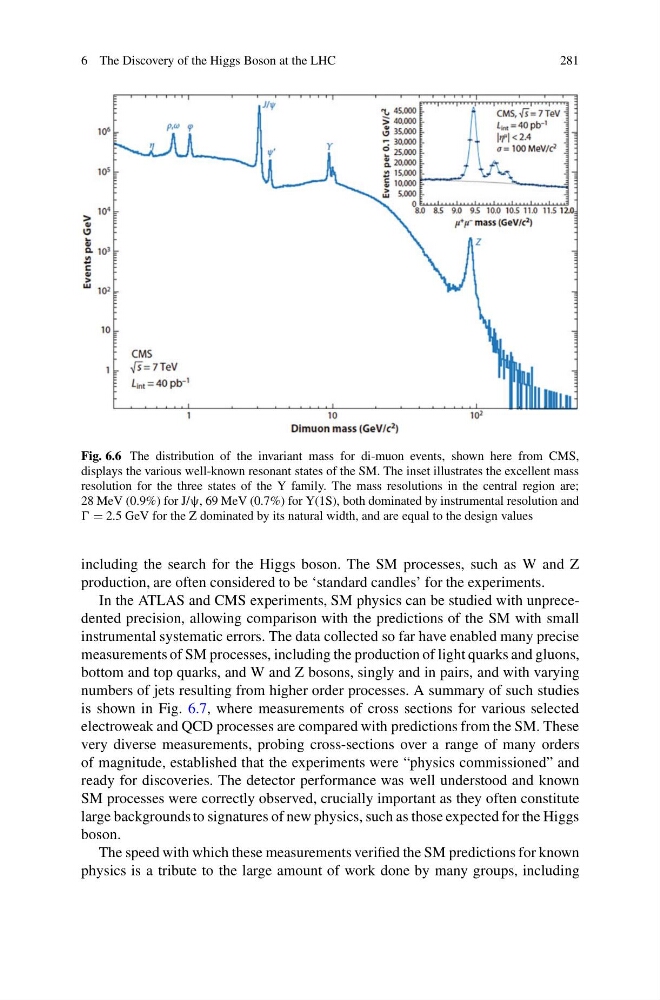
Fig. 6.6 The distribution of the invariant mass for di-muon events, shown here from CMS,
displays the various well-known resonant states of the SM. The inset illustrates the excellent mass
resolution for the three states of the Y family. The mass resolutions in the central region are;
28 MeV (0.9%) for J/ψ, 69 MeV (0.7%) for Y(1S), both dominated by instrumental resolution and
= 2.5 GeV for the Z dominated by its natural width, and are equal to the design values
including the search for the Higgs boson. The SM processes, such as W and Z
production, are often considered to be ‘standard candles’ for the experiments.
In the ATLAS and CMS experiments, SM physics can be studied with unprecedented precision, allowing comparison with the predictions of the SM with small
instrumental systematic errors. The data collected so far have enabled many precise
measurements of SM processes, including the production of light quarks and gluons,
bottom and top quarks, and W and Z bosons, singly and in pairs, and with varying
numbers of jets resulting from higher order processes. A summary of such studies
is shown in Fig. 6.7, where measurements of cross sections for various selected
electroweak and QCD processes are compared with predictions from the SM. These
very diverse measurements, probing cross-sections over a range of many orders
of magnitude, established that the experiments were “physics commissioned” and
ready for discoveries. The detector performance was well understood and known
SM processes were correctly observed, crucially important as they often constitute
large backgrounds to signatures of new physics, such as those expected for the Higgs
boson.
The speed with which these measurements verified the SM predictions for known
physics is a tribute to the large amount of work done by many groups, including
281
Fig. 6.6 The distribution of the invariant mass for di-muon events, shown here from CMS,
displays the various well-known resonant states of the SM. The inset illustrates the excellent mass
resolution for the three states of the Y family. The mass resolutions in the central region are;
28 MeV (0.9%) for J/ψ, 69 MeV (0.7%) for Y(1S), both dominated by instrumental resolution and
= 2.5 GeV for the Z dominated by its natural width, and are equal to the design values
including the search for the Higgs boson. The SM processes, such as W and Z
production, are often considered to be ‘standard candles’ for the experiments.
In the ATLAS and CMS experiments, SM physics can be studied with unprecedented precision, allowing comparison with the predictions of the SM with small
instrumental systematic errors. The data collected so far have enabled many precise
measurements of SM processes, including the production of light quarks and gluons,
bottom and top quarks, and W and Z bosons, singly and in pairs, and with varying
numbers of jets resulting from higher order processes. A summary of such studies
is shown in Fig. 6.7, where measurements of cross sections for various selected
electroweak and QCD processes are compared with predictions from the SM. These
very diverse measurements, probing cross-sections over a range of many orders
of magnitude, established that the experiments were “physics commissioned” and
ready for discoveries. The detector performance was well understood and known
SM processes were correctly observed, crucially important as they often constitute
large backgrounds to signatures of new physics, such as those expected for the Higgs
boson.
The speed with which these measurements verified the SM predictions for known
physics is a tribute to the large amount of work done by many groups, including