

6 The Discovery of the Higgs Boson at the LHC
271
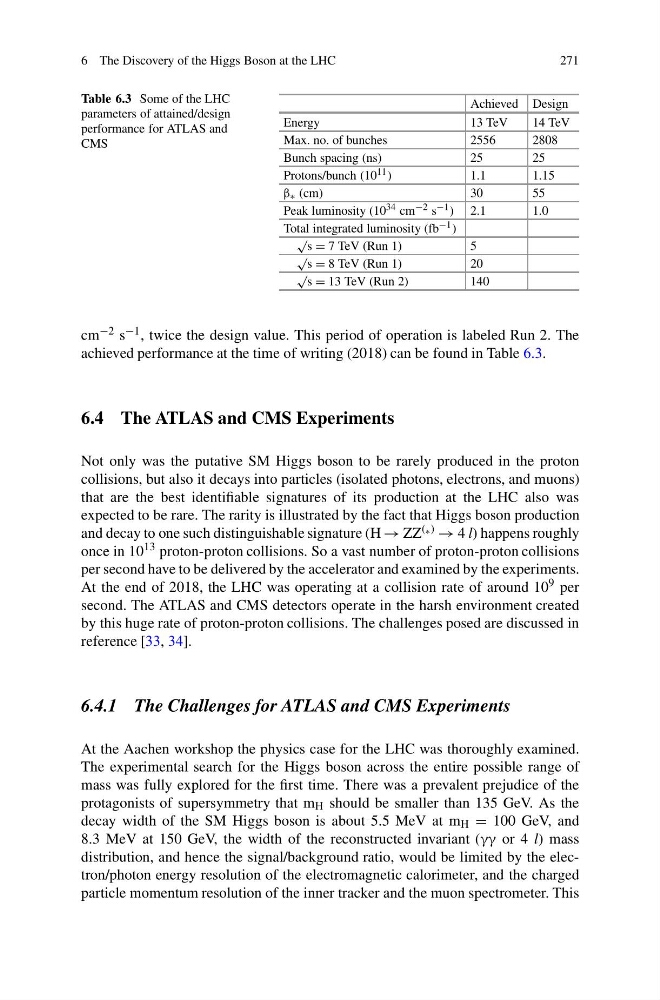
Table 6.3 Some of the LHC
parameters of attained/design
performance for ATLAS and
CMS
Achieved Design
Energy
13 TeV
14 TeV
Max. no. of bunches
2556
2808
Bunch spacing (ns)
25
25
Protons/bunch (10 11 )
1.1
1.15
β ∗ (cm)
30
55
Peak luminosity (10 34 cm −2 s −1 ) 2.1
1.0
Total integrated luminosity (fb −1 )
√
s = 7 TeV (Run 1)
5
√
s = 8 TeV (Run 1)
20
√
s = 13 TeV (Run 2)
140
cm −2 s −1 , twice the design value. This period of operation is labeled Run 2. The
achieved performance at the time of writing (2018) can be found in Table 6.3.
6.4 The ATLAS and CMS Experiments
Not only was the putative SM Higgs boson to be rarely produced in the proton
collisions, but also it decays into particles (isolated photons, electrons, and muons)
that are the best identifiable signatures of its production at the LHC also was
expected to be rare. The rarity is illustrated by the fact that Higgs boson production
and decay to one such distinguishable signature (H → ZZ ( ∗ ) → 4 l) happens roughly
once in 10 13 proton-proton collisions. So a vast number of proton-proton collisions
per second have to be delivered by the accelerator and examined by the experiments.
At the end of 2018, the LHC was operating at a collision rate of around 10 9 per
second. The ATLAS and CMS detectors operate in the harsh environment created
by this huge rate of proton-proton collisions. The challenges posed are discussed in
reference [33, 34].
6.4.1 The Challenges for ATLAS and CMS Experiments
At the Aachen workshop the physics case for the LHC was thoroughly examined.
The experimental search for the Higgs boson across the entire possible range of
mass was fully explored for the first time. There was a prevalent prejudice of the
protagonists of supersymmetry that m H should be smaller than 135 GeV. As the
decay width of the SM Higgs boson is about 5.5 MeV at m H = 100 GeV, and
8.3 MeV at 150 GeV, the width of the reconstructed invariant (γγ or 4 l) mass
distribution, and hence the signal/background ratio, would be limited by the electron/photon energy resolution of the electromagnetic calorimeter, and the charged
particle momentum resolution of the inner tracker and the muon spectrometer. This
271
Table 6.3 Some of the LHC
parameters of attained/design
performance for ATLAS and
CMS
Achieved Design
Energy
13 TeV
14 TeV
Max. no. of bunches
2556
2808
Bunch spacing (ns)
25
25
Protons/bunch (10 11 )
1.1
1.15
β ∗ (cm)
30
55
Peak luminosity (10 34 cm −2 s −1 ) 2.1
1.0
Total integrated luminosity (fb −1 )
√
s = 7 TeV (Run 1)
5
√
s = 8 TeV (Run 1)
20
√
s = 13 TeV (Run 2)
140
cm −2 s −1 , twice the design value. This period of operation is labeled Run 2. The
achieved performance at the time of writing (2018) can be found in Table 6.3.
6.4 The ATLAS and CMS Experiments
Not only was the putative SM Higgs boson to be rarely produced in the proton
collisions, but also it decays into particles (isolated photons, electrons, and muons)
that are the best identifiable signatures of its production at the LHC also was
expected to be rare. The rarity is illustrated by the fact that Higgs boson production
and decay to one such distinguishable signature (H → ZZ ( ∗ ) → 4 l) happens roughly
once in 10 13 proton-proton collisions. So a vast number of proton-proton collisions
per second have to be delivered by the accelerator and examined by the experiments.
At the end of 2018, the LHC was operating at a collision rate of around 10 9 per
second. The ATLAS and CMS detectors operate in the harsh environment created
by this huge rate of proton-proton collisions. The challenges posed are discussed in
reference [33, 34].
6.4.1 The Challenges for ATLAS and CMS Experiments
At the Aachen workshop the physics case for the LHC was thoroughly examined.
The experimental search for the Higgs boson across the entire possible range of
mass was fully explored for the first time. There was a prevalent prejudice of the
protagonists of supersymmetry that m H should be smaller than 135 GeV. As the
decay width of the SM Higgs boson is about 5.5 MeV at m H = 100 GeV, and
8.3 MeV at 150 GeV, the width of the reconstructed invariant (γγ or 4 l) mass
distribution, and hence the signal/background ratio, would be limited by the electron/photon energy resolution of the electromagnetic calorimeter, and the charged
particle momentum resolution of the inner tracker and the muon spectrometer. This