

5 QCD on the Lattice
247
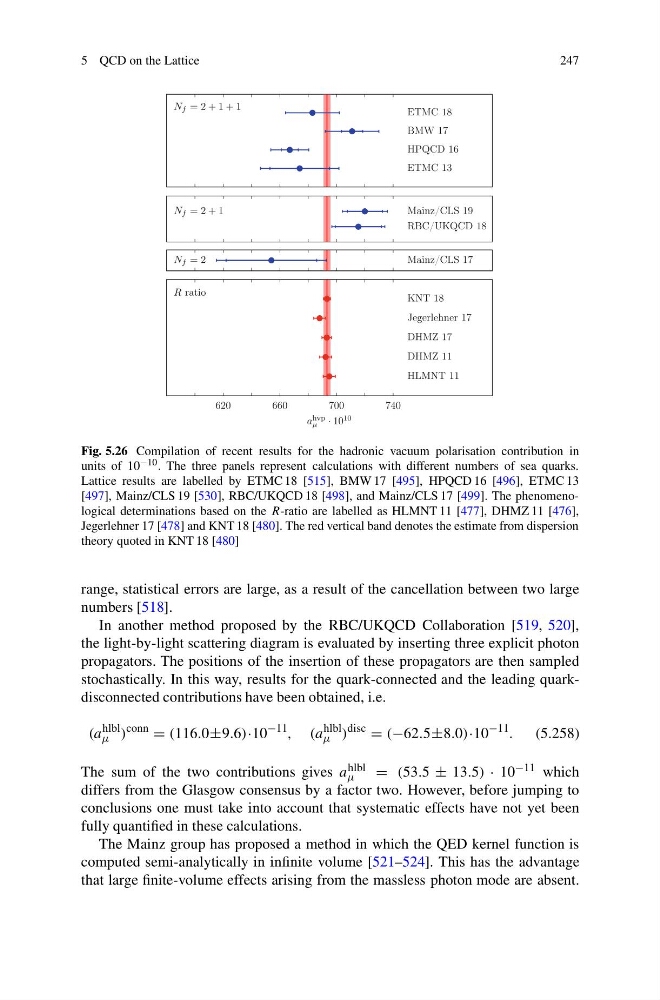
Fig. 5.26 Compilation of recent results for the hadronic vacuum polarisation contribution in
units of 10 −10 . The three panels represent calculations with different numbers of sea quarks.
Lattice results are labelled by ETMC 18 [515], BMW 17 [495], HPQCD 16 [496], ETMC 13
[497], Mainz/CLS 19 [530], RBC/UKQCD 18 [498], and Mainz/CLS 17 [499]. The phenomenological determinations based on the R-ratio are labelled as HLMNT 11 [477], DHMZ 11 [476],
Jegerlehner 17 [478] and KNT 18 [480]. The red vertical band denotes the estimate from dispersion
theory quoted in KNT 18 [480]
range, statistical errors are large, as a result of the cancellation between two large
numbers [518].
In another method proposed by the RBC/UKQCD Collaboration [519, 520],
the light-by-light scattering diagram is evaluated by inserting three explicit photon
propagators. The positions of the insertion of these propagators are then sampled
stochastically. In this way, results for the quark-connected and the leading quarkdisconnected contributions have been obtained, i.e.
(a
hlbl
μ )
conn
= (116.0±9.6)·10
−11
, (a
hlbl
μ )
disc
= (−62.5±8.0)·10
−11
.
(5.258)
The sum of the two contributions gives a hlbl
μ
= (53.5 ± 13.5) · 10 −11 which
differs from the Glasgow consensus by a factor two. However, before jumping to
conclusions one must take into account that systematic effects have not yet been
fully quantified in these calculations.
The Mainz group has proposed a method in which the QED kernel function is
computed semi-analytically in infinite volume [521–524]. This has the advantage
that large finite-volume effects arising from the massless photon mode are absent.
247
Fig. 5.26 Compilation of recent results for the hadronic vacuum polarisation contribution in
units of 10 −10 . The three panels represent calculations with different numbers of sea quarks.
Lattice results are labelled by ETMC 18 [515], BMW 17 [495], HPQCD 16 [496], ETMC 13
[497], Mainz/CLS 19 [530], RBC/UKQCD 18 [498], and Mainz/CLS 17 [499]. The phenomenological determinations based on the R-ratio are labelled as HLMNT 11 [477], DHMZ 11 [476],
Jegerlehner 17 [478] and KNT 18 [480]. The red vertical band denotes the estimate from dispersion
theory quoted in KNT 18 [480]
range, statistical errors are large, as a result of the cancellation between two large
numbers [518].
In another method proposed by the RBC/UKQCD Collaboration [519, 520],
the light-by-light scattering diagram is evaluated by inserting three explicit photon
propagators. The positions of the insertion of these propagators are then sampled
stochastically. In this way, results for the quark-connected and the leading quarkdisconnected contributions have been obtained, i.e.
(a
hlbl
μ )
conn
= (116.0±9.6)·10
−11
, (a
hlbl
μ )
disc
= (−62.5±8.0)·10
−11
.
(5.258)
The sum of the two contributions gives a hlbl
μ
= (53.5 ± 13.5) · 10 −11 which
differs from the Glasgow consensus by a factor two. However, before jumping to
conclusions one must take into account that systematic effects have not yet been
fully quantified in these calculations.
The Mainz group has proposed a method in which the QED kernel function is
computed semi-analytically in infinite volume [521–524]. This has the advantage
that large finite-volume effects arising from the massless photon mode are absent.